
Christianity is not a crutch, it’s a wheelchair

20120606-105500.jpg
Christianity is about God providing what you and I are incapable of providing. A frequent statement on religion is that it’s a crutch. As Christians we forget that without Jesus showing up, a crutch will not be enough. No, Christianity is a wheelchair because apart from Christ we’re broken.

The freedom of being broken
Christianity is about Jesus. Paul says in Ephesians how we were once dead but made alive in Christ. He further states that by nature we were children of wrath. The Bible also uses terms like enemies of God, unworthy, etc. Here is the key: Jesus showed up and did what we could not nor cannot do. Freedom results in being broken because we have no need to worry if we’re good enough or capable enough to earn God’s favor.

Big savior, not stingy one
God did not dispense grace with a teaspoon or an eye dropper. God poured it on. God demonstrated GREAT love, being RICH in mercy, LAVISHING grace upon those in Christ. God did this so you can show His IMMEASURABLE riches of grace in KINDNESS towards us in Jesus. This is not a God who is mad, reluctant or stingy. This is a God who is present, active and very willing.

A family for good
Jesus freed us to bless others. Because we don’t have to worry about being capable of earning Grace, because we don’t have to worry if God is willing enough to care for us, in Jesus you and I have the freedom to focus on serving others. We should serve because that is what God expects to do. Not as a “Jesus project,” but because loving God means loving the things He loves- people. A trophy of God’s grace is a vibrant Christian who serves.

Dirty boys are cool
Moms love it when their boys are clean. Dads love it when their boys are muddy. It’s time the church gets muddy. If we’re a family for good then we need to be willing to get messy. More people need the wheel chair of God’s grace because people cannot save themselves, they need Jesus. We need to love people because God loves people. We need to love people with no expectation of return, because that’s what Jesus did. If we’re willing to serve with no expectation of return that opens the opportunity share about Jesus. Let’s get dirty. There’ll be a time to clean up later.

The Bottom line:
When we realize that Christianity is a wheelchair not a crutch it frees us up to be what God created us to be. In being broken we can love humbly, seeing messy lives as us if it were not for Grace. In seeing a big savior we have full assurance that God is willingly and actively involved in our life. He is our life. In being a family for good we see purpose and intentionality. In getting into the messy things of life we see God gave us a mission.

One more thing…
I’m fine with Christianity being a wheelchair. Resting in God and having Him taking us to where He wants us to go is the most incredible experience of life. God doesn’t push the chair on clean streets. God wants to hit the mud puddles! We can clean up for the supper later.
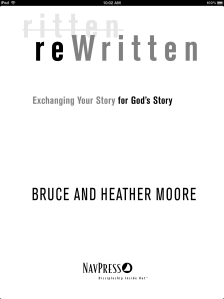
Book Review: reWritten by Bruce & Heather Moore

“With each life opportunity, God reveals to us more of His story for our lives and the potential for what we can become if we trust Him to author our future.” p. 35

Many of us have wondered, is this really how my life is supposed to be? Maybe your life’s story is marked by poor decisions or the hurtful actions of others. How can you turn things around? Is God still interested in using you? The answer is a resounding “Yes!”

Rewritten guides you through five life opportunities to exchange your story for God’s story. When you become the person He designed you to be and accomplish the tasks appointed to only you, you will experience the greatest fulfillment you could ever know and bring hope to a broken world.

The authors
Bruce & Heather Moore made the most extreme decision of their lives by leaving a large suburb church to rebirth a dying church with one year to live. They have seen the radical transformation of a church and the stories of countless lives rewritten. Bruce serves as Senior Pastor at Christ Fellowship Tampa and they have a very active preschooler.

Layout
reWritten is logical and flows together well as a book. The book is written in three sections: Your Story, God’s Story and The Exchange. The aim of the books is towards those whose lives are a wreck, though anyone will benefit from reading it. The first part had me skeptical at first of the book, until I remembered that ministry is really that messy. The second part is well written. The third part is pure gold. I appreciate discussion and thought questions, ‘story builders,’ were well placed throughout the chapters than merely as an after thought.

Story as metaphor
The Moore’s use the concept of story as a metaphor throughout the book. The over all concept of exchanging our story for God’s story. reWritten reflects this in the layout. The metaphor adds significance to how God uniquely designed each one of us for His good purpose. What stands out from this is how approachable the book is; gracious and dealing with truth.

He said what?!
My heart leaped when I read the table of contents. We too often get locked into the idea that if life is good, then God is blessing. The Moore’s deal with the topics of humility and suffering! Too often these areas are ignored. Of note, the section of forgiveness is well done. It’s important to read the book from beginning to end to get the full scope, but mark the last section up well. It’s an excellent resource for counseling. I appreciate in how the personal stories shared makes God the hero. Some stories end exceptionally, while other end with ‘because this is what God wants of us.’

“With each moment that we suffer, God brings us gifts that change our perspective and allow other people to see His grace in our lives.” p. 139 on suffering

The writing
reWritten is approachable without being inaccurate. It is definitely written from a pastoral heart that cares deeply for people. The book has one of the best rhythms I’ve seen in a long time. The first section had me on edge a little as almost being cliché. When starting to read remember that, yes, ministry is that messy. We forget that too often. The second part is a clear description of God’s image in our lives and the rhythm really picks up there. The pattern of the book is one we should model in ministering to people; moving from where they’re at to where God wants the to be.

The bottom line:
reWritten is an excellent resource to help people to take the mess of their story and to seeing what God wants to do in their life. This is a book that pushes us to live Godly, seeking what He is doing in our circumstances. It builds a big picture of the great God we serve. Well written, the book also addresses topics we often ignore, such as humility and suffering. For those who actively council and minister to people, reWritten is a helpful guide to keep on hand.

The Gospel according to farm & sports injury

In recent news people are debating the issue of the labor department setting 85 pages of regulations to protect minors from farm injuries. In 2010 there was about 7,500 farm injuries. The thought is farm injuries are often severe and debilitating. I’m not for injuries or exploitation. This isn’t a let’s call out government overreach either. Here is what I am saying: Mountains of regulations doesn’t make one safe nor can one be completely safe. As humans we often pick an legislate an issue, ignoring the fact that life is often beyond our control.

Soccer
According to an ABCnews article between 1990-2003 1.6 million boys and girls were injured playing soccer. I’ve personally interacted with some whose soccer injuries were debilitating and are now a life long issue. If child safety and the prevention of exploitation is a concern, why has not the 1.6 million soccer injuries been addressed? Wait, soccer is popular here so I better stop now…

Football
According to WebMD football injuries didn’t fair so well. In fact, in one year alone it made up a third of all the soccer injuries between 1990-2003.

Researchers found high school football players suffered more than half a million injuries nationwide during the 2005-2006 season. And they were more likely to suffer season-ending injuries, such as fractures and concussions, than those who play collegiate football.

Now, I’d ask the same question I asked before, but recognizing the religious zealotry that is football, I better pipe down.

Oops, there’s more…
According to stopsportsinjuries.org 3.5 million high school athletes are injured. 30,000 of which are hospitalized. This data was found in the mid 90’s, but according to other statistics there’s been a 5 fold increase in some specific types of injuries. What’s even funnier is how the CDC states more than half of the injuries were preventable.

The Gospel
At it’s core the Gospel is this: We are incapable of saving ourselves. The hope of Jesus dying on the cross and rising again is that one day He will make all things new. We can’t save ourselves and it’s Jesus’ work in our life that makes the difference. Here’s the catch. No amount of legislation can make us good. Just like with childhood injuries, we too look for specific “bad” things that we can easily prevent, but we often ignore things that may not be as severe, but still leaves a significant impact of life long repercussions.

How about you?
Are you content because you’re not doing the “bad” stuff? You’re not in the “7,500 farm injuries crowd.” Yet, you’re doing things that are still wrong. You’re in the “millions of soccer injuries” crowd. You’re no better for doing a “less” bad thing. Fine, you may not be having an affair. But, if you’re gazing at a person and committing adultery in your heart, that still has repercussions that can harm a marriage. Here is what’s cool: Jesus covered it all. He can work in the “really” bad and the “less” bad issues.

The bottom line:
The issue with child labor on farms points out to a pattern in human behavior. Injuries are bad and often they’re preventable. No legislation can prevent injuries because we’re fallen and we’re broken. We often focus on a major issue, but injuries are injuries. The same is true for sin. We’re incapable of keeping ourselves safe. We’re also incapable of saving ourselves. We need Jesus and He’ll make all things new.

My guide to becoming a recovering fundamentalist: The conclusion

“Be holy for I am holy” ~God
“We can make God’s Word say what we want if we’re not careful” ~A Mentor

I want to close this guide with the final two good things that come from fundamentalism. Granted these two areas have been tainted by what was discussed earlier. We should still look at two key things. Holiness and a love for God’s Word is the baby. Legalism is the bath water.

Holiness
God wants us to be holy. While the pursuit of holiness and the process of being set apart for God may be distorted by legalism, any movement that at its core seeks to be holy is commendable. Jesus came to forgive us our sins. Jesus is in the process of purifying His bride, the church. An emphasis on holiness isn’t legalism, it’s a focus on godliness. “Shall we continue to sin that grace may abound” is a struggle all Christians face. I commend fundamentalism for its desire for holiness. We all should.

The Bible
Authorial intent of the Bible, a significant tenet of fundamentalism, is an essential element to the faith. We can make the Bible say what we want if we’re not careful. Along with sticking to the Bible, however, is the adage you can’t make everyone happy. As Jesus’ life proved, sticking to God’s Word can cause conflict. The Bible is critical as faith comes by hearing and hearing by the Word of God. Too often movements play fast and loose with the Bible. It should be the authority for faith and practice.

Now what?
Every movement has or will have issues. Throughout church history movements have risen and faded. We must be careful to not treat a movement as a strawman. Rather than reacting we should seek God and the Scriptures and act accordingly. Reacting instead of acting is often what sets movements in the wrong direction. Writing off fundamentalism is just reacting. Looking at heart issues and identifying what is good and what needs to change is acting with proper measure.

The Cross
Any error is covered by the cross. As long as there is breath in our lungs, there is opportunity for repentance. I understand that many have been abused or deeply hurt in highly (hyper?) fundamentalist churches. For one thing, not all fundamentalists are like that. For another, people can get hurt by other churches and movements too. Why? Because Jesus isn’t done with us yet. We must ask ourselves this: Is there a sin so great that Jesus forgave it at the cross but we can’t? The cross covers all, and our hurts should be left there as well.

The bottom line:
We have two choices in what we can boast in: the cross or ourselves. It doesn’t matter the movement. Fundamentalism promotes the Gospel, pursues holiness and highly views the Bible. These are essentials to the Christian faith. The lack of humility, legalism and unbalanced view of separation may have clouded fundamentalism. For sure there is a need for “self-policing” that needs to happen. Again, this is true for any movement for they’re issues of the human heart. We all struggle in these areas. To become a recovering fundamentalist takes three key things: 1) Boasting in the cross, not self. 2) Choosing grace. 3) Keeping the Gospel first and central.

The Tyranny of God’s Blessing

God’s blessing is not fragile. Too often we view God’s blessing as some delicate mist. If we make the slightest wrong move *p o o f* it vanishes away. Preachers and churches often craft statements like If you don’t do [insert topic de jour here] then you won’t get God’s blessing. Another way we see this tyranny is when making decisions. We struggle to figure out which choice God will bless. Why? Cause if we choose wrongly, *p o o f*… This view treats God’s blessing as a form of tyranny. This misses the point of the Gospel, and misunderstands God’s love.

The Rock
The last few weeks I’ve been reflecting on the life of Peter. Peter and I both have what I like to call “hoof in mouth disease.” Peter was passionate and full of life. This often got him into trouble. Yet, I wouldn’t hesitate for a moment to say that God blessed Peter and his ministry. Peter denied Jesus. Three times, actually. This same Peter preached the first sermon of the church. Peter reached out to gentiles (Acts 10), was care-fronted by Paul for hypocrisy (Gal 2) and yet wrote to prolific letters (1&2 Peter). Peter died upside down on a cross. God blessed his ministry.

A Prostitute, A Foreigner, An Adulteress
Rahab was a prostitute. She’s in Jesus’ genealogy of Matthew. Hebrews 11 lists her as a women of faith. Ruth acted in faith and married Boaz. She’s also in Jesus genealogy. A book written about her faithfulness in pursuing God stands in contrast to the time of Judges when “everyone did what was right in their own eyes.” Israel did not view foreigner’s well at that time. Bathsheba committed adultery with King David. She’s also in Jesus’ genealogy. David was still considered a man after God’s own heart. Glaring issues, still blessed by God.

The Gospel
God’s blessings is not fragile because the Gospel is not fragile! The grace and mercy of the Gospel overcomes the fragility of God’s blessings. To treat God’s blessing as something delicate is to fundamentally misunderstand the Gospel. Jesus died ONCE of ALL our sin. Jesus rose again, defeating sin and death. While we were yet sinners Christ died for the ungodly. Jesus acted before we were worthy of being blessed. God’s blessing isn’t connected to our actions as much as its connected to the Gospel.

Wisdom & Faith
Act based on wisdom and faith. Being in Christ doesn’t mean we should do anything what we want. Does God bless sin? No. Bible makes that pretty clear. Two key themes in Scripture point to how God desires for us to act: 1) acting based on wisdom and 2) acting based on faith. They are tired together. Make the best informed choice you can make and step out on faith. Seek wise counsel, search the Scripture, pray throughout the process and act in faith. That makes God happy.

What if I choose wrong?
John says that if we confess our sins Jesus is faithful and just to forgive. Why? The Gospel is the foundation of God blessings us. God even uses our mistakes to conform and sharpen us into the image of Christ. Be less worried about error and more concerned about gaining wisdom and acting in faith. God’s blessing isn’t that fragile. In fact, it’s His desire to bless those who are in Christ. Yes, we can squander God’s blessing. But, look at Peter, God can bless big messes. Some trophies of Grace just take more polishing than others.

The bottom line:
We shouldn’t use “God’s blessing” as a form of tyranny. Rather, God’s blessing should point us to the Gospel. God’s blessing and love are not fragile things. They produced for us a unwaivering relationship with Him through the death burial and resurrection of Jesus. If we make mistakes, the Cross covers it. Focus on gaining wisdom and walking in faith. God even uses our mistakes to form us more into

Book Review: Dream House by Barry Bandara

“In many ways, our families are in a battle- a battle of priorities. If we don’t take the time to account for all the movement of our family now and then, we can easily become overwhelmed with all that we have to do.” p. 70

Pastor Barry Bandara gives us an excellent blueprint for developing our own “Dream House.” The book is humorous, insightful and usable. Often books on parenting place a massive guilt burden on parents. Make no mistake about it, there are times when you will say ouch. Overwhelming, you’ll walk away saying “I can do this!” We need more resources that are refreshingly humorous while also giving clearly communicated wisdom.

Overview
Taking from the three best sources possible: God’s Word, wisdom from others and his own failures & success, Barry takes us through the various “rooms” of our dream house and how it relates to family. Along with each chapter and at the end, Barry also shares resources he and his wife found helpful. The metaphor and the warmth of his writing keep the principles understandable and approachable. (Some books I’ve read you almost need a PhD to understand them!)

The big win
Dream House is written by a man who practices what he preaches. I’ve had the privilege to serve with Pastor Barry and to see him as a father. He practices what he preaches. I’m a better husband and father because of his ministry. Often with family resources we ask: will this work? The answer is yes.

The book
What is helpful is the book gives us principles and not programs to add in our homes. Dream House gives you what needs to be done, how it can be done, as well as other resources to do it. This leaves the book highly adaptable for different family contexts. The questions at the end of each chapter are also helpful to figure out how to apply what was said in your own family.

Marriage counseling
Pastor Barry presents a 10 year rule in his book. The idea is to think 10 years down the road. If your child is 2 how do I want them to act when they are 12, and so on. Dream House is a book I’d highly recommend for marriage counseling. It gives a blue print of raising a healthy family and many of the needed principles need to start before kids. You may think “we’re just getting married,” but kids are not that far off.

The bottom line:
Dream House is an excellent resource on leading your family well. It’s written with a warmth and practicality often lacking. I’m looking forward to using Dream House in my own ministry and my own family.

My guide to becoming a recovering fundamentalist: The Gospel

In Philippians Paul instructs us to rejoice when the Gospel is preached. There is no doubt in my mind that the Gospel is preached faithfully in fundamentalist churches. Heart issues aside (all groups have them) fundamentalism does have at its core the Gospel. This is first and foremost one of the benefits of fundamentalism. It’s the baby from the bathwater.

Come again?
Let’s face it, the Gospel is offensive. The Bible says so and reality says so. One of the problems with the strawman we call fundamentalism is this: We figure that by bashing fundamentalists we are somehow more palatable to our culture. We can write ‘fundamentalists’ off as extremists. So, we cast aside fellow brothers and sisters in Christ. In other words: we bash ‘fundies’ to make ourselves look good. Friends, the Gospel is offensive. Bashing any group doesn’t make the Gospel less offensive and doesn’t make us look good either.

There are false Gospels
There is and always has been movements to teach and promote a false Gospel. The Bible tells us it will happen and we see throughout history that it happens. In the fundamentalist modernist controversy we have to remember that the stance that was being taken was for the truth of God’s Word and the essential issues regarding Jesus. Paul instructs us to pay attention to our ministry and our doctrine. While we may not agree with the practical outgrowth that happened to fundamentalism, It’s founding is solid and it’s motive solid. If anything fundamentalism does teach us there is a point where you have to stand your ground and say this is truth and this is heresy.

Reacting
I often say act don’t react. But like many proverbial statements, it’s not always true all the time. There are times when reaction is correct, like placing you hand accidentally on a hot stove. Galatians states how we should not be deceived, that what we reap we will sow. Fundamentalism started as a good reaction to a bad trend. To hold as vile fundamentalism by touting all its ills is a standard none would care to live by. I don’t think we want to reap that in our own ministries.

The bottom line:
One of the greatest contributions of fundamentalism is a defense of the Gospel. Such passion for the Gospel and the Bible should not be taken lightly. Further, we shouldn’t bash a movement like a strawman, as we reap what we sow. The Gospel is offensive. While we as Christians shouldn’t be offensive we must remember there is a point where we have to say what is false and what is true.

Make it corny to make it stick

I remember early on in teaching a key aspect of the art: When you make something corny it sticks longer. Corny is what it is. But, it’s not all bad. Think of it this way. If you want someone to remember something, to have it mull around in their head, what do you do? A strong emotional attachment to something helps it stick to one’s memory.

Winter, often used a symbol of death, ended yesterday. It was incredibly warm. I couldn’t help but think that some people’s winter ends with a permanent heat wave. Then I thought, wow, that’s a corny thought. But, it reminded me of something. There are eternal consequences for our actions. For some winter ends in bliss, for others in torment. Often people try to squelch, suppress, or overly emphasis and scare people with the topic of hell. It’s real, it’s a consequence, it should effect how we live. However, hell isn’t the main thing.

Spring is associated with birth and new life, and that is the main thing. Jesus came to conquer sin and death. He came to point people to life and in Him we’re a new creature.

The bottom line: Some people’s winter will end with an eternal heat wave. Corny? Yep. So, I hope it sticks and causes you to love people to Jesus.

Coming up…

This week I had the joy of sermon planning and preparing for upcoming series. I love meeting with God and seeking what He wants said. Coming up after Galatians…

Jesus: God. Man. Savior. We’ll be looking on Resurrection Sunday about who Jesus is, the God/man who conquered sin and death.

Sizzle: A series in Song of Songs that describes a young woman’s choice between a glitzy life or a simple life with her betrothed shepherd boy. The book uplifts romantic marital love while also casting a dark cloud on the glitzy life.

Dream House: A family series based on Pastor Barry’s recent book. Strong families make for strong ministry. Our family is our first ministry. This series will give practical guidance to have our “Dream House.”

Workshop: Building trophies of grace. This series we’ll examine who God is and what we should do as a result. Too often our doctrine is treated as information rather than proclamation of a great God. He wants to be known and made know.

No Excuses: We’ll look at how we shouldn’t be ashamed of the Gospel and our need for Jesus. In God’s courtroom we’re all guilty, but that’s not how the story ends.

Unmerited Gift: God didn’t leave us blind or turned His back on us. He stamped on us grace through His Son. This changed everything.

J.O.Y.: Our Christmas series will look at how Jesus came to Earth for Others and what this should mean to You. During our Christmas Eve service we’ll talk about Jesus as the light of hope and giver of Joy.

Assurance: We have a hope that doesn’t disappoint and we have freedom to bless others. We don’t have to fear God’s wrath. Assurance tells us why…

Blue Print: Wonder what on Earth God is doing? This series focuses on God’s desire to show mercy and redeem people. Does this blow your mind? Paul had that reaction too.

The Gospel in Nikes: The Gospel changes everything. It’s not about some weird set of do’s and don’t’s. The Gospel relates to every aspect of our life from dealing with conflict to our involvement in culture.

This is whats up for the next year. I look forward to seeing what God will do as we study His Word and live it out.

Psalm 46

God Is Our Fortress
1 God is our refuge and strength, a very present help in trouble. 2 Therefore we will not fear though the earth gives way, though the mountains be moved into the heart of the sea, 3 though its waters roar and foam, though the mountains tremble at its swelling. Selah 4 There is a river whose streams make glad the city of God, the holy habitation of the Most High. 5 God is in the midst of her; she shall not be moved; God will help her when morning dawns. 6 The nations rage, the kingdoms totter; he utters his voice, the earth melts. 7 The LORD of hosts is with us; the God of Jacob is our fortress. Selah 8 Come, behold the works of the LORD, how he has brought desolations on the earth. 9 He makes wars cease to the end of the earth; he breaks the bow and shatters the spear; he burns the chariots with fire. 10 “Be still, and know that I am God. I will be exalted among the nations, I will be exalted in the earth!” 11 The LORD of hosts is with us; the God of Jacob is our fortress. Selah

~Psalm 46 ESV