Category: Theo…

A productive life John 15

A productive life thoughts from John 15
Connect to the vine through relationship with God
Stay connected through growing fellowship with Christ
Rely on The Lord and not yourself
Never under estimate the importance of prayer!
What brings god glory? Much fruit

Where’s the fruit?
Notice the progression
No fruit, fruit, more fruit, much fruit

Sermon by Bruce Aubrey

Christmas Wars: Return of theology

My bottom line is this: The focus of the First Advent should be on Jesus humbly being born in the likeness of human flesh and that at second advent is in the near future when Jesus returns to make all things new. Rather, this season is marked by what I call the Christmas Wars.

Xmas controversy
Christian_Chi_RhoAs a child I remember being scolded out of the blue because I wrote ‘xmas’ on my paper. I was following in the evil pathway of removing Christ from Christmas. Being the reader (nerd) that I was, I looked it up. (Note, this was before the advent of wikipedia, so I had to use this thing called a card catalog and books.) What I found was this: The X was from the greek letter Xsi which is the first initial of Christ’s name, Xristos in Greek. X marked with another letter or part of the word was an appropriate abbreviation for Christ. There is no grand conspiracy to remove Christ from Christmas.

Mas controversy
Jesus died once for all sin. In doing research I found another interesting aspect: I don’t celebrate Mass. Mass is the liturgy surrounding the celebration of the Eucharist. The Eucharist views communion as becoming wholly the blood and body of Jesus. It’s a perpetual sacrifice. Hence, the symbol of the crucifix. While the blood of Jesus cleanses us from all sin, it is through the resurrection that we’re saved. The Bible doesn’t teach a perpetual sacrifice but a single sacrifice at one point in time whereby the barrier between God and man is forever destroyed through the resurrection of Jesus. Communion then is a symbol where we proclaim the Lord’s death until he returns.

The First Advent
It is good to celebrate the First Advent. Why? Jesus demonstrated humility and a focus on people. My fear isn’t removing Christ from Christmas. My fear is not seeing Christ in Christians. Let’s be humble, friends. It’s what Jesus did.

The light of the World
It is good to celebrate Jesus as the light of the world. The real issue is whether we’ll accept by faith that Jesus is Lord and believe in our hearts that God raised him from the dead. Jesus died once for all sin, the just for the unjust. My concern isn’t removing Christ from Christmas. It’s removing Mass from Christ. Theology matters. We do not need to continually dip into a pool of grace to merit salvation. We need to simply accept God’s gift in Jesus whereby God lavishes his grace upon us! We don’t celebrate Mass, we celebrate a risen savior.

The bottom line:
As the Christmas wars heat up, again, let’s remember our theology. Ignorance is no excuse anymore as information is freely available and easier to access. The focus of the first advent should be on Jesus humbly being born in the likeness of human flesh and that at second advent is in the near future when Jesus returns to make all things new. Let us pray for and look to the Second Advent as we celebrate the humbleness of the first.

A brief defense on teaching about end times

To understand life one must understand death. The teaching on end times in the Bible is the Christian understanding of ‘death.’ I put death in quotes as the Bible teaches death to be an unnatural state resulting from sin. There is an over reaction to teachings about end times, but running from it is unwise. Here are some often heard objections to teaching the end times:

None of your business
When the disciples asked Jesus if now was the time for the kingdom, Jesus said it wasn’t their job to worry about a timeline. At the end of this narrative angels asked what on Earth the disciples were doing, just as Jesus went up into the clouds he’d come back in a like manner. While me must hold a timeline loosely, there is still the expectancy of Christ’s return. Hold fast to Christ’s return, hold loosely a timeline.

It’s divisive
There is little in the Bible that isn’t divisive. 25% of Scripture deals with prophetic events in the future. It’s a major thing. The teaching on end times focuses on three critical themes: 1) The person and nature of Jesus. 2) The restoration of peace and harmony as Jesus makes all things new. 3) The punishment of evil and the vindication of justice. These are no small themes and the Bible speaks to them. Christianity isn’t about an eternal fight of good vs evil. Evil has an end date.

Left behind series is annoying
Lot’s of things are annoying in life. I don’t fault someone with trying to communicate what they believe artistically. There are weird or annoying things in all aspects of life. Just look at Facebook and you’ll see what I mean. Anytime we place a major emphasis on one doctrine over the others there will be issues. Further, anytime we move the Gospel from being first and central things get messed up. However, that doesn’t mean other doctrines are unimportant or shouldn’t be discussed. Our culture tries to run and hide from death and that’s unhealthy.

End times focuses on fear
No doubt the study of end times should be sobering. In it we see the outpouring of God’s wrath but we also see the outpouring of God’s love. For those in Christ the teaching on end times should be motivational and push us to place our trust in Christ. Not merely for our salvation, but also that he will work all things together for good. Fear is not all bad. Losing our fear of God is dangerous, as is over emphasizing the fear of God. A significant portion of passages on the end times is for encouragement and hope, not fear.

About that timeline
Jesus chastises leaders for being able to predict the weather but not understand the times. While we should hold our timelines loosely, it is not sin to think through one. Jesus expects us to be aware of what’s going on. We should be careful to not have it cause undue division within the church or play guessing games that force current events into our timeline. Having an idea of a timeline is part of having an answer for the hope that is within us.

Allegorical vs Literal
This seems to be the real crux of the problem and worthy of a post. Briefly stated, I don’t think end times passages are allegories about good vs evil and that the Gospel is social justice. Such is a massive misunderstanding of the Gospel and the nature of God. (I also believe that Christians have wrongly viewed the Gospel as divorced from social justice.) I do believe that end times passages often describe the indescribable and should be approached with an air of humility, not certitude, when taking a literal approach to Scripture.

The bottom line:
How we view ‘death’ determines how we view life. In things I’ve seen or heard recently it seems there is an overreaction to those who emphasize teachings on the end times. However, it is a significant aspect to the Bible, Jesus and the apostles taught on it, and ignoring it is not an option. Like so much in life, we need discernment.

For peace?

20120726-112706.jpg
People often ask for peace. I spoke with young men this morning about for keys to having peace. A good reminder for us all.

1) Work through conflict Phil 4:2-3
Work through or help others work through conflict. Avoiding conflict will result in a lack of peace. Choose courage and work through conflict.

2) Worshipful spirit Phil 4:4-7
When we rejoice and thank God for all situations we have peace. A worshipful spirit means we trust in God’s plan. Choose joy, it demonstrates faith.

3) Make disciples Phil 4:8-9
What we focus on we’ll see in others. By focusing on good things we’ll see it others, and then take the next step to apply to our own lives. This is the discipleship process. Making disciples leads to peace. Choose to focus on Nobel things and live them out.

4) Be content Phil 4:10-14
Possessions can distract us or they can propel us. We can accomplish God’s will with what we have. We can bless others and help others accomplish God’s will when we have an abundance. Choose to be content with what you have, it will maximize your ministry.

The bottom line:
If you’re lacking peace from God, check these areas as a start. They’ll take you a long way on the road of peace.

Daddy, will you be with me?

20120607-123512.jpg

Jadon loved seeing Venus through a neighbors telescope. The boyz acted mature beyond their years as they gazed through the telescope. The next time Venus crosses the sun is 105.5 years. Jadon would be 110. I’ll be in glory.

Tucking him in at night Jadon asked if I’d be with him the next time Venus crosses the sun. I said I’ll be in Heaven and I hope one day to seem him there too.

Curious, Jadon asked if everyone goes to heaven. Only those who know Jesus and accepted what Jesus did for us go to heaven. So, that’s why church is important, he replied.

We talked about sin and how all of us don’t deserve Heaven, but Jesus came anyway and gave us a way in. The only way. We talked about how amazing God is. Then we talked about how my foot shadow looked like a train…

There are God moments that you’ll hold dear with your children if you’re present and praying and persistent. I love bed time. Not because of the sleeping angels & silence soon coming, rather the time I get to speak to my boyz heart and soul. His foot shadow looked like a caboose…

Christianity is not a crutch, it’s a wheelchair

20120606-105500.jpg
Christianity is about God providing what you and I are incapable of providing. A frequent statement on religion is that it’s a crutch. As Christians we forget that without Jesus showing up, a crutch will not be enough. No, Christianity is a wheelchair because apart from Christ we’re broken.

The freedom of being broken
Christianity is about Jesus. Paul says in Ephesians how we were once dead but made alive in Christ. He further states that by nature we were children of wrath. The Bible also uses terms like enemies of God, unworthy, etc. Here is the key: Jesus showed up and did what we could not nor cannot do. Freedom results in being broken because we have no need to worry if we’re good enough or capable enough to earn God’s favor.

Big savior, not stingy one
God did not dispense grace with a teaspoon or an eye dropper. God poured it on. God demonstrated GREAT love, being RICH in mercy, LAVISHING grace upon those in Christ. God did this so you can show His IMMEASURABLE riches of grace in KINDNESS towards us in Jesus. This is not a God who is mad, reluctant or stingy. This is a God who is present, active and very willing.

A family for good
Jesus freed us to bless others. Because we don’t have to worry about being capable of earning Grace, because we don’t have to worry if God is willing enough to care for us, in Jesus you and I have the freedom to focus on serving others. We should serve because that is what God expects to do. Not as a “Jesus project,” but because loving God means loving the things He loves- people. A trophy of God’s grace is a vibrant Christian who serves.

Dirty boys are cool
Moms love it when their boys are clean. Dads love it when their boys are muddy. It’s time the church gets muddy. If we’re a family for good then we need to be willing to get messy. More people need the wheel chair of God’s grace because people cannot save themselves, they need Jesus. We need to love people because God loves people. We need to love people with no expectation of return, because that’s what Jesus did. If we’re willing to serve with no expectation of return that opens the opportunity share about Jesus. Let’s get dirty. There’ll be a time to clean up later.

The Bottom line:
When we realize that Christianity is a wheelchair not a crutch it frees us up to be what God created us to be. In being broken we can love humbly, seeing messy lives as us if it were not for Grace. In seeing a big savior we have full assurance that God is willingly and actively involved in our life. He is our life. In being a family for good we see purpose and intentionality. In getting into the messy things of life we see God gave us a mission.

One more thing…
I’m fine with Christianity being a wheelchair. Resting in God and having Him taking us to where He wants us to go is the most incredible experience of life. God doesn’t push the chair on clean streets. God wants to hit the mud puddles! We can clean up for the supper later.

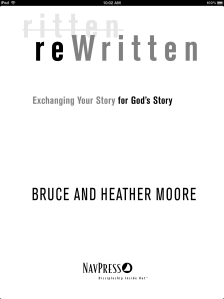
Book Review: reWritten by Bruce & Heather Moore

“With each life opportunity, God reveals to us more of His story for our lives and the potential for what we can become if we trust Him to author our future.” p. 35

Many of us have wondered, is this really how my life is supposed to be? Maybe your life’s story is marked by poor decisions or the hurtful actions of others. How can you turn things around? Is God still interested in using you? The answer is a resounding “Yes!”

Rewritten guides you through five life opportunities to exchange your story for God’s story. When you become the person He designed you to be and accomplish the tasks appointed to only you, you will experience the greatest fulfillment you could ever know and bring hope to a broken world.

The authors
Bruce & Heather Moore made the most extreme decision of their lives by leaving a large suburb church to rebirth a dying church with one year to live. They have seen the radical transformation of a church and the stories of countless lives rewritten. Bruce serves as Senior Pastor at Christ Fellowship Tampa and they have a very active preschooler.

Layout
reWritten is logical and flows together well as a book. The book is written in three sections: Your Story, God’s Story and The Exchange. The aim of the books is towards those whose lives are a wreck, though anyone will benefit from reading it. The first part had me skeptical at first of the book, until I remembered that ministry is really that messy. The second part is well written. The third part is pure gold. I appreciate discussion and thought questions, ‘story builders,’ were well placed throughout the chapters than merely as an after thought.

Story as metaphor
The Moore’s use the concept of story as a metaphor throughout the book. The over all concept of exchanging our story for God’s story. reWritten reflects this in the layout. The metaphor adds significance to how God uniquely designed each one of us for His good purpose. What stands out from this is how approachable the book is; gracious and dealing with truth.

He said what?!
My heart leaped when I read the table of contents. We too often get locked into the idea that if life is good, then God is blessing. The Moore’s deal with the topics of humility and suffering! Too often these areas are ignored. Of note, the section of forgiveness is well done. It’s important to read the book from beginning to end to get the full scope, but mark the last section up well. It’s an excellent resource for counseling. I appreciate in how the personal stories shared makes God the hero. Some stories end exceptionally, while other end with ‘because this is what God wants of us.’

“With each moment that we suffer, God brings us gifts that change our perspective and allow other people to see His grace in our lives.” p. 139 on suffering

The writing
reWritten is approachable without being inaccurate. It is definitely written from a pastoral heart that cares deeply for people. The book has one of the best rhythms I’ve seen in a long time. The first section had me on edge a little as almost being cliché. When starting to read remember that, yes, ministry is that messy. We forget that too often. The second part is a clear description of God’s image in our lives and the rhythm really picks up there. The pattern of the book is one we should model in ministering to people; moving from where they’re at to where God wants the to be.

The bottom line:
reWritten is an excellent resource to help people to take the mess of their story and to seeing what God wants to do in their life. This is a book that pushes us to live Godly, seeking what He is doing in our circumstances. It builds a big picture of the great God we serve. Well written, the book also addresses topics we often ignore, such as humility and suffering. For those who actively council and minister to people, reWritten is a helpful guide to keep on hand.


The Gospel according to farm & sports injury

In recent news people are debating the issue of the labor department setting 85 pages of regulations to protect minors from farm injuries. In 2010 there was about 7,500 farm injuries. The thought is farm injuries are often severe and debilitating. I’m not for injuries or exploitation. This isn’t a let’s call out government overreach either. Here is what I am saying: Mountains of regulations doesn’t make one safe nor can one be completely safe. As humans we often pick an legislate an issue, ignoring the fact that life is often beyond our control.

Soccer
According to an ABCnews article between 1990-2003 1.6 million boys and girls were injured playing soccer. I’ve personally interacted with some whose soccer injuries were debilitating and are now a life long issue. If child safety and the prevention of exploitation is a concern, why has not the 1.6 million soccer injuries been addressed? Wait, soccer is popular here so I better stop now…

Football
According to WebMD football injuries didn’t fair so well. In fact, in one year alone it made up a third of all the soccer injuries between 1990-2003.

Researchers found high school football players suffered more than half a million injuries nationwide during the 2005-2006 season. And they were more likely to suffer season-ending injuries, such as fractures and concussions, than those who play collegiate football.

Now, I’d ask the same question I asked before, but recognizing the religious zealotry that is football, I better pipe down.

Oops, there’s more…
According to stopsportsinjuries.org 3.5 million high school athletes are injured. 30,000 of which are hospitalized. This data was found in the mid 90’s, but according to other statistics there’s been a 5 fold increase in some specific types of injuries. What’s even funnier is how the CDC states more than half of the injuries were preventable.

The Gospel
At it’s core the Gospel is this: We are incapable of saving ourselves. The hope of Jesus dying on the cross and rising again is that one day He will make all things new. We can’t save ourselves and it’s Jesus’ work in our life that makes the difference. Here’s the catch. No amount of legislation can make us good. Just like with childhood injuries, we too look for specific “bad” things that we can easily prevent, but we often ignore things that may not be as severe, but still leaves a significant impact of life long repercussions.

How about you?
Are you content because you’re not doing the “bad” stuff? You’re not in the “7,500 farm injuries crowd.” Yet, you’re doing things that are still wrong. You’re in the “millions of soccer injuries” crowd. You’re no better for doing a “less” bad thing. Fine, you may not be having an affair. But, if you’re gazing at a person and committing adultery in your heart, that still has repercussions that can harm a marriage. Here is what’s cool: Jesus covered it all. He can work in the “really” bad and the “less” bad issues.

The bottom line:
The issue with child labor on farms points out to a pattern in human behavior. Injuries are bad and often they’re preventable. No legislation can prevent injuries because we’re fallen and we’re broken. We often focus on a major issue, but injuries are injuries. The same is true for sin. We’re incapable of keeping ourselves safe. We’re also incapable of saving ourselves. We need Jesus and He’ll make all things new.

My guide to becoming a recovering fundamentalist: The conclusion

“Be holy for I am holy” ~God
“We can make God’s Word say what we want if we’re not careful” ~A Mentor

I want to close this guide with the final two good things that come from fundamentalism. Granted these two areas have been tainted by what was discussed earlier. We should still look at two key things. Holiness and a love for God’s Word is the baby. Legalism is the bath water.

Holiness
God wants us to be holy. While the pursuit of holiness and the process of being set apart for God may be distorted by legalism, any movement that at its core seeks to be holy is commendable. Jesus came to forgive us our sins. Jesus is in the process of purifying His bride, the church. An emphasis on holiness isn’t legalism, it’s a focus on godliness. “Shall we continue to sin that grace may abound” is a struggle all Christians face. I commend fundamentalism for its desire for holiness. We all should.

The Bible
Authorial intent of the Bible, a significant tenet of fundamentalism, is an essential element to the faith. We can make the Bible say what we want if we’re not careful. Along with sticking to the Bible, however, is the adage you can’t make everyone happy. As Jesus’ life proved, sticking to God’s Word can cause conflict. The Bible is critical as faith comes by hearing and hearing by the Word of God. Too often movements play fast and loose with the Bible. It should be the authority for faith and practice.

Now what?
Every movement has or will have issues. Throughout church history movements have risen and faded. We must be careful to not treat a movement as a strawman. Rather than reacting we should seek God and the Scriptures and act accordingly. Reacting instead of acting is often what sets movements in the wrong direction. Writing off fundamentalism is just reacting. Looking at heart issues and identifying what is good and what needs to change is acting with proper measure.

The Cross
Any error is covered by the cross. As long as there is breath in our lungs, there is opportunity for repentance. I understand that many have been abused or deeply hurt in highly (hyper?) fundamentalist churches. For one thing, not all fundamentalists are like that. For another, people can get hurt by other churches and movements too. Why? Because Jesus isn’t done with us yet. We must ask ourselves this: Is there a sin so great that Jesus forgave it at the cross but we can’t? The cross covers all, and our hurts should be left there as well.

The bottom line:
We have two choices in what we can boast in: the cross or ourselves. It doesn’t matter the movement. Fundamentalism promotes the Gospel, pursues holiness and highly views the Bible. These are essentials to the Christian faith. The lack of humility, legalism and unbalanced view of separation may have clouded fundamentalism. For sure there is a need for “self-policing” that needs to happen. Again, this is true for any movement for they’re issues of the human heart. We all struggle in these areas. To become a recovering fundamentalist takes three key things: 1) Boasting in the cross, not self. 2) Choosing grace. 3) Keeping the Gospel first and central.