Tag: culture

Why Kids Ministry: Part 1

The Value of Children

A Child is a person who is going to carry on what you have started. They are going to sit where you are sitting and when you are gone, attend to those things which you think are important. You may adopt all the policies you please; but how they are carried out depends on them. They will assume control of your cities, states and nations. They are going to move in and take over your churches, schools, universities and corporations. All your books are going to be judged, praised or condemned by them. The fate of humanity is in their hands.
~Abraham Lincoln

I highly doubt a church will come right out and claim that children are not important to God. The adage is true, however, actions speak louder than words. It alarms me that only one out of four churches lists reaching children as a priority. The church, like the society it dwells in, does not value children. Note Barna’s transformation in his chapter entitles I mist the Ocean:

Yet somehow the wisdom and necessity of seeing children as the primary focus of ministry never occurred to me. In that regard, perhaps I’ve simply been a product of my environment. Like most adults, I have been aware of children, fond of them and willing to invest some resources in them; but I have not really been fully devoted to their development. In my mind, they were people en route to significance—i.e., adulthood—but were not yet deserving of the choice resources.

An audiotape of Barna’s workshop describes the reality of this problem. Barna was surprised at how many pastors called and asked if the workshop on children could be moved to a more “skippable” spot because their time was so valuable. Barna purposely placed the session on children in an inconvenient place for people to skip it, thus it confirming his findings.

The problem  will continue to grow
Given advances in medicine and the standard of living, the adult population is continuing to grow. 1993 marked the first year where there were more senior citizens than teens. This trend can be partially attributed to the millions of humans who have been aborted. As the adult population grows, the propensity to gear church ministries primarily to adults will grow. What can children contribute to church finances or church growth? The results of this attitude leave children largely on their own. The mere lack of role models for children points to this issue. Marva Dawn’s states:

What makes the battle so intense in the present world is that so much of life is becoming ambiguous, chaotic, fearsome, unmoored. Consequently, people cling more desperately to whatever idolatries seem to them capable of freeing them from pain, confusion, weariness, or meaninglessness. The powers function to twist such things as efficiency, money, or fame into the gods of our lives, and thus God’s designs for good are distorted, corrupted, and deflected into contrary purposes. Our neighbors in the world (and we, in spite of knowing better) wind up with the ultimate concerns that are trite, violent, enslaving or flimsy. These goals will never ultimately satisfy or repress our deepest longing; they will never alleviate our aching bone-weariness, satiate our galling thirst, or pierce our bitter darkness.

A generation that did not know
What happens when a society does not reach its young ones is disaster. Judges 2:10 states that “another generation rose up who did not know the LORD or the works He had done for Israel.” This is a very easy thing to do if one does not know God nor the things that He has done. With biblical literacy low, many 20-year-olds leaving the church, and church statistics are as dismal as the world. It is becoming safer to say that a new generation grew up that did not know God nor the things of God.

The bottom line
To have a lasting impact on the world one must reach people when they are young, when they are children. Jesus’ words carry more urgency today than ever. Not showing children the way to Christ is another way of hindering them. Mediocrity in the pew comes from lack of diligence in to the cradle. If the “kingdom of heaven belongs to such as these,” the church needs to give serious attention to reaching and equipping the emerging generation.  Millenials search for spirituality and significance may be grasping for the God they know to be there whom they were not clearly told about.
Are you special?

I soaked in two ‘articles’ about being a specialist. In the first article, the end of 60 Minutes raised the question about the lack of family doctors compared with specialists. In the second article, D.A. Carson wrote on the trials of biblical studies. He raised the issue of theological scholars being too specialized and neglecting their study of other fields. The problem is not specializing but the loss of understanding the whole.

Look beyond
Often the ideas and solutions needed for your field are not found in your field. My dad made sure that I did not get ‘stuck’ in one thing. He wanted me to have a very broad and vast array of experiences to pull and learn from. This developed into a strong desire for learning and the ability to look at a problem from a variety of vantage points.

Read elsewhere
When interviewing various leaders in children’s ministry I asked what books on children’s ministry they recommend. They had recommendations, but without fail they all said the best ideas and books were not children’s ministry books. Read widely and read broadly. One conference a speaker suggested not reading everything in your field. Few books pass the test of time. Read those kinds of books.

Life is complex
The problem is not people specializing. Our culture and the vast sharing of information pushes that to happen. There are advantages to being a specialist. But, with every advantage there is often a disadvantage. The culture turned into multiple fragments. Life is a complex whole. Just think of all the news stories about unintended consequences from a solution implemented. Are we lost in the details as a culture?

Jack of all trades
We need Jack! We need people who have a broad understanding across multiple fields. They may be masters of none, but they have an understanding of the bigger picture. In thinking through the two articles and other past experiences, I agree we need more generalists, more “family doctors.” They may not be the best at fixing a particular part, but they help us avoid negative and unintended consequences from being too focused. They help us appreciate the forest and the broader work of art known as life.

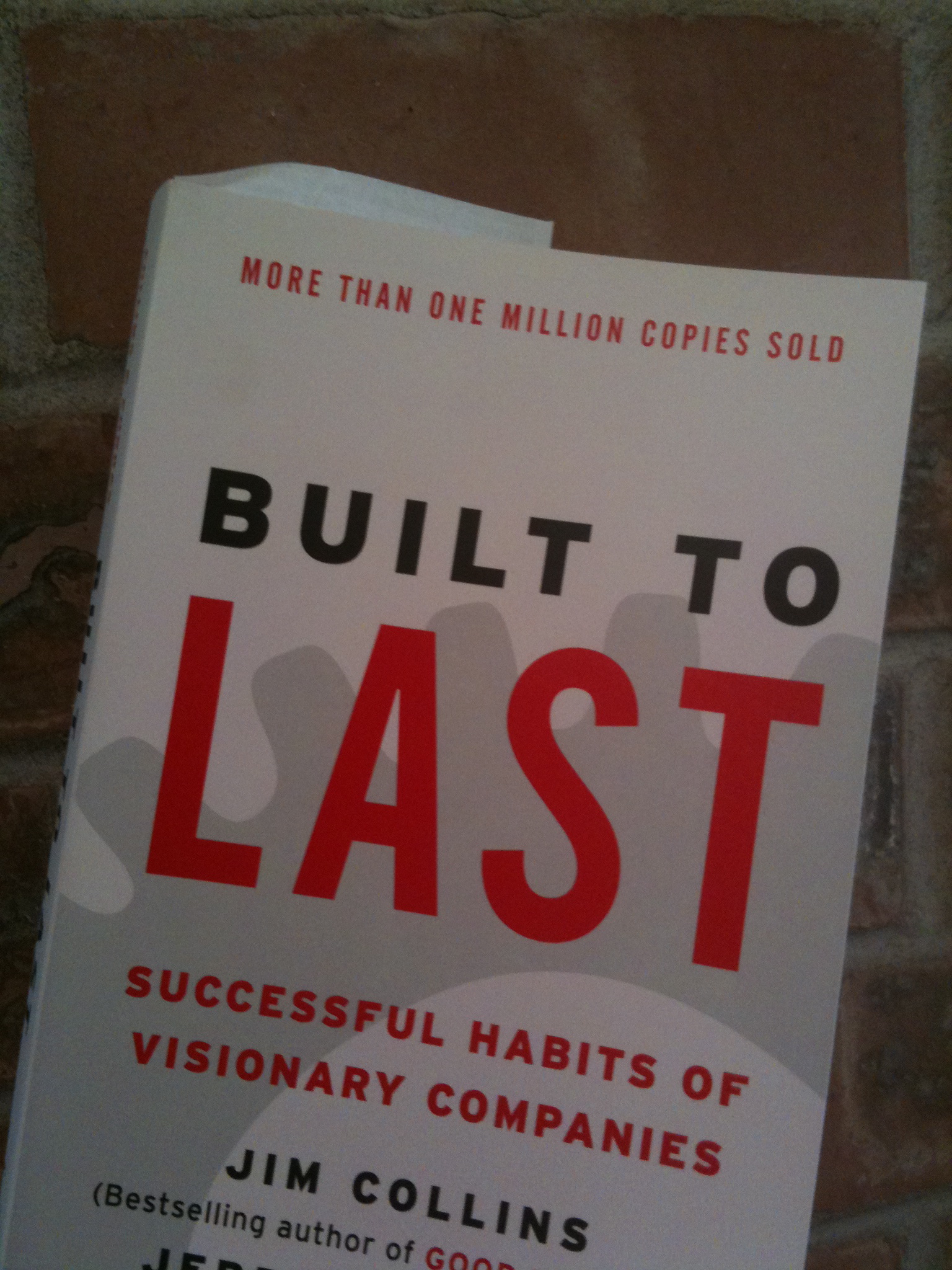
Book Review: Built to Last by Jim Collins & Jerry I. Porras

If you are involved in building and managing an organization, the single most important point to take away from this book is the critical importance of creating tangible mechanisms aligned to preserve the core and stimulate progress. This is the essence of clock building. ~ P. 89

A pastor friend highly recommended I read ‘Built to Last.’ I would echo that sentiment. The quotation above really encapsulates the book. To put it in other words, the book is more concerned about who you are as apposed to what you do. The visionary companies described in their book were more about who they were- their core ideology- then the products produced. Their great products were a result of their core ideology in action.

Building the core
The purpose and values of an organization is what is most essential and non-changing. It is the preservation of this core ideology that drives leadership development, products, adaptations, consistency and culture of visionary companies. These companies have transitioned through multiple CEO’s, economies, products, and culture shifts. Core ideology is the center of visionary companies, not profit nor product. The company itself is the greatest achievement. Preserving the core allows freedom to and opportunity to explore what the company can do.

Vision?
The greatest shock in reading the book was the un-central role vision played. Many of the leaders were not charismatic visionary leaders, though some were. In reading through the book everything went back to who the company was at its core. Growth of these companies normally occurred in one of two ways, BHAG’s or trying a lot things and keeping what sticks. The paperback version, which I read, had a chapter about vision, but this chapter still pointed back to the core ideology. Surprising fact from this book: can you build a dynamic organization without a vision? Yes. Without a core ideology? No. The book does not negate vision, but vision is certainly not the driving force, as the book almost arguing against it being the driving force.

Ministry value
The greatest ministry value from this book is to focus more on who you are and want to be rather than what you do. Values are discovered, rather than imposed, and a culture is developed rather then chosen. Attention should be given to the theology of what a church should be more than its actions. What a ministry does will have a greater impact if it is from its ideological center. As with any book, discernment should be used. The church is an organism not an organization.

A big key to the success of these companies was the preservation of its core ideology, particularly through multiple CEO’s. This is an element many churches struggle with. I have heard of too many stories of ministries declining after a successful tenure of a key leader. The draws attention to a much broader discussion.

The book
The book read ok and the stories were excellent. It did feel very choppy to me. The book is a report on a study and it felt like a report on a study. Things they pointed out were very well done, but the book could have been considerably shorter and communicated the same thing. While a worthwhile read, it was not the most enjoyable to read.

Bottom lines
Focus on living out and preserving the ideological core of the organization you’re in.
Focus on developing the culture and leadership of the organization you’re in.

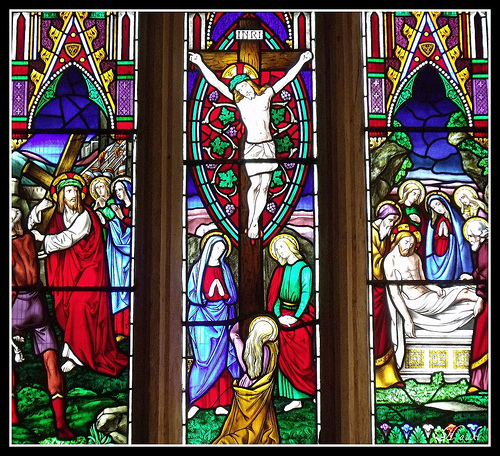
We need more stained glass windows…


Stained Glass Window
by Hauki-

“We will use these stones to build a memorial. In the future, your children will ask, ‘What do these stones mean to you?’ Then you can tell them…” ~ Joshua 4:6-7a NLT

Where is the art?
Stained glass windows were used to communicate basic bible stories to a largely illiterate world. Part of this was an extreme case of the Bible being in a language people didn’t understand. To communicate the stories from the Bible, the church used art. The buildings, decor, everything was to communicate and teach something about God, to inspire worship. For better or worse, we’ve lost the sense of art in many churches.

Theology in Art
God frequently used artistic expression as a tool to both remember and pass on who He is. Think about this, how abstract is a pile of stones in a middle of a river? The picture itself has to be explained. Think of the passover where God uses taste to communicate bitterness- the bitter herbs. Intertwined through the Old Testament God placed artistic expression to generate conversation. Some expressions were very abstract, others very understandable, they all were intended to generate conversation and engage people in theology- understanding who God is.

Generate why….
We need awe. We need environments and opportunities that get kids and adults to ask why, to dream. There is a broader context to following Christ. Our walk of faith is not an island unto itself. God showed Himself to be the one true God. If the church is truly one body, then our story and the stories of others in history connect. Theology is not a vacuüm, its communicated and lived out in history, in life. Art understands this language, as God created that rainbow of grammar and syntax. We need more stained glass windows…

Questions:
If all the words in your ministry environments disappeared, what does it communicate about God and who you are?

What have you done to help people see what God has done through the history of your church or ministry?

Do kids in your ministry start asking questions and talking about God because of what surrounds them?

Relevant!

Relevant, defined by the Oxford American Dictionary, means closely connected or appropriate to the matter at hand. If there is ever a battle in any ministry, it is relevancy! The key issue is that to be relevant means to change to match or be appropriate to the matter at hand. You cannot remain relevant and have no change. To keep relevant is to keep changing. Experiences in my life often get me to ponder what exactly the battle for relevancy is.

The battle of relevancy is keeping our mission as the driving force of our ministry.
What too often happens in ministry is that program drives the ministry and not the mission. (For those who like things defined, a program is simply what we do. To have no program is a program in and of itself.) Both the refusal to change (stubbornness) or the fear of being irrelevant (restlessness) are examples of the program driving the ministry. Change for change’s sake is not relevancy any more than maintaining traditions is faithfulness. In both cases the driving force is not the mission.

Relevancy is faithfulness to the mission!
As situations, opportunities, or just plain life occur, so will the need for change. The question that should drive change is: Are we fulfilling our mission to the fullest of our ability?  If the mission is what drives the ministry there will be times when a good program must go for a better one. If the mission is what drives the ministry there will be times when everyone else is changing, but we must maintain what we are doing. In the battle of relevancy, we rejoice when the answer is to keep doing what we are doing, and we roll up our sleeves with eagerness when the answer is a call to change. Faithfulness to our mission is demonstrated when we constantly live out our mission in our ministry. Relevancy is lost when the goal is relevancy or when change never happens. In both cases the program drives the ministry: ‘We gotta keep current.’ ‘If it was good enough for Paul.’ Both are ill. But when God gives us a mission, life happens. We ask for the mountains to conquer. And if we see a more effective way of doing things, we celebrate what God did with the former, and we act in faith with the new changes ahead.

Halls of Fame…
The real tradition of a church is God’s Word, and the specific mission that God has called a particular church too. Programs will change if a church is relevant. But, what God’s Word teaches, and the mission God calls a church to should not. It is very easy to begin equating our programs with or as theology. Such is false. Programs serve the the function of living out what God’s Word says and what the church’s mission is. As the meaning of God’s Word is specific, the application is often broad. As we better understand God by studying His Word (theology), it should be readily apparent the need to change ourselves and our churches to match up with who Christ is (application). Churches must never become ‘museums.’ In our communities churches must become ‘halls of fame’ of God’s Grace. For in times past, today and in the future, the church must proclaim the immeasurable greatness of who God is. They must inspire anew those who are seeking to become like Christ while eagerly expecting His return. Halls of fame celebrate and respect the past, while at the same time inspire and build anticipation of what is to come. And, while the actual game changes very little (all analogies break down at some point) how new generations of players engage in the ‘game’ keep it fresh, alive and exciting. God’s Word never changes, nor our mission. But, with a never changing foundation begs the question: What’s next?