Tag: change

Not Perfect is a Holy Thing: You and I

Person: You and I
Epic Fail: Pick any sin
God’s View: Holy

If you think God cannot use you because you’re not perfect: STOP! God uses imperfect people. Heroes of the Bible are viewed as heroes because of God’s grace and a heart of repentance. While some will be rewarded more than others based on the quality of our work, God will make us perfect and sinless one day. This week we will look at how ‘Not Perfect is a Holy Thing.’ People who had epic failures, and yet they pleased God. People like you and I.

Think process not product
The focus on holiness should be on the process of being who God wants us to be. The New Testament often speaks of of growth. Jesus used the analogy of the vine. Paul uses the concept of a body or a building. Maturity is not described as an event, but more the process of repentance. The Bible describes our walk with Christ in organic terms, and not as a college course. On this side of eternity holiness is about becoming like Christ. It is a process, not a product.

Holiness is being set apart. Think of it this way: If I do not sin am I being holy? I am being the person God wants me to be? Am I pursuing what He wants? The people listed in Hebrews 11’s were imperfect throughout their lifetimes and had epic failures. God’s final mention is one of admiration and pleasure because of their faith. Their success occurred from God choosing them for His service. These imperfects were set apart. God made them holy. God used imperfect people.

Epic fail: pursing perfection
We want our heroes and ourselves to be perfect. Jesus, who knew no sin, became sin on our behalf. This is the perfect picture of grace. Grace is the measure of a biblical hero. Grace focuses on on what God did. The heroes in the Bible were not perfect. People in life and in scripture succeeded and became highly esteemed because of His grace. Heroes in the Bible failed in epic measure, but that is not God’s final verdict! Pursing perfection is pursing self; pursing holiness is pursing God’s grace.

The Apostle John states: ‘If we say we have no sin then we lie.’ He goes further and states that the truth is not in us. Being sinless misses the mark. There is more to holiness than perfection. I would go as far to say that holiness does not equal perfection, though that is not a license to go sin. Holiness has more to do with purpose then perfection, pursuit instead of destination. All sin is covered by the cross. Real failure is the lack of repentance.

God’s final view is done and will be done
Our position in Christ matters a great deal! Once we are in Christ we are declared holy. God views us as holy. When we see Christ face to face we will be holy and lacking of all  sin. All of this is based on what Christ did, not what we did or didn’t do. God’s final verdict on you and I who are in Christ is one of sinless perfection. This position is eternally secured by Christ and sealed by the Spirit. It is done.

Here is God’s verdict on you and I: “For I am confident of this very thing, that He who began a good work in you will perfect it until the day of Christ Jesus. Phil 1:6” It will be done!
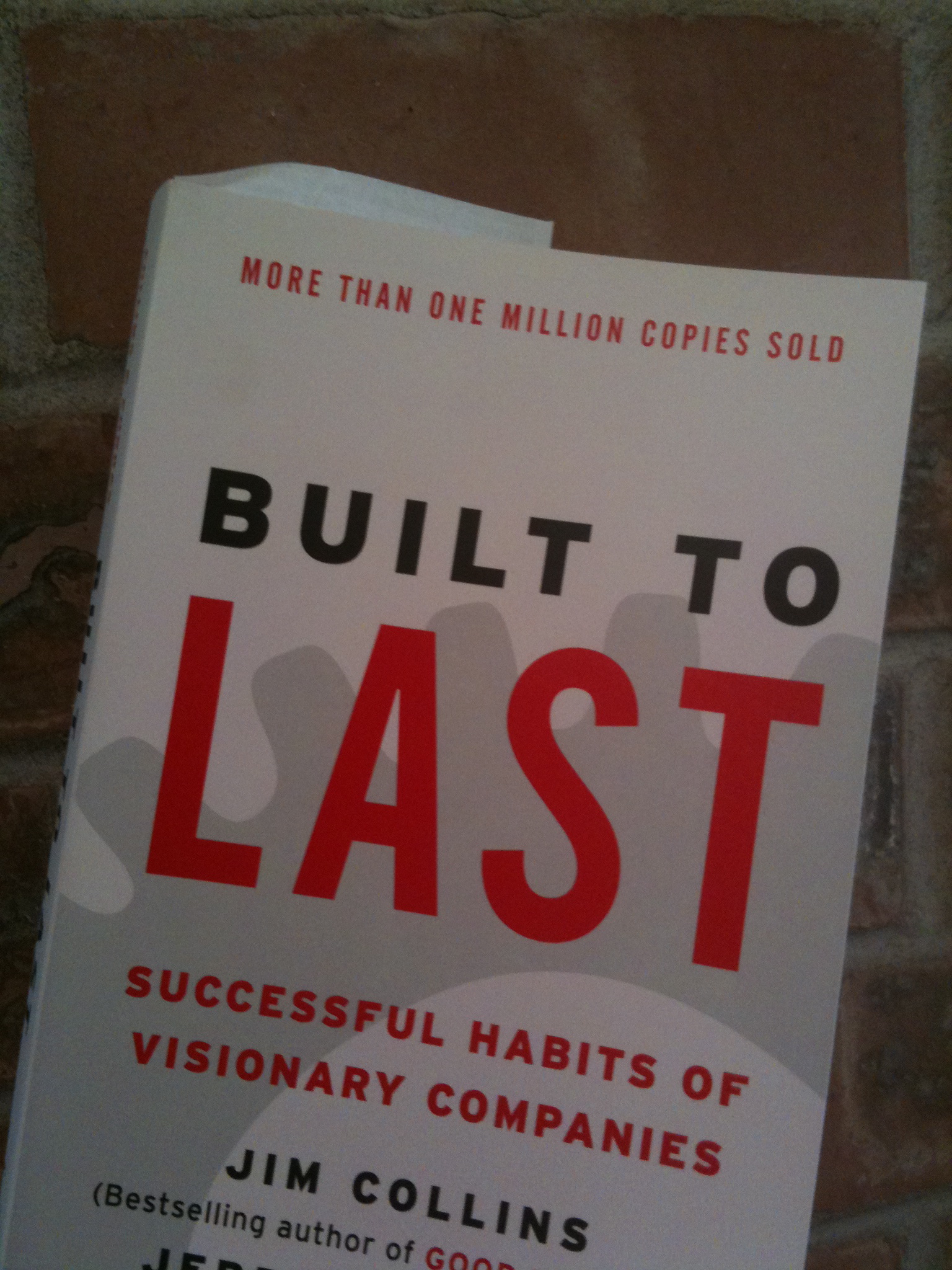
Book Review: Built to Last by Jim Collins & Jerry I. Porras

If you are involved in building and managing an organization, the single most important point to take away from this book is the critical importance of creating tangible mechanisms aligned to preserve the core and stimulate progress. This is the essence of clock building. ~ P. 89

A pastor friend highly recommended I read ‘Built to Last.’ I would echo that sentiment. The quotation above really encapsulates the book. To put it in other words, the book is more concerned about who you are as apposed to what you do. The visionary companies described in their book were more about who they were- their core ideology- then the products produced. Their great products were a result of their core ideology in action.

Building the core
The purpose and values of an organization is what is most essential and non-changing. It is the preservation of this core ideology that drives leadership development, products, adaptations, consistency and culture of visionary companies. These companies have transitioned through multiple CEO’s, economies, products, and culture shifts. Core ideology is the center of visionary companies, not profit nor product. The company itself is the greatest achievement. Preserving the core allows freedom to and opportunity to explore what the company can do.

Vision?
The greatest shock in reading the book was the un-central role vision played. Many of the leaders were not charismatic visionary leaders, though some were. In reading through the book everything went back to who the company was at its core. Growth of these companies normally occurred in one of two ways, BHAG’s or trying a lot things and keeping what sticks. The paperback version, which I read, had a chapter about vision, but this chapter still pointed back to the core ideology. Surprising fact from this book: can you build a dynamic organization without a vision? Yes. Without a core ideology? No. The book does not negate vision, but vision is certainly not the driving force, as the book almost arguing against it being the driving force.

Ministry value
The greatest ministry value from this book is to focus more on who you are and want to be rather than what you do. Values are discovered, rather than imposed, and a culture is developed rather then chosen. Attention should be given to the theology of what a church should be more than its actions. What a ministry does will have a greater impact if it is from its ideological center. As with any book, discernment should be used. The church is an organism not an organization.

A big key to the success of these companies was the preservation of its core ideology, particularly through multiple CEO’s. This is an element many churches struggle with. I have heard of too many stories of ministries declining after a successful tenure of a key leader. The draws attention to a much broader discussion.

The book
The book read ok and the stories were excellent. It did feel very choppy to me. The book is a report on a study and it felt like a report on a study. Things they pointed out were very well done, but the book could have been considerably shorter and communicated the same thing. While a worthwhile read, it was not the most enjoyable to read.

Bottom lines
Focus on living out and preserving the ideological core of the organization you’re in.
Focus on developing the culture and leadership of the organization you’re in.

Why Not Wednesday: Rearranging Deck Chairs

The cliche “that’s just rearranging deck chairs” has a negative connotation, but sometimes that is exactly what is needed. Slight changes are seemingly insignificant. Rearranging of things can open up a world of possibilities. One of the best things to help build creative muscle is to just move things around, take on a different perspective. It adds freshness, and keeps you from getting into a rut. It helps you become aware of things around you, and may help you at least find some lost pens.

Rearrange your deck chairs:
Move things around on your desk. Is the phone on your right really the best place?
Move your living-room furniture around
Take a different route home from work, and park differently.
Rearrange a friends desk… Enjoy your co-worker trying to figure out what’s different.
Set your desktop differently, if you’re a Mac user, move the dock to the side instead of the bottom.
Change how you normally arrange you library on iTunes.
Reverse your meal, eat dessert first, then the main course, then appetizer…Better yet, go out to eat and do this. When he brings you the bill for dessert, order a meal, then, when he brings the bill again, order and appetizer…

Bottom line:
Rearrange your “deck chairs.”

Methods and Content and Needs (oh, my!)

There is a tension between methods, content, and needs. With tensions we often pit one against each other, or take the “both/and” approach. This pours into another tendency; using nebulous terms such as balance, equilibrium or compromise. Everyone defines balance differently. We love to prioritize, especially if we’re analytical types, or just make bigger messes, if we’re mystical ministry as art types. How do we navigate these big three things?

The big three defined
What do I mean by methods and content and needs? Here are some definitions with examples of how they look when taken to an extreme:

Methods: What we do.
On steroids? Over emphasis on the non-biblical.. aka maximizing leadership, synergistic program developments, the latest greatest book based on statistical analysis.

Content: Who we are, theology.
On steroids? Over emphasis on the biblical… aka comatose preachy preaching, Word studies from languages we don’t speak, dead orthodoxy.

Needs: Where people around us are at.
On Steroids? Over emphasis on doing… aka the social Gospel, building self-help groupies, incredible families enterprises, political action.

What we need is balance right? In a word, no. Equilibrium? Not so much. Both/and? Sigh. These concepts often get people thinking in terms of 50/50 or compromise. I believe God cares about all three.

Think organic
The body is an incredible organic analogy. No one thinks to prioritize the heart, lungs or brain. Without each of these things you’re quite dead, and perhaps this is why many ministries are dying. We think in terms of health. We seek to sharpen our minds, and build a strong cardiovascular system. These are both keys to a long healthy life.

How the disciples succeeded
In Acts 6 the church was not healthy in an area. Hellenistic widows were being overlooked (need). The old program was not working and a new one was needed (methods). The Apostles recognized that focusing their energy on that problem would take away from what was essential, God’s Word and prayer (content). These things could have been in tension, but they weren’t. Rather the situation called for radical change, an opportunity to live out the Gospel and repentance, and a chance to reaffirm who we are. The church moved forward and God’s power was unleashed.

Where the disciples learned success
WWJD? Luke tells another story. 5,000 men were hungry and in need of food (need). The disciples thought the best idea was to send them away: there wasn’t enough food or enough money to feed everyone (program). Jesus was not about to stop what was essential, His teaching (content). Did  the disciples pass this test? No. But, they learned and God’s power was evident. (When we lack in an area, God will provide.)

The lesson
The disciples learned from failure that ministry is about health. Methods, content, and needs must have an intentional active focus. They did not sacrifice one area to bolster another. They brought up the weaker area through the power of God, while continuing the other essential areas. They changed when needed, tackled opportunities when they arrived, and kept their message front and center.

The bottom line
Think organically. The overall health of your ministry is related to the health of the three areas discussed. Ask: How is your health?

Methods:
Are in you a rut or open to radical change?
How well are you leading?
What steps of change or improvement have you taken lately?

Content:
How well do you know and understand God?
Are you still a student to the Bible & Theology?
What was the last theological topic you’ve studied lately?

Needs:
Do you know where your people are at?
When was the last time you studied your community to see how you can best serve?
How has your ministry demonstrated compassion?