Are you special?

I soaked in two ‘articles’ about being a specialist. In the first article, the end of 60 Minutes raised the question about the lack of family doctors compared with specialists. In the second article, D.A. Carson wrote on the trials of biblical studies. He raised the issue of theological scholars being too specialized and neglecting their study of other fields. The problem is not specializing but the loss of understanding the whole.

Look beyond
Often the ideas and solutions needed for your field are not found in your field. My dad made sure that I did not get ‘stuck’ in one thing. He wanted me to have a very broad and vast array of experiences to pull and learn from. This developed into a strong desire for learning and the ability to look at a problem from a variety of vantage points.

Read elsewhere
When interviewing various leaders in children’s ministry I asked what books on children’s ministry they recommend. They had recommendations, but without fail they all said the best ideas and books were not children’s ministry books. Read widely and read broadly. One conference a speaker suggested not reading everything in your field. Few books pass the test of time. Read those kinds of books.

Life is complex
The problem is not people specializing. Our culture and the vast sharing of information pushes that to happen. There are advantages to being a specialist. But, with every advantage there is often a disadvantage. The culture turned into multiple fragments. Life is a complex whole. Just think of all the news stories about unintended consequences from a solution implemented. Are we lost in the details as a culture?

Jack of all trades
We need Jack! We need people who have a broad understanding across multiple fields. They may be masters of none, but they have an understanding of the bigger picture. In thinking through the two articles and other past experiences, I agree we need more generalists, more “family doctors.” They may not be the best at fixing a particular part, but they help us avoid negative and unintended consequences from being too focused. They help us appreciate the forest and the broader work of art known as life.

Why not Wednesday? Play

A professor told me clearly: “Play is a child’s job.” Well, really, its ours too. Think of it this way, how much did you learn while playing?  Take some time and answer these questions while thinking about how you can bring ‘play’ in your life:

1) What games did I enjoy playing the most in life and why?

2) What was my favorite toy? What adventures did I have with it?

3) What aspect of your job now relates the most to what you played as a kid?

4) Ok, what toy did you not get as a kid that you wished you had? (did you get it?)

5) When you played, did you ever think about the social, political, scientific, and job related skills you were developing? (hmmm…)

6) How many “problems” did you solve in your imaginary or gamed adventures?

Pursuing Learning And Yearning

To be godly or not to be, that is the wrong question…

God or Godly Character? Is it a matter of balance? How do we address the fact of God changing the inside verses outward appearance and conformity? In discipleship and teaching there is a tension between these two.

Where we are at
Within the North American Church there seems to be a dichotomy between theology and practice. Such a focus tends to make church man centered rather than God centered as people focus on what is seemingly practical and ‘skip’ the foundation that sustains the practical. The high value we see for practical, application, “easy to do” gives evidence to this dichotomy. At the same time, I’ve seen dead orthodoxy where the Bible and theology are taught, but frankly it is dull and seemingly not applicable to one’s life, just tons of data. Theology is not a data dump.

Where the Bible points
The pattern we often see in Scripture is that as people encounter God (theology), their lives change (application). In Joshua chapter 1, God explicitly tells Joshua to know the law cold (theology) so he may be careful obey it and have success by following it (application). Paul instructs Timothy to be watchful of his teaching (theology) and his ministry (application). Theology at its core, its very essence, is encountering God. Encountering God demands that we change as we realize who He is. To separate theology from application is to create a dichotomy that does not exist in Scripture.

Bottom line
We act (application) based on what we believe (theology).

Perhaps if our eyes become more attuned to God and our relationship with Him, that correct behavior will follow. That is the pattern we see in Scripture. Your faith has healed you, go and sin no more.

Manic Monday: On planning

When looking out the airplane window at the ground below, something popped out at me. There are these massive grid lines in the mid west. Then, as if to purposefully mess us up, God places this meandering river that totally messes up these neat and efficient grids. Maybe our grids are not so efficient? If you wanted to water as much land as possible, a meandering river beats a neat grid.

Sometimes its best to set our attitude to wonder and discovery as our plans often follow the path of the river instead of our nice planned and efficient grids. Look out the window and see what seems random but is still extremely planned out.

Look out the window.

(especially on Mondays)

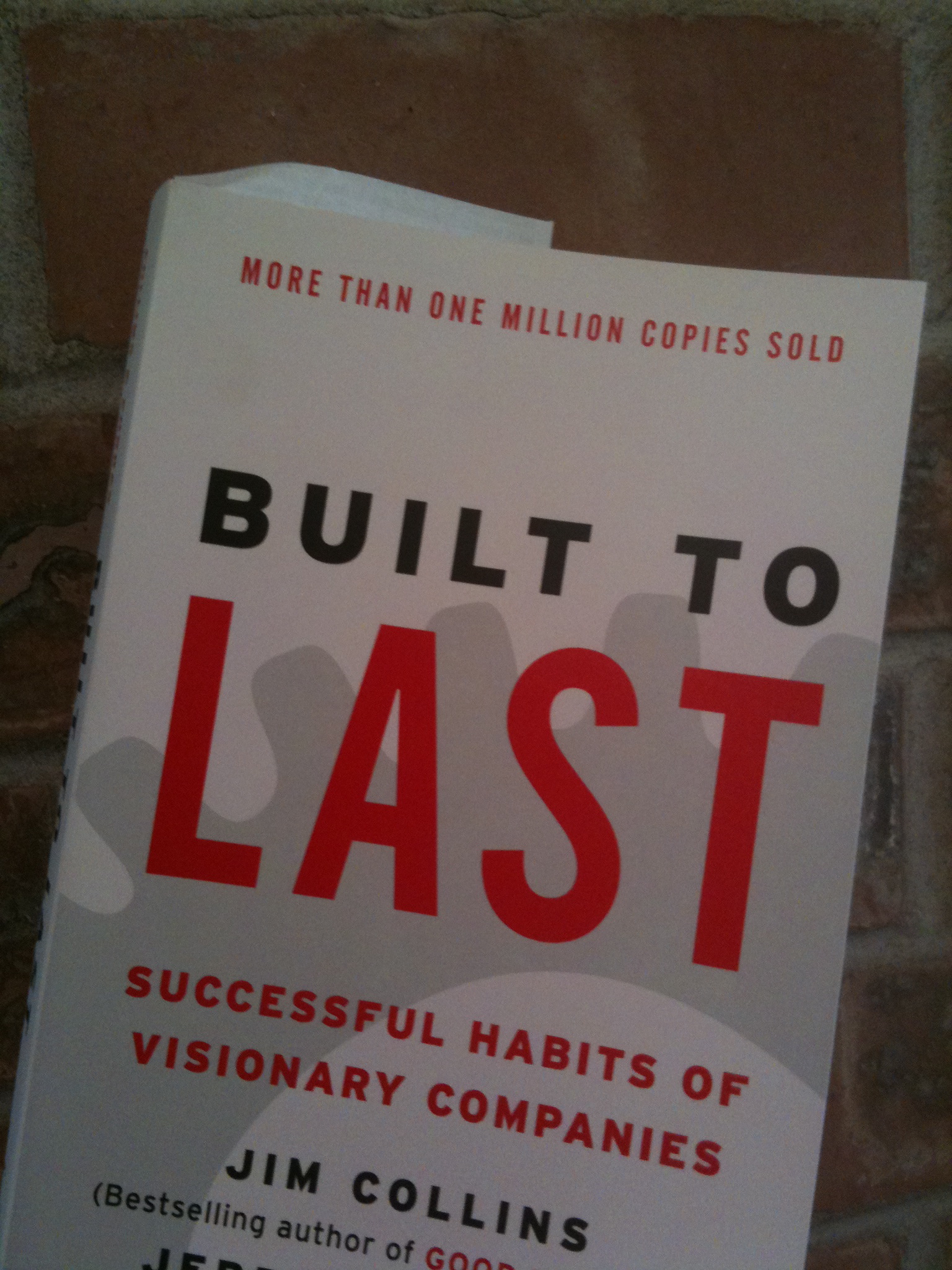
Book Review: Built to Last by Jim Collins & Jerry I. Porras

If you are involved in building and managing an organization, the single most important point to take away from this book is the critical importance of creating tangible mechanisms aligned to preserve the core and stimulate progress. This is the essence of clock building. ~ P. 89

A pastor friend highly recommended I read ‘Built to Last.’ I would echo that sentiment. The quotation above really encapsulates the book. To put it in other words, the book is more concerned about who you are as apposed to what you do. The visionary companies described in their book were more about who they were- their core ideology- then the products produced. Their great products were a result of their core ideology in action.

Building the core
The purpose and values of an organization is what is most essential and non-changing. It is the preservation of this core ideology that drives leadership development, products, adaptations, consistency and culture of visionary companies. These companies have transitioned through multiple CEO’s, economies, products, and culture shifts. Core ideology is the center of visionary companies, not profit nor product. The company itself is the greatest achievement. Preserving the core allows freedom to and opportunity to explore what the company can do.

Vision?
The greatest shock in reading the book was the un-central role vision played. Many of the leaders were not charismatic visionary leaders, though some were. In reading through the book everything went back to who the company was at its core. Growth of these companies normally occurred in one of two ways, BHAG’s or trying a lot things and keeping what sticks. The paperback version, which I read, had a chapter about vision, but this chapter still pointed back to the core ideology. Surprising fact from this book: can you build a dynamic organization without a vision? Yes. Without a core ideology? No. The book does not negate vision, but vision is certainly not the driving force, as the book almost arguing against it being the driving force.

Ministry value
The greatest ministry value from this book is to focus more on who you are and want to be rather than what you do. Values are discovered, rather than imposed, and a culture is developed rather then chosen. Attention should be given to the theology of what a church should be more than its actions. What a ministry does will have a greater impact if it is from its ideological center. As with any book, discernment should be used. The church is an organism not an organization.

A big key to the success of these companies was the preservation of its core ideology, particularly through multiple CEO’s. This is an element many churches struggle with. I have heard of too many stories of ministries declining after a successful tenure of a key leader. The draws attention to a much broader discussion.

The book
The book read ok and the stories were excellent. It did feel very choppy to me. The book is a report on a study and it felt like a report on a study. Things they pointed out were very well done, but the book could have been considerably shorter and communicated the same thing. While a worthwhile read, it was not the most enjoyable to read.

Bottom lines
Focus on living out and preserving the ideological core of the organization you’re in.
Focus on developing the culture and leadership of the organization you’re in.

Why not Wednesday: Be a kid!

“Whoever does not receive the kingdom of God like a child will not enter it at all.” ~Jesus

We often hear the line “child-like faith.” Jesus uses children to teach about humility and faith. Other than the disciples, children are the only group Jesus blesses in his earthly ministry. Leaders in children’s ministry love this verse. (We love other verses too!) In watching my two boyz grow, I’m learning more and more that child-like faith is not about simple trust or joyous abandon. I’m also thinking that children as a model of humility is less about their status. Here is what my boyz are teaching me about child-like faith.

“Amazing!”
My oldest son when I brought (OK, dragged) our first real Christmas tree into the house, stood in complete amazement. The word he used: Amazing! My youngest started kicking and flailing his arms as mom held him in a way he could see the tree. It was big, it was huge. And, after all dad’s kicking, screaming and complaining about a dumb ol’ tree in our house, two boyz changed my heart (my wife gave me the “see I told you so” look). The little and big things are equally amazing to kids. Jadon had the same reaction to the ice machine, the moon, ice cream, toy trains, the list goes on. Kids get amazement. They get wonder. But, its more than just the newness my boyz eagerly seek amazement. Its wired into their DNA. The quest for amazement is a skill we lose or forget.

“Daddy! Daddy!”
Daddy! Daddy! Means the same thing as Jesus saying “Truly truly, I say unto you!” Its not enough for a kid to be amazed. When amazed, we HAVE to share about it. Whether its demonstrating a newly conquered skill, or some simple thing they discovered, kids talk about it. They have to. Discovery is the root of their joy. What is learned and enjoyed must be shared- except with a brother or another child. We’ll talk about depravity at another time. Kids talk. They share what is most valuable- their hopes, dreams, and mostly the little things of life. Its wired into their DNA. The desire to share is a skill we lose or forget.

MA-MAAAAA!!!
When it comes to being hurt, dad is second fiddle to mom. Kids get the ministry of presence. But, my boyz get mad if I’m not around, even though its mama they want to play with or hold them. Jadon grabbed my hand once, sat me down on the couch and then took my wife’s and took her to the choo-choo’s. When I got up to go to the kitchen, play stopped and Jadon looked at me. He did not resume until dad was back in the picture. Kids get that people are the most important thing. People are more important than the task or what is being done. And whether it’s being held, or just being near, kids thrive on presence. Its wired into their DNA. The importance of people is a value we lose or forget.

CHOO-CHOO’S! Train. Train. Trains!?

Kids are devoted. When they like something, they want more. And more. And more. You get the picture. But, they don’t just want it- they CRAVE it! Jadon cannot get enough trains. Gavin cannot get enough doors for him to open. They must have more. They celebrate what they love. They ask for what they love and they go crazy when they get it. What they love is bigger than life. You do not have to convince them they know it. Its wired into their DNA. Devotion is a value we lose or forget.

Child-like faith is being amazed at, sharing, being there for, and being fully devoted to God and the people He places in our life. Sure, simple trust and joyous are a part of that, but those barely scratch the surface. Children are not simple followers. They are much, much more, and we would be wise to re-learn the skills that were once a part of our DNA.

Three lessons from Apple…

“Everyone in silicon valley was trying to be someone else…”
~Welcome to Macintosh

It is no secret that I’m a Mac. I watched Welcome to Macintosh, written and directed by filmmakers Robert Baca and Josh Rizzo, while my wife baked incredible delights. Expecting to enjoy the back ground story behind my beloved computer company, three big lessons stood out to me: 1) Be who you are, 2) Only take on projects you are passionate about and 3) Be dedicated to your strategy. These lessons are reflected both positively and negatively in Apple.

1) Be who you are!
A theme throughout the documentary was people trying to be who they were not. In Apple’s dark times, this was rampant. People in Apple were trying to be Steve Jobs, or some other key person. (It was also mentioned that its a Silicon Valley wide issue.) This theme really came out when discussing the future of Apple without Steve Jobs. The worst thing that could happen would be for someone to come in and try and be the next Steve.

Ministry touch point
One thing is clear: God designed you to be you, and ministry happens best when you are true to how God designed you! Focus on how God designed you. There may be similarities with others. There may be great ideas from others you can incorporate. But, the final question must always be asked and answered effectively: Who did God design YOU to be?

2) Only take on projects you are passionate about
A key quote from the movie: “When Apple really got behind a product, it did well, when they didn’t, it did really poor.” The story of the iPod demonstrated this point. Apple did not invent the mp3 player. Apple revolutionized it. Good design aesthetics and simplicity stand as pillars in Apple culture. The people of Apple also love music. The iPod revolutionized the mp3 market and music industry based on the merging of those two passions. Apple’s culture of innovation and passion drive the company, more so than the profit aspect. Its art verses business. It’s being verses doing.

Ministry touch point
If God is our delight, our desires will become/match up with His. If a project lacks passion, a key question to ask is: Is this what God wants us to do? (Sometimes the answer is yes, as obedience to His Word is another key aspect.) Passion is not everything, but it is what often will gets the job done. No something is not a negative. The power of no is a stronger yes. God gives us all 24/7 to accomplish His will. Our no’s are just as important as our yes. Go for the passionate yes, and be ready to say no a lot.

3) Be dedicated to your strategy
Innovation, simplicity, good design drive Apple. It is not a mistake that Apple developed 3 game changers: the personal computer, the iPod, and the iPhone. Apple rarely invented a concept, but they revolutionized it and made it usable. Apple’s success came about when they held to their core strategy or values. Again, its about being not doing.

Ministry touch point
How you get a job done is as important as what you do. Its a variation on the “Its the journey not the destination” principle. Understanding and articulating your values and strategy is essential to accomplishing effective ministry in the long run. Being creative is not always about new, but making something usable and best. Apple innovated, and their strategy centers on that. Innovation and creativity should be a result of who you are, and not the other way around. Its about being missional not program driven.

We need more stained glass windows…


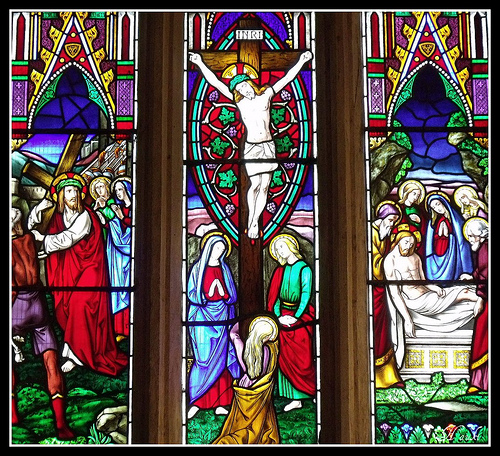
Stained Glass Window
by Hauki-

“We will use these stones to build a memorial. In the future, your children will ask, ‘What do these stones mean to you?’ Then you can tell them…” ~ Joshua 4:6-7a NLT

Where is the art?
Stained glass windows were used to communicate basic bible stories to a largely illiterate world. Part of this was an extreme case of the Bible being in a language people didn’t understand. To communicate the stories from the Bible, the church used art. The buildings, decor, everything was to communicate and teach something about God, to inspire worship. For better or worse, we’ve lost the sense of art in many churches.

Theology in Art
God frequently used artistic expression as a tool to both remember and pass on who He is. Think about this, how abstract is a pile of stones in a middle of a river? The picture itself has to be explained. Think of the passover where God uses taste to communicate bitterness- the bitter herbs. Intertwined through the Old Testament God placed artistic expression to generate conversation. Some expressions were very abstract, others very understandable, they all were intended to generate conversation and engage people in theology- understanding who God is.

Generate why….
We need awe. We need environments and opportunities that get kids and adults to ask why, to dream. There is a broader context to following Christ. Our walk of faith is not an island unto itself. God showed Himself to be the one true God. If the church is truly one body, then our story and the stories of others in history connect. Theology is not a vacuüm, its communicated and lived out in history, in life. Art understands this language, as God created that rainbow of grammar and syntax. We need more stained glass windows…

Questions:
If all the words in your ministry environments disappeared, what does it communicate about God and who you are?

What have you done to help people see what God has done through the history of your church or ministry?

Do kids in your ministry start asking questions and talking about God because of what surrounds them?

Why Not Wednesday: Rearranging Deck Chairs

The cliche “that’s just rearranging deck chairs” has a negative connotation, but sometimes that is exactly what is needed. Slight changes are seemingly insignificant. Rearranging of things can open up a world of possibilities. One of the best things to help build creative muscle is to just move things around, take on a different perspective. It adds freshness, and keeps you from getting into a rut. It helps you become aware of things around you, and may help you at least find some lost pens.

Rearrange your deck chairs:
Move things around on your desk. Is the phone on your right really the best place?
Move your living-room furniture around
Take a different route home from work, and park differently.
Rearrange a friends desk… Enjoy your co-worker trying to figure out what’s different.
Set your desktop differently, if you’re a Mac user, move the dock to the side instead of the bottom.
Change how you normally arrange you library on iTunes.
Reverse your meal, eat dessert first, then the main course, then appetizer…Better yet, go out to eat and do this. When he brings you the bill for dessert, order a meal, then, when he brings the bill again, order and appetizer…

Bottom line:
Rearrange your “deck chairs.”