Category: Theo…

Secularism and the problem of humanity

DSC_0057I am not surprised. The news that broke this week about Planned Parenthood is a natural outgrowth of secular thought. Just as superiority of a certain ethnicity is an outgrowth of evolutionary thought. Treating aborted babies as a cash crop is consistent. Stating the alternative of just throwing ‘it’ away a dry juxtaposition on an empty system. We must realize that secularism is not morally neutral.

Religion as a whole has its problems. Though by religion in North America people usually mean Christianity. After all, the voice of the church was not loud when slavery was around, though there were Christians and churches that decried the barbarism. The ills of the past are often thrown in Christianity’s face. Such misses the point of Christianity, but that is for another day. In reality the problem is not religion specific, but of the marriage of church and state that is the issue. What is often decried as “church” was really “state” in past history.

That is the past, let us focus on recent history. In the 20th century secularism took on greater vigor. As evolutionary thought exploded and theologically conservative Christians (unwisely) abandoned centers of cultural influence, secularism blossomed with greater speed. Along with the explosion of secularism was the political movement of socialism/communism/fascism. Society formed a spectrum of tolerance whereby religion was either forbidden, ‘tolerated to a point,’ or said to only be placed in one’s private life, not the public square. The premise of this form of thought is fairness, justice, and what is best for society as a whole. Humanity paid a price.

Racism now had scientific backing, not just a mere political/colonialism one. In the name of the greater good and the shelving to outright forbidding religion the human soul was lost. Religion was no longer to “force” it’s views on morality, though morals were being forced on everyone through secular society: Conform or be labeled and destroyed. In this seemingly progressive period of history, racism fell out of favor, though the strongest supporters of secularism and racism still had cards to play: government and “best for society.”

The slavery of the confederacy was outlawed, and the KKK type things were formed. These too slowly fell out of favor, but eugenics and then the abortion issue came into vogue as KKK types lost favor. Social safety nets also formed under the nobility of the “war on poverty.” Going against the wisdom or the effectiveness of such social help programs is to be going against the poor. Going against abortion is to be on the wrong side of the war on women. Standing for morality based on a religious premise is to be like the racists of the past, except such people are not.

In the United States, slavery, the Confederacy, the KKK, Socialism, Secularism, and Planned Parenthood have one common ancestor. Globally secular and evolutionary thought pays a common price. In recent history secularism slaughtered millions. In the name of the common good or even choice a terrible price was paid: people can be less than human. And when people are less then human, discarding such lesser beings is consistent both scientifically or for the common good. Harvesting human body parts from abortions instead of dumping them in the trash is not unreasonable. The wretchedness of such a juxtaposition is lost upon secularism. Gone (maybe, doubtfully) is the racism, but the pillar of racism isn’t: that a group of people can be less than human.

Secularism is not the answer, for in it we have more people slaughtered than any event in history of mankind, minus the flood. If avoiding religion brings the slaughter of millions, and the abuse of religion brought on its own tragedies, what then is the solution? For humanity could not live up to the ideals of religion, nor could humanity live up to its own ideals in secularism. Racism is bad, that is nearly universal now, but abortion kills more African Americans than any other type of death, bar none. Our social safety nets have destroyed families and heaped upon us the problem of absent fathers. Fatherless homes have a massive impact on crime, mental health, the economy, and education. We now live in the mess created in large measure by secularism. What, then, is the solution?

The misunderstanding of Christianity is that the church is perfect. The church is not perfect, but it is about being perfected by the only one who can change us. The good news, known as the Gospel, is that Jesus showed us a better way to solve problems: Loving sacrifice. Jesus demonstrated this by dying on a cross, though he is innocent, for our sins, though we are guilty. The concept of freedom comes from God and specifically the person of Jesus. For freedom’s sake Christ set us free. Government or secularism cannot solve humanities ills, nor can religion.

Can there be good and nobel secularists? Yes. But, there cannot be a good and noble secular society. Secularism is not morally neutral and has it’s own sins to atone for. But justice and the good of society cannot come at the price of our humanity. We bear the image of God. All people of all ethnicities do. If this were not true, than why did Jesus say go into all the world and preach the Gospel? The greatest mark of equality is not by law, but by Jesus. The only answer for religion and secularism’s ills is the forgiveness that Jesus already provided. There is no other way to balance the scales of justice. Humanity’s sin is too great.
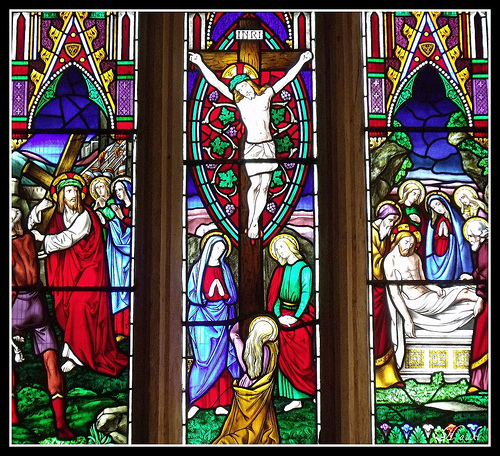
Who turned out the lights for a brighter future?

Stained Glass Window
by Hauki-

Every once in a while an article or articles you post online blows up your feed. Clearly, lighting in a worship center is a sensitive issue. In the ground swell of discussion there are a few concerns and patterns that need to be addressed. The lighting issue is a symptom of a greater issue within the North American Church, issues we do need to repent of.

One God, sneaky idols…
Churches worship methods as Christians worship preferences. While churches decry consumerism, Christians can point out the out of balance focus on methodology. Shedding light on modern idols is essential. We should operate from our theology and not our methodology. Methods change, who God is does not. On the individual side, church is not a commodity or business, it is a family. Being the church via one’s preferences misses a major point in the Bible: It’s not about you. Let us be frank: method worship and preference worship are major idols we the church need to remove.

One family, many discussions…
We are too quick to end discussions, as if the truth is already clearly known or understood. We are too quick to take offense. For example: The no light crowd pounces on the non-biblical issue with a side of evangelism. The all light all the time crowd brings out the design and Bible issue. Boom. Then there are people on the entire spectrum who say we shouldn’t discuss such things as there are more important issues. All three shutter discussion that is healthy and important. As Christians we stop discussion way too often and to our hurt. Cue the passages that talk about listening.

One creator, numerous stories…
Design communicates. Design matters. How we act as a church communicates our message as much or more so than what we say. For instance: Try communicating about Jesus’ birth in a brightly lit room, or discuss heaven in a dimly lit dark one. In both these scenarios the environment is antithetical to the story. Both these stories also need to be communicated with utmost clarity. We must stop treating the arts, such as design, as a non biblical, minor issue. Our mission to clearly communicate and proclaim who God is requires that such be brought under the light of our theology to reach a darkened world. After all, artists are a part of the body of Christ.

One church, open back doors…
In the last few decades there is a price the church paid: the de-churched. The idolatry, shuttering of discussion, and schizophrenic views on the arts cost the church too much. After all, we are family. Perhaps church growth would improve if our back doors were what we shuttered and not discussion, if we valued the glory of God more and our little kingdoms less. We can open our front doors more with artistic brilliance as more darken the seats of our worship centers. That is a worthy discussion, but there are sins we as a church family must repent of first. We’ve already paid too high a price.

The bottom line:
How we light our churches is not a big deal. How we discuss it shines a light on a dark stains the blood of Christ can easily wipe clean. While lighting may not be significant, there is too deep a price we paid. So, why not have the discussion and let the grace which God lavished on us and predestined before the foundations of the world conform us to the image of His son. Why not focus on the long-suffering and patience aspects of love found in 1 Corinthians 13. As a family we can and must do better.

Church would be better if people thought like and agreed with me!

Coffee-LoveI finally found the solution to ALL the church’s problems! For sure this will be a chapter in my up and coming book “Humility and how I achieved it.” Oh wait! I do have a chapter about that! Let me be frank, cause I love you. Church has a big y’all don’t agree with me issue. Here is what I mean:

Be a cheerleader
That’s right. Start off by trying to encourage people not be a critic. (Yeah, some of you preacher boys should just stop reading right now and focus on this part.) We all have too many critics but not enough cheerleaders. My critics practically killed me! Cheerleading is a choice.

Be loving
There is nothing more comfortable than being around a loving person. That person may even point out where you’re wrong, like a loving mommy saying “you’re not wearing that are you!?” while baking you epic chocolate chip cookies. Seriously, love comforts. Don’t pour gas on a bad situation. Bring about peace and comfort. That’s what I do.

Be a team
You live as a team or you die as a team. Period. Work together. I do believe the Spirit is readily available to help with this. After all, if we don’t row together alike a team… Work it out and be a team. Easy to do when the above is true! So, get in line and be like me!

Be Loyal
We have affection and and sympathy for people we are loyal to. An we even do that for friends of our friends. So, care about the people I care about.

Be one
Here is what it comes down to: You need to have the same mind and love as me. Really. Church would be so much better this way. Now, I know what you’re thinking. You’re thinking that this whole thing is be in arrogant. “Oh course everything in church would be better if we thought like you, duh!” “You’re just thinking of yourself! What about diversity all?” My response? You’re just thinking about you. In fact, you think church would be better if people were one with you and not me.

Why I’m right and you should be like me
I could have had the good life, but I didn’t. I sacrificed and worked hard just like you do. But, I did it for you and not myself. I put up with a lot. And frankly, it killed me. You humiliated me and being in this job I got blamed for things I didn’t even do. But hear me out. There is a day coming when everyone will agree that I am right and people should be like me. Mark my words: everyone.

The bottom line:
This chapter is called Philippians Chapter Two. My brother Paul wrote it for me. (If y’all think like and agree with him you’ll be well on your way to being like me.) Humility is the KEY! So, what church to be better? Be humble like me. It’s the only thing that work.

Love you all!
~Jesus

Get to work! A perspective on prophesy

IMG_0852“It is not for you to know the times or seasons that the Father has fixed by his own authority.” ~Jesus

Given the news of late and also preparing for an up and coming sermon series, some people raised questions on how events relate to prophecy. This tendency is one of the great dangers of dispensationalism and Christian belief in general. (While dispensationalists are often the straw man for prophecy issues, they’re really a human nature thing.)

Why prophecy?
God gave prophecy to exhort us to live holy, worshipful and servant-minded lives. His interests were not so much in knowing the future but in resting in Him who is in control. In times of dire consequence, God offered pieces of His plan to comfort. Meaning? God is demonstrating that He is in control. However, our focus shouldn’t be on the events but on God and walking in His ways.

Is it now? Are we there yet?
Before Jesus ascended back to heaven the disciples asked if now was the time for the kingdom. Jesus said to not worry about it, but instead gave them a mission. This may seem odd given all the teachings of Jesus exhorting people to read and understand the times. This seemingly paradoxical response is followed by more prophecy down the road. Like the Old Testament, prophecy pointed to a God who is in control and a call to holy, servant-minded living.

But…
Chill out. Love and serve your neighbors. Preach the Gospel boldly. Prophecy isn’t so we can sit in the grand waiting room we call a worship center and listen to Christian music while waiting for Jesus to return. Prophecy is a call for us to make disciples until Jesus does return. With all the news coming about of late remember Acts 1:7 and get to work on Acts 1:8!

The bottom line:
Many times throughout history current events lined up with aspects of Scripture. Rather than fear or trying to figure out the answer, we must respond to prophecy by boldly proclaiming the Gospel. The details of God’s plan is none of our business. God shared enough to give us hope, show he’s in control and point us to a mission. Now, go finishing the mission God called you to. Get to work!

The great divorce: Belief from action

IMG_0349Ask a dumb question and you’re bound to get a bad answer. In the vast online discussion on living for Christ one such questions is rampant. What is more important: theology or how we live? Let me be frank, it’s a dumb question. Why? We act (live) based on what we believe (theology).

God to Joshua
God tells Joshua that he MUST be absorbed with the Torah (first 5 books of the Bible). Why? That Joshua may be careful to do all that is written in it. The result is success. God did not distinguish between action and belief, He called for both. Right actions flow from right thinking. God designed us as theological & philosophical beings. Theology and philosophy are intensely pragmatic because it’s the source of our actions.

Paul to Timothy
A key theme Paul wrote to Timothy was to guard both ministry (living) and doctrine (theology). This theme echoes the idea that God instructed Joshua. Either bad theology or bad living will undercut our mission of making disciples. This is a tension in life that is best left in place. Resolving this tension, which is too often done, creates a bigger mess. Poor Christian living is often a result of bad theology.

The other words of Christ in red…
Jesus makes this point as well. In the seven letters to the churches in Asia Minor Jesus upholds the value of upholding correct theology and living. Jesus calls out the error in either direction and praises success in either direction. While incorrect, people often value the words of Christ in red as more important than the other Holy Spirit (who is also God) parts of the Bible. Hilariously, people often forget the red words in Revelation. Jesus will judge our actions and doctrine.

This divorce hurts our kids
When we focus on belief vs action we lose the ESSENTIAL third rail of proclamation. God wants to be known and made known. The belief vs action debate is inherently self-focused. God upholds correct theology and correct living because He wants us to make Him known. It’s time to hang up the “preach the Gospel and when necessary use words.” God wants us to use words. Bad theology and bad living will undercut our sharing that message. Our focus should be on our spiritual children and grand children.

The trinity
God the Father has a plan. Part of that plan is making Himself known to us. Life is not about us. God leads for His own name’s sake! God gave us the Bible (special revelation) so He could be KNOWN (theology). God the Son acted as a servant to point people to the Father. (He also did a lot of theology.) In communion this aspect of servanthood is demonstrated as we take the bread that symbolizes Jesus’ body which is for us. Becoming like Jesus is fundamentally servanthood (action). God the Spirit empowers God’s plan and living like Christ. The Spirit is our third rail. Acts 1:8 points this out. The Spirit leads us to not just live well, but to make God known (proclamation).

The bottom line:
We act based on what we believe. This drives us to share with others who God is by the power of the Spirit. Being like Jesus involves correct theology AND correct living for upholding our message of a risen savior. Don’t get stuck with the dumb question of belief vs living. Ask this question: Is my theology and life such that I can boldly proclaim the excellencies of Him who came as a servant, died innocently for our sin, rose victoriously on the third day and will soon return as King to make all things new?

Sacrificial Service: Isaiah 53

1 Who has believed what he has heard from us? And to whom has the arm of the LORD been revealed? 2 For he grew up before him like a young plant, and like a root out of dry ground; he had no form or majesty that we should look at him, and no beauty that we should desire him. 3 He was despised and rejected by men; a man of sorrows, and acquainted with grief; and as one from whom men hide their faces he was despised, and we esteemed him not. 4 Surely he has borne our griefs and carried our sorrows; yet we esteemed him stricken, smitten by God, and afflicted. 5 But he was wounded for our transgressions; he was crushed for our iniquities; upon him was the chastisement that brought us peace, and with his stripes we are healed. 6 All we like sheep have gone astray; we have turned–every one–to his own way; and the LORD has laid on him the iniquity of us all. 7 He was oppressed, and he was afflicted, yet he opened not his mouth; like a lamb that is led to the slaughter, and like a sheep that before its shearers is silent, so he opened not his mouth. 8 By oppression and judgment he was taken away; and as for his generation, who considered that he was cut off out of the land of the living, stricken for the transgression of my people? 9 And they made his grave with the wicked and with a rich man in his death, although he had done no violence, and there was no deceit in his mouth. 10 Yet it was the will of the LORD to crush him; he has put him to grief; when his soul makes an offering for guilt, he shall see his offspring; he shall prolong his days; the will of the LORD shall prosper in his hand. 11 Out of the anguish of his soul he shall see and be satisfied; by his knowledge shall the righteous one, my servant, make many to be accounted righteous, and he shall bear their iniquities. 12 Therefore I will divide him a portion with the many, and he shall divide the spoil with the strong, because he poured out his soul to death and was numbered with the transgressors; yet he bore the sin of many, and makes intercession for the transgressors.
English Standard Version

End times: Why it matters & Why I’m a ‘dispensationalist

Our view of death determines our view of life. Biblical teachings on end times, known as eschatology, is essentially a Christian view of death. The recent trends to avoid or downplay this teaching is unhealthy. Over emphasizing the doctrine is also unhealthy. In the push away from end times I’m often asked why I am a Dispensationalist. My reply is I’m a little ‘d’ not a big ‘D’ because I don’t emphasize the doctrine or focus on the current possible details. The short answer: in studying scripture, it’s what I see it teaching. I submit we should not shy away from end times.

It’s taught in scripture
Avoiding the end times parts of the Bible is to miss significant teachings of Scripture. In Matthew 16, Jesus chides the religious leaders for being able to determine the weather but were clueless on “the signs of the times.” Paul taught on the rapture, whatever view you take on it, to a baby church plant. He then wrote twice to that baby church to clarify end times teaching. The book of a Revelation is all about end times. The Bible does give us a framework and does teach on the end times. It does not give us a specific time table and tells us to not worry about timing (Acts 1:7).

It’s a matter of encouragement and perspective
The rapture and Revelation give us both encouragement and perspective. These essentials are lost if we avoid the end times. The rapture is meant to encourage us when a saint dies. (A strong argument for pre-tribulational rapture.) We don’t mourn as others do because death is a temporary state. The end times give us the needed perspective so we can practice blessing people instead of returning evil for evil. A HUGE part of end times is God balancing the scales of justice of a world filled with injustice. How can I bless those who persecute me when a I’m faced with injustice? The end times gives us the perspective of why.

It’s a matter of God’s character
I’m a Dispensationalist because I think Israel means Israel in the Bible. As Hosea illustrates, God will go after and redeem national Israel as Hosea redeemed his wife from prostitution. I’d submit that spiritualizing Israel in the New Testament makes the Bible ludicrous. Why? What assurance of salvation do we have if God wrote off Israel? This is the issue Romans 9-11 addresses. Further, Paul makes a clear distinction between national Israel and Gentiles in Romans 11. God’s treatment of Israel gives confidence in His treatment of us and the church. God is the God of second chances, of grace, and He keeps His Word.

It’s a matter of our character
Paul’s states in Romans 11 that we should be careful as God did not spare the natural branches, neither will he spare us. Much rejection of Dispensationalsim is arrogance of the grafted in branches. End times keeps us humble before God. For sure humans tend toward arrogance. Churches often become arrogant as well. In Acts 1:7 Jesus didn’t say there is no kingdoms of Israel, he said the timeline was none of our business. In Revelation Israel is specifically mentioned as well as mentions of various nations. End times is a check on our character.

It’s a matter of faith
Hebrews 11 has an end times perspective. It is true that the big issue in theology is a matter of interpretation, but not all views are valid. I believe in the plain interpretation of the Bible, meaning what the author intends to communicate is the meaning. All other viewpoints have no true bearing in how to interpret Scripture. There is a pattern of literal fulfillment of prophecy throughout Scripture. Spiritualizing prophecy yet unfulfilled is to play hermeneutical voodoo. While God is mysterious and did not give us all the answers, He is predictable in that he keeps His word with an uncanny literalness.

The bottom line:
Avoiding the end times is to lose much needed perspective and clarity for godly living. While I do not major on a time line of future events, there is a framework given to us for the purpose of encouragement and perspective. Key to all this is that God is not done with national Israel, just like he’s not done with you or me. His grace, mercy and justice are evident in end times teachings of Scripture. Be carefully balanced, but do not avoid this essential doctrine of Scripture.

Side note:
Much of the antagonism towards dispensational thought started with Augustine who was anti-chiliasm (premailinalsim). While Calvin moderated (somewhat) on the matter, the antagonism towards pre-millennial viewpoints endured. As people act based in what they believe, much anti-semitism came from a non-dispensational viewpoint.

Thoughts on the creation debate

DSC_0059The debate between Ken Ham and Bill Nye went as many perceived it would. Both sides made their points in a civil way, rallied their base and demonstrated clearly the issues. Sadly, I think both tended to speak past each other. Ken did a solid job presenting the Christian worldview, though more scientific evidence to support that would view would have mad his case stronger. He did clearly show that one can be a creationist and make significant contributions to science. I fear that point may be missed.

Bill Nye was either ill prepared or he really didn’t care to debate the issue. Either way, what came across to me was tolerating something he disdained to push a naturalistic viewpoint. Did he argue well? Yes, and I’d submit in terms of performance he edged out Ken. However, it came across clearly that he had no concept of the worldview Ken was coming from. A reasonable man would seek to understand and then be understood. Bill operated from a caricature of a creationist not from an understanding of a creationist worldview.

Bill and Ken were even on: failing to prove their thesis, being civil and rallying their base. Nye edged out and beat Ken on performance. In terms of being prepared, Ken was clearly more ready. Over all, I think Ken won the debate as he did show the viability of creationism, though he failed to prove his thesis. I think Ken over reached with his thesis.

The reasonable man
A reasonable man is one who uses analytical thought and understands a system before critiquing it. Bill failed in this. He clearly did not have any understanding of the Bible from Ken’s perspective. His case could be more clear had he more knowledge. A reasonable man would be more attentive to his question being raised. Frequently, Bill stated that if one could offer one proof it would change the world. Ken’s evidence of the tree encased in basalt was blown off. Ken’s rebuttal answered Bill’s question, but was ignored.

No evidence
Evidence’s chances of changing Bill’s viewpoint was small at best. Given his lack of preparedness, I don’t think Bill much cared. While he did conduct himself in a civil manner, he blew off two major points Ken was making: 1) the viability of creationists 2) historical vs observational science. Bill obviously disagreed, but his point came across as trite and pigeon holed creationists as anti-science. Ken’s case clearly demonstrated the opposite. I agree Ken should have offered more scientific evidence, but I also don’t think it would matter.

Jesus first
This debate demonstrated a key point of belief for me: It’s Jesus first, then creation. I am a creationist because of Jesus. Theologically, that is true of all creationists. I’ll write on that later. A key point that is this: How do you scientifically prove a supernatural creation? Is there any proof of that? Yes, his name is Jesus. The feeding of 5,000 plus and 4,000 plus demonstrates instant control over creation & matter. It was observed, recorded and in an environment that was antagonistic to Jesus. (The crowds loved the food, but also yelled crucify him later.) There is no way to pull off those feedings as a con. Also, Jesus rose from the dead as he said he would and when he said he would. This is a recent, verifiable and proven occurrence.

Given the authenticity of Jesus, the probability that Genesis 1-11 is correct carries weight. Jesus took those accounts as literal, and given his assertions as being one with the father, he was there. It is more reasonable to trust Genesis because of Jesus than evolution with billions of years and chance. While I’ve met people who came to Jesus because of a reasoned explanation of creationism, the main thing is Jesus. The biggest weakness of creationism is they don’t focus on Jesus enough when he is verifiably the best evidence that creationism is true.

Worldview is an issue
The debate demonstrated the need for Jesus. It is important for Christians to give a reasoned defense of Scripture and to treat the Bible as a legitimate source. Ken did that very well. At the same time, we must realize we are speaking a different ‘language’ than those who are not in Christ. The Gospel will and does come across as foolishness. This is where I think Ken was more prepared than Bill. Ken understood Bill’s worldview, but Bill did not understand Ken’s. Had Bill taken the time to understand Ken’s worldview, he could have made is point better. Whether from arrogance, disdain or plain lack of being prepared I do not know, but Bill failed at a key point. For Christians, it should demonstrate that a reasoned case for something is not enough. We don’t save anyone, only God does.

Creationism is viable
Ken answered the question that creationism is viable. He gave clear examples of creationists contributing positively to science and engineering- something Bill is pleading for. Ken and Bill agree there is a need for children to pursue science and engineering. That Bill did not make this point is sad. Ken demonstrated the reasonableness of creationism based on a Christian worldview, that creationists have and are contributing positively to science and that there are significant issues with evolution. While Bill made a case and argued well, he did not show that creationism isn’t viable. His lack of understanding a Christian worldview greatly undercut his point.

The bottom line:
First, seeks to understand and then be understood is a key rule of thumb when entering a debate. Second, you cannot argue people into heaven, but we should have a clear and reasonable defense for the hope that is within us. Third, evidence rarely matters when the issue is worldview. Finally, seek to make a difference and not a point. Even if you win the debate that evolution is wrong, if one doesn’t accept the message we received, the debate doesn’t matter. Jesus died and rose again on the third day. The key to passing on that message is a submissive spirit that does good works (1 Peter).

Our job isn’t to reach America, it’s to reach americans. ~Rick Warren

A change of focus

I’ve read frequently how the best leaders focus on their strengths. Focus on their weaknesses actually inhibit growth. Could the same be true for churches? I’m beginning to wonder if we’re so focused on what we’re not doing right/well that we’re missing what is our strengths. Let me suggest a few strengths we should focus on.

1) Jesus rose from the dead, conquering sin & death, and sits at the right hand of the father.

2) Jesus keeps his own, is in the process of purifying his own, and one day will return to be with his own forever.

3) Jesus states he will build his church, and it will be continued to the day of completion.

4) Jesus maps out a plan for his church that in the end results in her being pure and without blemish.

5) Jesus modeled humility & love while also showing holiness & doctrinal correctness.

6) Jesus told jokes and, after all, uses people like you and I.

7) Jesus gave us a helper, the Spirit, who also helps in our weakness, seals us, keeps us and empowers our ministry.

I could be wrong. But my hunch is the church needs to start focusing on its strengths.

Because we can…

messy small.001A camper gave me the pout lip and stated clearly for all that I was only doing this because I was getting paid. Upon informing him that I had to actually pay to work at the particular camp and had to work through some inconveniences to be there, he softened. We had a great conversation and week at camp. People are skeptical of good actions.

The beauty of the Gospel.
In the Gospel, we don’t have to good things. (Ducking under my virtual desk for things thrown at me.) We don’t have to earn a relationship with God. We don’t have to do good things so keep God happy with us. We don’t have to do good things because we are obligated to. (By this time some yeah, but seminary types are pulling out the long knives.) The beauty of the Gospel is that God is full satisfied with us because he is fully satisfied in the finish work of Jesus!

Because he could…
Let that sink in for a moment! Jesus didn’t have to die on the cross. God could have easily let the Earth just end in misery and not redemption. The beauty of the Gospel is God acted cause he could. We often coldly say that God’s character required it. This is one of the ways the Gospel is profoundly mysterious because it contains the interplay of perfect justice and perfect love. “Tear down this temple and I’ll rebuild it in three days!”

Because we can!
Why do we serve, because we can! We can serve because we don’t have to worry about what God thinks of us. We can serve because we’re free from the bondage of selfishness. Because of our security in Christ, Jesus enables us to serve. That is the power of the resurrection. As Paul puts it: “To live is Christ, but to die is gain.” When our identity and our security is in Christ it profoundly frees us to be a blessing to others.

The bottom line:
Nothing can separate us from the love of God. This core doctrine frees us to serve and be there for others.