Tag: theology

God is not stupid

I understand the plight to focus on essentials and not have a hostile environment when it comes to theology or the deep questions of life. In these conversations I cannot help but sense an eerie feeling. Do we think God is stupid and or modern man is evolved and enlightened?

Creation:
Instead of creation described poetically, what if God poetically created?

The creation account is written poetically. Days 1-3 God creates spaces and Days 4-6 He fills them. Upon completion God creates rest on the 7th days, and hence our week. The debate over creation vs evolution within Christianity will likely not go away, and should always be congenial. I have to ask, why can’t God poetically create?

While we may not like the way some defend the young Earth view, creationists do show plausibility of a young Earth and catastrophism. Are all discussions sound, bulletproof and complete? No. Neither is evolutionary thinking, which has changed demonstrably since its inception. Early humans maybe naïve, but I don’t think God created humans as intellectually inept. Why do we often view earlier humans as incapable of clear or deep thought? Who is to say that God created in the way He did for no other reason than the discussions about origins today?

Bible:
If an all-etc being, can He not communicate both timelessly, accurately, and use man at the same time?

We act based on what we believe. I wonder if we truly believe God is all-powerful or all-knowing. I mention this because we don’t seem to apply that to the Bible. Why can’t God use fallen man to communicate accurately and sufficiently?

Words and language move people. How many movements start based on an idea? Putting ourselves in God’s shoes, if we wanted to communicate who we are with clarity, how would we do it? Based on history, it seems we prefer to write things down: narratively, poetically, playfully. We learn best through narrative, it gives context, tone, color, and a depth mere bullet points or technical writing cannot. Are not the best story tellers those who are both cunning and correct and the greatest of these stories true?

Grace:
Isn’t freedom of choice as much an act of grace as freedom from consequences?

In hard times we yell at God, asking why He could allow bad things to happen. He could have stopped tyranny, death, destruction, but He has not…yet. While Naive, knowing neither good nor evil, God gave Adam the ability of choice, much like a parent knowing what the outcome will be. There was revealed, demonstrable and verifiable evidence of God’s existence, and yet Adam chose pride. Would we do better?

We often think of grace covering the consequences of our actions, but grace also covers our choices. Even in good times we often forget where they come from or worse that we are deserving of them. God hates sin, but yet he allowed people to sin and create the mess we’re in today. Do we not value our freedom above all else?

Rights:
Why does pursuing our rights lead to so much frustration?

Over the course of human history we, both big and small, pushed for our rights. Wars and quarrels, pain and suffering resulted and resound over rights. We either vocally or deep down demand them. We feel entitled to them. We blame God for allowing the violation of them. If He is love and peace, then why…?

I sense we wish God was more like us. Maybe we should reverse that and look at how He wants us to be more like Him? God has the right to wipe us all out, but He patient. God has the right to shun accusations or anger towards Him, but He listens. God has the right of full worship, yet He came humbly and unjustly executed as a criminal. God has the right to make us all puppets, but He gave us a choice. Maybe the answer to much of our suffering isn’t for God to be like us, but for us to be like Him?

The bottom line:
God is not stupid. When discussing the deeper questions of life and theology, we must not forget that. Human depravity and naïvety is a variable, but truth and God are a constant. If God is truly who He claims to be, then perhaps He overcame people’s problems while still choosing to communicate through them. We may not like or understand how or why God chose the path He did, but we should remember that God is God and we are not.

Millennials: Hey world, I have a soul!

Millennials are about the rediscovering of the human soul. I read lately about “Millennials.” Depending on what definition you go by, I am one or I am not one; I consider myself one. Time tables are largely arbitrary. What amazes me about Millennials is the focus on significance and impact. There is more to life and its purpose then mere existence.

I am more than my parts
The problem with modernism and the industrial revolution? They reduced everything to a mathematical formula or chemical equation. Reason was supreme, science was king. Under this onslaught of reason on steroids I cannot help but notice- things got worse not better. Reason & science can build you a bomb, but it cannot tell you if you should use it. The atrocities of modernism should cause pause about being enlightened.

Here is what I mean: Technological progress and the acquisition of knowledge does not equate to human progress. Such ‘progress’ lead to events like Nazi Germany, Soviet Union, abortion on a grand scale, pollution on a grand scale, the break up on the family, drug abuse, etc. Modernity forgot something. I am more then my parts. I have a soul.

My soul is fallen
Anyone who states a person is inherently good never worked with children. People, by nature, are depraved. I often get tirades of pessimism when I state this, but it is the truth. If people are naturally good and education the silver bullet, then things should be getting better. They are not. Again, I cannot help but notice how things got worse or at best remained the same.

Millennials focus on social justice, significance and impact may be the realization of something far more critical: We have a soul and it is fallen. The human soul often craves justice. This sense of freedom and justice demands action. They are foundational to the meaning of life.

The law has failed
The rule of law and the destructive nature of religious fundamentalism did not solve the problems. Millennials crave spirituality, but often reject religion. It points to the argument Paul made in Roman’s 7: The law is good, but it cannot save nor sanctify us. (Romans 7 is debated passage. My take is that human nature is not the focus, but the role of the Law (Torah) is.) Milennials want to cut the fluff and get to the real answers.

The Gospel really is the main thing
The Gospel really is the answer to the questions Millennials are asking. Granted there are problems at home, in the work place, etc. We need help in learning how to handle our money, our relationships, our conflicts. The Bible teaches that it is the role of older generations to teach and pass on that wisdom. Millennials are a generation of wanting listeners. But, that wisdom is not the answer they are looking for.

Theology & exposition of the Scripture stands ands as the answer. For this gets to what should be the root voice and foundation for the church: There is a God who wants be known, make Himself known and the Gospel is the only way that can happen. God doesn’t want us to know about Him, in such case general revelation would be sufficient. God wants to be known in community with us. God is active and involved. The story of Jesus Christ is pivotal to the questions Millennials are asking. The answer results and demands action. The Gospel really is the main thing.

The Bottom line
Millennials are reminding human history that we have a soul. The best response to the questions being raised is the Gospel. Teaching theology as about God, or  teaching pragmatic & practical formulas misses the mark of what is asked. One is mere reason against questions of decades past, the other a softer form of legalism, both neglect that God created us with a soul. The Millennials questions bring us back to the main thing: That change occurs best from the inside out, and only the Gospel can produce that change. It’s as if with one voice they are shouting: Hey wold, I have a soul!

Book Review: The Pursuit of God by A.W. Tozer

Tozer’s book is incredibly technical and mysterious at the same time. He pushes you, hard, and asks very pointed questions about your belief in who God is. Often theology proper (the study of God Himself) is glossed over and assumed. Tozer implies throughout the book that maybe it should be first among the theologies.

God Speaks
The big thing that stands out is how God actively wants to communicate today, just as much as in times past. The very fact that God gave us the Bible speaks volumes on how God wants to actively pursue and interact with people. God is not a set it and forget it person. God speaks actively today as He did in times past. This includes authorial intent, what God spoke and meant then is what He is saying to us today.

“The Bible will never be a living book to us until we are convinced that God is articulate in his universe…I think a new world will arise out of the religious mists when we approach our Bible with the idea that it is not only a book which was once spoken, but a book which is now speaking.” (p. 71-72, Italics author’s emphasis)

More than Saved
We forget God the father. The book brings out something we too easily forget, lose, or never attained. God gave salvation as a means to pursue Him, not as a ‘get out of jail free card.’ The danger of viewing the Bible or Christianity as a psychological self-help community, or merely as a redemptive story is that both neglect the key to the Bible, to faith, to life, and that is a personal God. Jesus will and purpose was the will of the Father. We must get back to that.

Format
Tozer is hard to read. He writes in a way that we do not speak or think like today. This makes getting through the book a little difficult. It’s like reading someone’s journal. He is very humble and very pointed, but it is a chore to get through the book. I say this to be aware of it, not as a criticism. I wish I read this book long ago.

Tozer ends each chapter with what is a lost art in churches today- written prayers. His prayer for himself and those who read the book create a significant impact. One can develop a solid prayer life from the end of each chapter. We often view prayer as only genuine and heartfelt if it is spontaneous. A book of prayers may be helpful and a great resource for today. Each generation must speak to God. Being formal is just as genuine and heartfelt as being spontaneous.

Bottom line:
The Pursuit of God is on my “Must Read List.” It brings into balance that Christianity and the Bile is about God wanting and being known, and everything else is subservient to that foundational principle.

To be godly or not to be, that is the wrong question…

God or Godly Character? Is it a matter of balance? How do we address the fact of God changing the inside verses outward appearance and conformity? In discipleship and teaching there is a tension between these two.

Where we are at
Within the North American Church there seems to be a dichotomy between theology and practice. Such a focus tends to make church man centered rather than God centered as people focus on what is seemingly practical and ‘skip’ the foundation that sustains the practical. The high value we see for practical, application, “easy to do” gives evidence to this dichotomy. At the same time, I’ve seen dead orthodoxy where the Bible and theology are taught, but frankly it is dull and seemingly not applicable to one’s life, just tons of data. Theology is not a data dump.

Where the Bible points
The pattern we often see in Scripture is that as people encounter God (theology), their lives change (application). In Joshua chapter 1, God explicitly tells Joshua to know the law cold (theology) so he may be careful obey it and have success by following it (application). Paul instructs Timothy to be watchful of his teaching (theology) and his ministry (application). Theology at its core, its very essence, is encountering God. Encountering God demands that we change as we realize who He is. To separate theology from application is to create a dichotomy that does not exist in Scripture.

Bottom line
We act (application) based on what we believe (theology).

Perhaps if our eyes become more attuned to God and our relationship with Him, that correct behavior will follow. That is the pattern we see in Scripture. Your faith has healed you, go and sin no more.

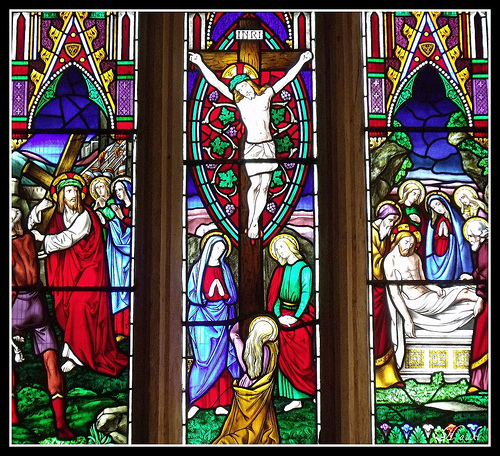
We need more stained glass windows…


Stained Glass Window
by Hauki-

“We will use these stones to build a memorial. In the future, your children will ask, ‘What do these stones mean to you?’ Then you can tell them…” ~ Joshua 4:6-7a NLT

Where is the art?
Stained glass windows were used to communicate basic bible stories to a largely illiterate world. Part of this was an extreme case of the Bible being in a language people didn’t understand. To communicate the stories from the Bible, the church used art. The buildings, decor, everything was to communicate and teach something about God, to inspire worship. For better or worse, we’ve lost the sense of art in many churches.

Theology in Art
God frequently used artistic expression as a tool to both remember and pass on who He is. Think about this, how abstract is a pile of stones in a middle of a river? The picture itself has to be explained. Think of the passover where God uses taste to communicate bitterness- the bitter herbs. Intertwined through the Old Testament God placed artistic expression to generate conversation. Some expressions were very abstract, others very understandable, they all were intended to generate conversation and engage people in theology- understanding who God is.

Generate why….
We need awe. We need environments and opportunities that get kids and adults to ask why, to dream. There is a broader context to following Christ. Our walk of faith is not an island unto itself. God showed Himself to be the one true God. If the church is truly one body, then our story and the stories of others in history connect. Theology is not a vacuüm, its communicated and lived out in history, in life. Art understands this language, as God created that rainbow of grammar and syntax. We need more stained glass windows…

Questions:
If all the words in your ministry environments disappeared, what does it communicate about God and who you are?

What have you done to help people see what God has done through the history of your church or ministry?

Do kids in your ministry start asking questions and talking about God because of what surrounds them?

Methods and Content and Needs (oh, my!)

There is a tension between methods, content, and needs. With tensions we often pit one against each other, or take the “both/and” approach. This pours into another tendency; using nebulous terms such as balance, equilibrium or compromise. Everyone defines balance differently. We love to prioritize, especially if we’re analytical types, or just make bigger messes, if we’re mystical ministry as art types. How do we navigate these big three things?

The big three defined
What do I mean by methods and content and needs? Here are some definitions with examples of how they look when taken to an extreme:

Methods: What we do.
On steroids? Over emphasis on the non-biblical.. aka maximizing leadership, synergistic program developments, the latest greatest book based on statistical analysis.

Content: Who we are, theology.
On steroids? Over emphasis on the biblical… aka comatose preachy preaching, Word studies from languages we don’t speak, dead orthodoxy.

Needs: Where people around us are at.
On Steroids? Over emphasis on doing… aka the social Gospel, building self-help groupies, incredible families enterprises, political action.

What we need is balance right? In a word, no. Equilibrium? Not so much. Both/and? Sigh. These concepts often get people thinking in terms of 50/50 or compromise. I believe God cares about all three.

Think organic
The body is an incredible organic analogy. No one thinks to prioritize the heart, lungs or brain. Without each of these things you’re quite dead, and perhaps this is why many ministries are dying. We think in terms of health. We seek to sharpen our minds, and build a strong cardiovascular system. These are both keys to a long healthy life.

How the disciples succeeded
In Acts 6 the church was not healthy in an area. Hellenistic widows were being overlooked (need). The old program was not working and a new one was needed (methods). The Apostles recognized that focusing their energy on that problem would take away from what was essential, God’s Word and prayer (content). These things could have been in tension, but they weren’t. Rather the situation called for radical change, an opportunity to live out the Gospel and repentance, and a chance to reaffirm who we are. The church moved forward and God’s power was unleashed.

Where the disciples learned success
WWJD? Luke tells another story. 5,000 men were hungry and in need of food (need). The disciples thought the best idea was to send them away: there wasn’t enough food or enough money to feed everyone (program). Jesus was not about to stop what was essential, His teaching (content). Did  the disciples pass this test? No. But, they learned and God’s power was evident. (When we lack in an area, God will provide.)

The lesson
The disciples learned from failure that ministry is about health. Methods, content, and needs must have an intentional active focus. They did not sacrifice one area to bolster another. They brought up the weaker area through the power of God, while continuing the other essential areas. They changed when needed, tackled opportunities when they arrived, and kept their message front and center.

The bottom line
Think organically. The overall health of your ministry is related to the health of the three areas discussed. Ask: How is your health?

Methods:
Are in you a rut or open to radical change?
How well are you leading?
What steps of change or improvement have you taken lately?

Content:
How well do you know and understand God?
Are you still a student to the Bible & Theology?
What was the last theological topic you’ve studied lately?

Needs:
Do you know where your people are at?
When was the last time you studied your community to see how you can best serve?
How has your ministry demonstrated compassion?

Relevant!

Relevant, defined by the Oxford American Dictionary, means closely connected or appropriate to the matter at hand. If there is ever a battle in any ministry, it is relevancy! The key issue is that to be relevant means to change to match or be appropriate to the matter at hand. You cannot remain relevant and have no change. To keep relevant is to keep changing. Experiences in my life often get me to ponder what exactly the battle for relevancy is.

The battle of relevancy is keeping our mission as the driving force of our ministry.
What too often happens in ministry is that program drives the ministry and not the mission. (For those who like things defined, a program is simply what we do. To have no program is a program in and of itself.) Both the refusal to change (stubbornness) or the fear of being irrelevant (restlessness) are examples of the program driving the ministry. Change for change’s sake is not relevancy any more than maintaining traditions is faithfulness. In both cases the driving force is not the mission.

Relevancy is faithfulness to the mission!
As situations, opportunities, or just plain life occur, so will the need for change. The question that should drive change is: Are we fulfilling our mission to the fullest of our ability?  If the mission is what drives the ministry there will be times when a good program must go for a better one. If the mission is what drives the ministry there will be times when everyone else is changing, but we must maintain what we are doing. In the battle of relevancy, we rejoice when the answer is to keep doing what we are doing, and we roll up our sleeves with eagerness when the answer is a call to change. Faithfulness to our mission is demonstrated when we constantly live out our mission in our ministry. Relevancy is lost when the goal is relevancy or when change never happens. In both cases the program drives the ministry: ‘We gotta keep current.’ ‘If it was good enough for Paul.’ Both are ill. But when God gives us a mission, life happens. We ask for the mountains to conquer. And if we see a more effective way of doing things, we celebrate what God did with the former, and we act in faith with the new changes ahead.

Halls of Fame…
The real tradition of a church is God’s Word, and the specific mission that God has called a particular church too. Programs will change if a church is relevant. But, what God’s Word teaches, and the mission God calls a church to should not. It is very easy to begin equating our programs with or as theology. Such is false. Programs serve the the function of living out what God’s Word says and what the church’s mission is. As the meaning of God’s Word is specific, the application is often broad. As we better understand God by studying His Word (theology), it should be readily apparent the need to change ourselves and our churches to match up with who Christ is (application). Churches must never become ‘museums.’ In our communities churches must become ‘halls of fame’ of God’s Grace. For in times past, today and in the future, the church must proclaim the immeasurable greatness of who God is. They must inspire anew those who are seeking to become like Christ while eagerly expecting His return. Halls of fame celebrate and respect the past, while at the same time inspire and build anticipation of what is to come. And, while the actual game changes very little (all analogies break down at some point) how new generations of players engage in the ‘game’ keep it fresh, alive and exciting. God’s Word never changes, nor our mission. But, with a never changing foundation begs the question: What’s next?