Tag: Theology Proper

If you were God…

…How would you make yourself known? Would you even bother? Which would you chose?

Creation: Make a perfect paradise for all to enjoy!
(+) There are no struggles. It’s perfect. As God, you get to walk among the world without getting mad or frustrated at imperfection.

(-) People will reject you made it or will choose to focus on creation and not you.

Miracles:  Supernatural events that go against your created laws of science.
(+) There is clear demonstration of your power that also demonstrates your compassion for people.

(-) People will say ya right, attribute them to something else, or deny it happened all together. Those who benefited or appreciate the act done will soon forget it and move on, things getting back to normal.

Mass-disaster: This can take on a few forms, but it results in massive destruction and death.
(+)This approach clearly demonstrates your power, builds fear and in some ways, like the flood, cleans out most of the problem people. It satisfies your justice.

(-) Long term the reason behind the disaster is forgotten. Short term people will adjust out of fear or will just get mad and more offensive toward you. Injustice remains.

Chosen people: Choose a specific group of people to declare and prove your existence.
(+) There is a constant and tangible revelation of your existence. There is also a model of how you would like people to interact and live among each other.

(-) Your chosen people can become arrogant and/or stop doing what you ask of them. Eventually, people may grow tired of you all together. Your chosen people may not be capable of following your instructions anyway.

A special object: Create or decree a special object as pointing to your existence.
(+) There is a visible and verifiable object pointing to your existence that is more tangible than mere creation. It can become a focal point for people to come together in community.

(-) People will end up worshiping the object instead. Others will try to get the object and use it for their own purposed. Some will get tired of the routine and begin to ignore the object all together.

Become a man: Add to yourself humanity so you can live and interact among people.
(+) You demonstrate humility, a virtue you most admire. You can better claim empathy and sympathy for the plight of your creation. You are able to model and teach in a way no one else can, cutting out the “middle man.”

(-) Plato’s Republic said that if a perfectly just man existed, we’d kill him. Likely those who are in error will become jealous. People may just refer to you as a good guy or teacher. Other will accuse you of being divisive. Oh, and you have to walk among unholy imperfection.

A Book: Have people record who you are in a book by telling them what to write.
(+) Words transcend time. They cannot be completely blocked or stopped. It can act as a guide to how people should live, declare who your are, and give your perspective. After all, words and ideas started massive movements in human history.

(-) People will ignore it or say it is not accurate. Others will abuse it for their own purposes. Even if you divinely keep its accuracy, people will charge that since it was written by man it’s not 100% accurate, or since its details cannot be verified, it will be relegated as myth or primitive. Many will take what you say out of context.

The bottom line:
Place yourself in God’s shoes for a moment. You can choose to reject there even is a God. You can choose to reject absolute truth (doesn’t work in math). You can even chose to not bother to make yourself know. But… If you chose to make yourself know, how would you do it? Do you think it would work?

Maybe God isn’t the problem. God did all the things and people in history to now took the negative of each point… no matter how clear or vague the chosen route is.

Book review: No One Like Him by John S. Feinberg

Defined systematic theology as that branch of theology which studies the whole of Scripture and presents the results on the basis of logical connection, detailing what the scriptures mean in our contemporary context. This is the greatest strength of Feinberg’s work on the Doctrine of God. This doctrine has been brushed over in my life and “No One Like Him” is the first serious discourse I have read about the Doctrine. It raises the question of why this doctrine is often taken for granted.

The question being asked
Feinberg’s task in the book is to give a constructive overview (understated) of who God is, in terms of our contemporary culture. Constructive and contemporary are key elements in the book as Feinberg takes on a unique approach. Instead  of a flat-out rejection of any theological system that contradicts itself or his own system, Feinberg looks at what the issues of such systems are. Within process theology or the open view of God, the driving force, driven by contemporary culture, is a highly relational God. Feinberg brings out the value of such false systems, and then clarifies how a refined conservative approach fits the needs of contemporary culture. God is King, but He is the God who cares. While not purposely bringing a balance of two conflicting views, in each section Feinberg seeks to answer properly the questions being raised. This approach leads to a logical approach within the book.

Book Size
Oddly, another strength of the book is its size. One reading is not adequate to review this book as its flow of thought builds a solid argument for God. While the spirit of communication is to state one’s point as briefly as possible, making a case for a God who cares and is King is not something that can be done in a theological journal or a Two hundred page, easy read. In a contemporary culture where people generalize, the need to give ‘exhaustive’ coverage is critical in developing a subject, especially in dealing with a infinite person such as God.

The main Point
The conclusion Fienberg reaches is one of both/and. God is king, and God cares. The conclusion, while the answer for contemporary society, does not fit with how society thinks today. It is today’s culture which polarizes issues, not seeing how they fit together as a whole, resulting in the growing popularity of process theology. God as sovereign and man as a free agent seem incompatible, unless one thinks in a both/and mindset. Great comfort comes from knowing that one need only to prove the possibility of something, not the logical necessity of something. Classical thought, while solid, is a system derived by men with inherent problems.

The bottom line
After reading this book, it begs the question of why there is not a class dealing with God exclusively. It seems that since the concept of God is so immense. As Christians we gloss over the topic and move onto more tangible things, like Christology. Perhaps it is this avoidance of focusing on God that is the root of church decline in North America. In listening to the testimonies of those brothers and sisters undergoing persecution, it would seem that they have a better grasp of who God is than we do. A solid look at God would do us all good, as there truly is no one like Him.

Book Review: Crazy Love by Francis Chan

Crazy Love goes on my must read list! The book draws out things that we easily forget, like the transforming reality of God in our life. The interplay between church, theology, and living is hard to navigate. Crazy Love brings these elements together,

What if…
‘What if’ jumps out of this book. The question Francis Chan asked that has my mind spinning is this: What if churches were more known for giving and not taking? This question, and others like it, call for a radical approach to how we live for Christ. One chapter of the book just gives story after story of people living based on God’s crazy love for them. It really is not a fluff book.

Guilt by love
Crazy Love challenges you on the love front. Many people cringe at hell, fire and brimstone (HFB) sermons, saying they’re tired of feeling guilty all the time. Others criticize for ignoring the gruesome aspect of eternity. Crazy Love has the potential to produce more guilt or conviction then any HFB sermon I ever heard. It is the book equivalent of a loving mother looking you in the eye and saying: “I love you, but I’m disappointed.

Tone
Francis Chan writes with the art of a surgeon. He is very careful to say clearly what needs to say, while also attempting to hold back negative emotions that can get one sidetracked. Chan’s book refreshes you in how he specifically speaks against church bashing. He is right in asserting that what we truly love and are convicted about produces the most solid change. His tone focuses on process not perfection, pursuit, not purity. Perfection and purity will come because of what Christ did. The tone of this books would be one many writes should absorb.

Bottom line:
This review is brief for one reason: I don’t want to give anything away, you need to listen and engage yourself! The book will challenge your faith. Some may feel guilty at first from reading it, but it gives you a clear and balanced approach of how God’s love should impact us. For others, this book will reignite you passion to go all out for God.

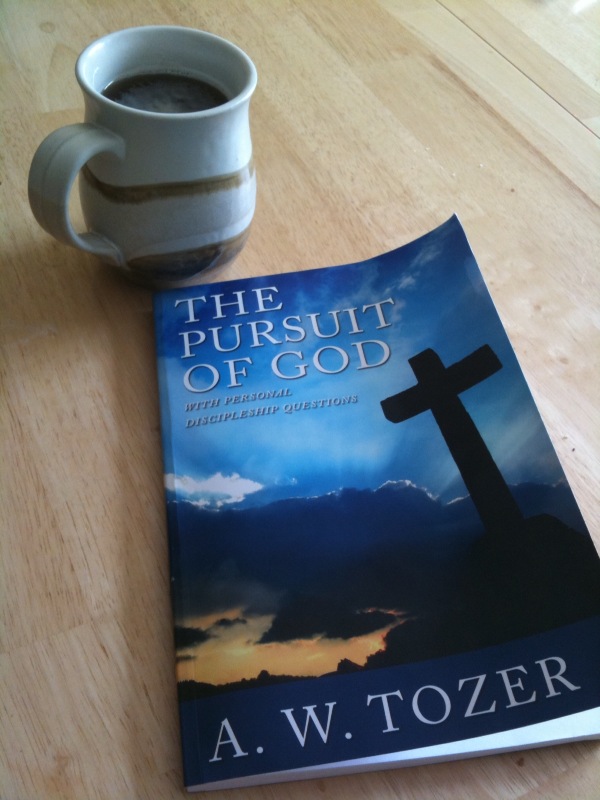
Book Review: The Pursuit of God by A.W. Tozer

Tozer’s book is incredibly technical and mysterious at the same time. He pushes you, hard, and asks very pointed questions about your belief in who God is. Often theology proper (the study of God Himself) is glossed over and assumed. Tozer implies throughout the book that maybe it should be first among the theologies.

God Speaks
The big thing that stands out is how God actively wants to communicate today, just as much as in times past. The very fact that God gave us the Bible speaks volumes on how God wants to actively pursue and interact with people. God is not a set it and forget it person. God speaks actively today as He did in times past. This includes authorial intent, what God spoke and meant then is what He is saying to us today.

“The Bible will never be a living book to us until we are convinced that God is articulate in his universe…I think a new world will arise out of the religious mists when we approach our Bible with the idea that it is not only a book which was once spoken, but a book which is now speaking.” (p. 71-72, Italics author’s emphasis)

More than Saved
We forget God the father. The book brings out something we too easily forget, lose, or never attained. God gave salvation as a means to pursue Him, not as a ‘get out of jail free card.’ The danger of viewing the Bible or Christianity as a psychological self-help community, or merely as a redemptive story is that both neglect the key to the Bible, to faith, to life, and that is a personal God. Jesus will and purpose was the will of the Father. We must get back to that.

Format
Tozer is hard to read. He writes in a way that we do not speak or think like today. This makes getting through the book a little difficult. It’s like reading someone’s journal. He is very humble and very pointed, but it is a chore to get through the book. I say this to be aware of it, not as a criticism. I wish I read this book long ago.

Tozer ends each chapter with what is a lost art in churches today- written prayers. His prayer for himself and those who read the book create a significant impact. One can develop a solid prayer life from the end of each chapter. We often view prayer as only genuine and heartfelt if it is spontaneous. A book of prayers may be helpful and a great resource for today. Each generation must speak to God. Being formal is just as genuine and heartfelt as being spontaneous.

Bottom line:
The Pursuit of God is on my “Must Read List.” It brings into balance that Christianity and the Bile is about God wanting and being known, and everything else is subservient to that foundational principle.