Tag: leadership

Are you special?

I soaked in two ‘articles’ about being a specialist. In the first article, the end of 60 Minutes raised the question about the lack of family doctors compared with specialists. In the second article, D.A. Carson wrote on the trials of biblical studies. He raised the issue of theological scholars being too specialized and neglecting their study of other fields. The problem is not specializing but the loss of understanding the whole.

Look beyond
Often the ideas and solutions needed for your field are not found in your field. My dad made sure that I did not get ‘stuck’ in one thing. He wanted me to have a very broad and vast array of experiences to pull and learn from. This developed into a strong desire for learning and the ability to look at a problem from a variety of vantage points.

Read elsewhere
When interviewing various leaders in children’s ministry I asked what books on children’s ministry they recommend. They had recommendations, but without fail they all said the best ideas and books were not children’s ministry books. Read widely and read broadly. One conference a speaker suggested not reading everything in your field. Few books pass the test of time. Read those kinds of books.

Life is complex
The problem is not people specializing. Our culture and the vast sharing of information pushes that to happen. There are advantages to being a specialist. But, with every advantage there is often a disadvantage. The culture turned into multiple fragments. Life is a complex whole. Just think of all the news stories about unintended consequences from a solution implemented. Are we lost in the details as a culture?

Jack of all trades
We need Jack! We need people who have a broad understanding across multiple fields. They may be masters of none, but they have an understanding of the bigger picture. In thinking through the two articles and other past experiences, I agree we need more generalists, more “family doctors.” They may not be the best at fixing a particular part, but they help us avoid negative and unintended consequences from being too focused. They help us appreciate the forest and the broader work of art known as life.
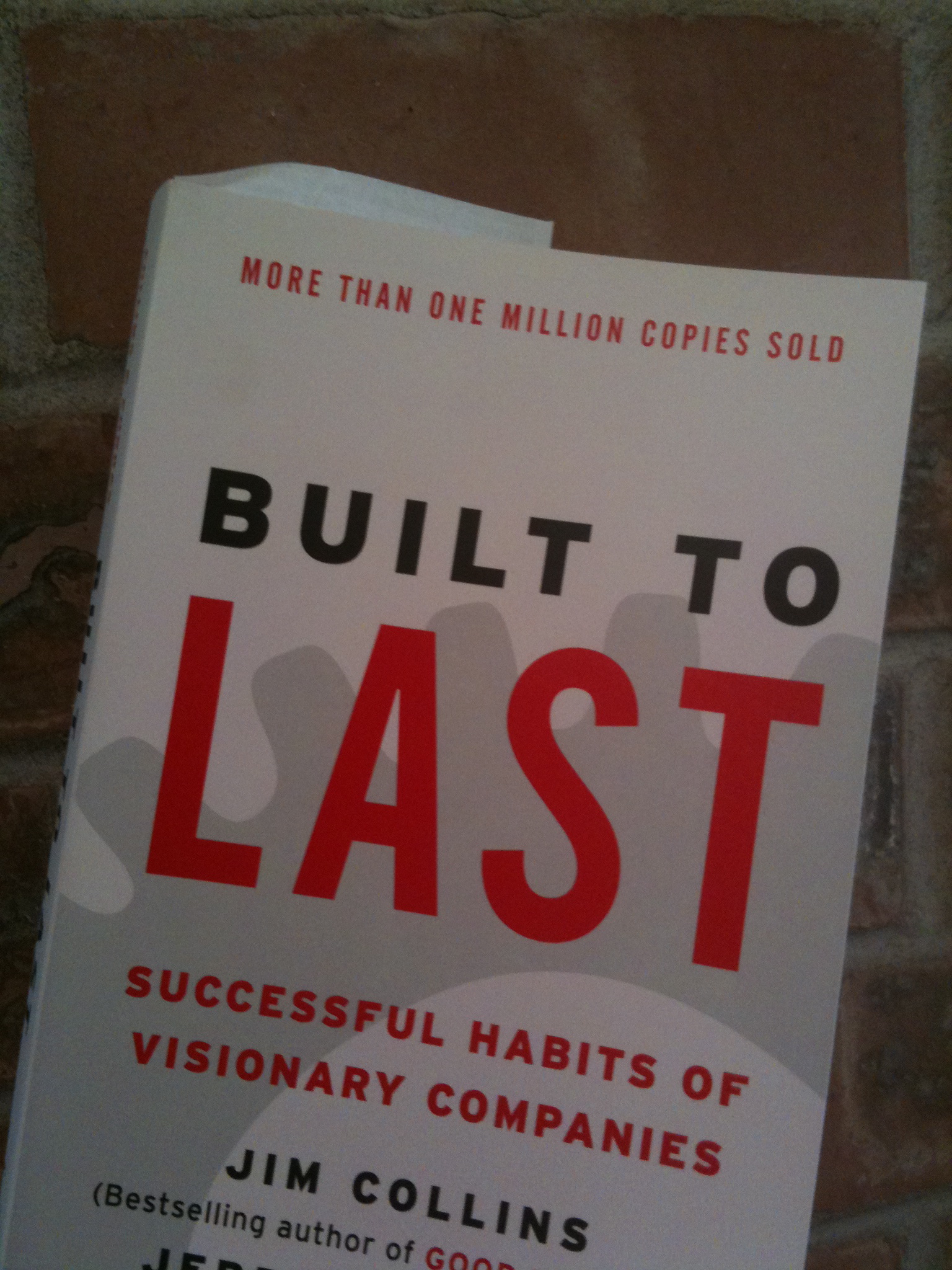
Book Review: Built to Last by Jim Collins & Jerry I. Porras

If you are involved in building and managing an organization, the single most important point to take away from this book is the critical importance of creating tangible mechanisms aligned to preserve the core and stimulate progress. This is the essence of clock building. ~ P. 89

A pastor friend highly recommended I read ‘Built to Last.’ I would echo that sentiment. The quotation above really encapsulates the book. To put it in other words, the book is more concerned about who you are as apposed to what you do. The visionary companies described in their book were more about who they were- their core ideology- then the products produced. Their great products were a result of their core ideology in action.

Building the core
The purpose and values of an organization is what is most essential and non-changing. It is the preservation of this core ideology that drives leadership development, products, adaptations, consistency and culture of visionary companies. These companies have transitioned through multiple CEO’s, economies, products, and culture shifts. Core ideology is the center of visionary companies, not profit nor product. The company itself is the greatest achievement. Preserving the core allows freedom to and opportunity to explore what the company can do.

Vision?
The greatest shock in reading the book was the un-central role vision played. Many of the leaders were not charismatic visionary leaders, though some were. In reading through the book everything went back to who the company was at its core. Growth of these companies normally occurred in one of two ways, BHAG’s or trying a lot things and keeping what sticks. The paperback version, which I read, had a chapter about vision, but this chapter still pointed back to the core ideology. Surprising fact from this book: can you build a dynamic organization without a vision? Yes. Without a core ideology? No. The book does not negate vision, but vision is certainly not the driving force, as the book almost arguing against it being the driving force.

Ministry value
The greatest ministry value from this book is to focus more on who you are and want to be rather than what you do. Values are discovered, rather than imposed, and a culture is developed rather then chosen. Attention should be given to the theology of what a church should be more than its actions. What a ministry does will have a greater impact if it is from its ideological center. As with any book, discernment should be used. The church is an organism not an organization.

A big key to the success of these companies was the preservation of its core ideology, particularly through multiple CEO’s. This is an element many churches struggle with. I have heard of too many stories of ministries declining after a successful tenure of a key leader. The draws attention to a much broader discussion.

The book
The book read ok and the stories were excellent. It did feel very choppy to me. The book is a report on a study and it felt like a report on a study. Things they pointed out were very well done, but the book could have been considerably shorter and communicated the same thing. While a worthwhile read, it was not the most enjoyable to read.

Bottom lines
Focus on living out and preserving the ideological core of the organization you’re in.
Focus on developing the culture and leadership of the organization you’re in.

Methods and Content and Needs (oh, my!)

There is a tension between methods, content, and needs. With tensions we often pit one against each other, or take the “both/and” approach. This pours into another tendency; using nebulous terms such as balance, equilibrium or compromise. Everyone defines balance differently. We love to prioritize, especially if we’re analytical types, or just make bigger messes, if we’re mystical ministry as art types. How do we navigate these big three things?

The big three defined
What do I mean by methods and content and needs? Here are some definitions with examples of how they look when taken to an extreme:

Methods: What we do.
On steroids? Over emphasis on the non-biblical.. aka maximizing leadership, synergistic program developments, the latest greatest book based on statistical analysis.

Content: Who we are, theology.
On steroids? Over emphasis on the biblical… aka comatose preachy preaching, Word studies from languages we don’t speak, dead orthodoxy.

Needs: Where people around us are at.
On Steroids? Over emphasis on doing… aka the social Gospel, building self-help groupies, incredible families enterprises, political action.

What we need is balance right? In a word, no. Equilibrium? Not so much. Both/and? Sigh. These concepts often get people thinking in terms of 50/50 or compromise. I believe God cares about all three.

Think organic
The body is an incredible organic analogy. No one thinks to prioritize the heart, lungs or brain. Without each of these things you’re quite dead, and perhaps this is why many ministries are dying. We think in terms of health. We seek to sharpen our minds, and build a strong cardiovascular system. These are both keys to a long healthy life.

How the disciples succeeded
In Acts 6 the church was not healthy in an area. Hellenistic widows were being overlooked (need). The old program was not working and a new one was needed (methods). The Apostles recognized that focusing their energy on that problem would take away from what was essential, God’s Word and prayer (content). These things could have been in tension, but they weren’t. Rather the situation called for radical change, an opportunity to live out the Gospel and repentance, and a chance to reaffirm who we are. The church moved forward and God’s power was unleashed.

Where the disciples learned success
WWJD? Luke tells another story. 5,000 men were hungry and in need of food (need). The disciples thought the best idea was to send them away: there wasn’t enough food or enough money to feed everyone (program). Jesus was not about to stop what was essential, His teaching (content). Did  the disciples pass this test? No. But, they learned and God’s power was evident. (When we lack in an area, God will provide.)

The lesson
The disciples learned from failure that ministry is about health. Methods, content, and needs must have an intentional active focus. They did not sacrifice one area to bolster another. They brought up the weaker area through the power of God, while continuing the other essential areas. They changed when needed, tackled opportunities when they arrived, and kept their message front and center.

The bottom line
Think organically. The overall health of your ministry is related to the health of the three areas discussed. Ask: How is your health?

Methods:
Are in you a rut or open to radical change?
How well are you leading?
What steps of change or improvement have you taken lately?

Content:
How well do you know and understand God?
Are you still a student to the Bible & Theology?
What was the last theological topic you’ve studied lately?

Needs:
Do you know where your people are at?
When was the last time you studied your community to see how you can best serve?
How has your ministry demonstrated compassion?