
Tag: God

Dream: Mr. Sandman…

God is the Sandman, the author and artist of a masterpiece that is you. Dreams are not fairy tales, events, or possessions. Dreams are reflections of God’s glory in and from your life.

“The Lord God formed man of dust from the ground…The Lord God fashioned into a women the rib which He had taken from the man…”
~ Genesis 2:7 & 22

“God created man in His own image, in the image of God He created them male and female He created them. God blessed them and said, ‘Be fruitful and multiply…’”
~ Genesis 1:27-28a

The God who fills things
We believe in the God who fills things. God filled creation, He filled the temple, He filled our days and He fills our very being. God is a designer, an artist, a musician, God is a dreamer. He thrives and exists in community. God is as poetic as He is just. The very concept of dream is rooted in the purposeful creation of you… ‘that you may be filled up to all the fullness of God.’

God as creator
The order of creation mirrors and exhibits God’s desire to fill things. Days 1 through 3 God creates the space and then fills it days 4 through 6. Upon His good creation God placed the crown jewel: mankind. From the sand God made us, purposefully, artistically, in community. Mankind was not a blank slate of random chance, God made mankind the visible finite image of the infinite God. He blessed the human race. And God commanded mankind to fill the Earth.

Time to dream
Starting on Day 7 of Creation, God creates the Sabbath. Sabbath, meaning 7th day, also caries the concept of rest. It was time to stop and smell the roses. It was a time to reflect. It was a time to rest. Later in Exodus, Leviticus and Deuteronomy God institutes feasts where His people could celebrate, learn, reflect, teach, and ultimately enjoy Him. The Sabbath and celebrations focuses on one key thing: to remember God. In remembering God, He reminds us of who He wants us to be.

God is the Sandman
The danger of not dreaming is forgetting God. Lack of dreams is not a loss of purpose, a depletion of vision, an absence innovation, busyness or exhaustion. A lack of dream or dreams is forgetting who artistically sculpted you from dust. God forged dreams in the purpose for your life, for you carry His image. And, once in Christ, that purpose, that dream becomes crystal clear. You are not a mistake. God made you. He gave you a dream.

The Bottom Line:
Even with the confusion of life, we must remember God. A dream answers this question: How is my life to glorify God? How is my life to reflect who God is because I carry His image? Whether you naturally dream, are in limbo, are busy, are apathetic, or life has you exhausted, reflect on this thought:

For we are His workmanship, created in Christ Jesus for good works, which God prepared beforehand so that we would walk in them. ~ Ephesians 2:10

God not so angry in the OT: The Law

Jesus summed up the Torah in two statements: Love God, Love people… I took the time to read Leviticus and Deuteronomy back to back… The theme? Love God, Love people.

Thinking on Jesus fulfilling the law
One aspect of Jesus fulfilling the law the law we often miss is Love God, Love people. Seriously. Jesus made it his mission to point people to God the Father, not himself. Jesus paid the ultimate sacrifice so we might, through him, have a relationship with God and better relationships with each other. Love God, Love people. The law is more that the 600+ commands. It boils down to the big 2….

Write your own law
Write or think through your own law… What are the non-negotiables? What are the annoyances? What are the paths of reconciliation? What are the deal-breakers? How do you show and actively help the dis-advantaged? How do you show hospitality? While we may gawk and the huge 600+ some odd commands, the number doesn’t seem so huge when you start adding up your own decrees. Now that you have your own law written down, who does it serve: you or others?

Absolute perfection and absolute holiness
The law points to the necessity of Christ and the reality of what God being holy means. For example: I have an eye defect at birth. Based on this one defect, if I were a Levite, I would not be permitted to sacrifice. My youngest son has eczema, he would not be able to sacrifice either. God did not want any imperfection in His presence. With that in view, how significant is Jesus touching and healing the lame, blind, lepers, and prostitutes? Jesus fulfilled the absolutes and provided for the imperfects like you and I!

The bottom line:
I think we misunderstand God in the Old Testament. In looking at the 600+ commands, it made provision for the disadvantage, for mistakes, and for evil. It deals much with human conflict and depravity. Perhaps it is not so much that God is vindictive as it is people are depraved and do not want to repent. Take a look at your own “law.” Who does it serve, yourself, or focus on others? God rooted the Law in His nature  and the service of others. Love God, Love people.

Provision through perseverance

Often people state one’s need to enter the desert before God uses them. Others put it as God needing to break someone before using them. After reading through Proverbs 1-5, I wonder if we have it backwards. What if the desert is God’s provision?

Wisdom as an active pursuit
Proverbs chapter 1 details how we should actively pursue wisdom. It states how the fear of the Lord is the beginning of knowledge. Proverbs also contrasts the destructive end of foolishness and the emptiness of naïvety. The last statement brings out the biggest issue: “But he who listens to me shall live securely and will be at ease from the dread of evil.” Thus begins the perseverance resulting in provision pattern.

Perseverance results in provision
The formula of Proverbs states if you actively pursue wisdom, it will give you life. For example:

Perseverance
Proverbs 3:1- “My son, do not forget my teaching, but let your heart keep my commandments.”

Provision
Proverbs 3:2- “For length of days and years of life and peace they will add to you.

Wisdom takes perseverance to posses. It is more an act than a possession. Wisdom does not come by chance. Wisdom is not absorbed. One must pursue it and live it. Keep wisdom through the challenges of life, and it become yours. It takes listening, pondering, treasuring, and keeping wisdom to get it. Wisdom is forged and realized through hardship.

Fear God
Both wisdom and knowledge start with the fear of the Lord. It is here that we come to the desert. In reading through the persevering for wisdom followed by provision, it makes sense that God would use the desert. Desert moments bring clarity of thought, aptness to listen, and they confront our finite mortality.

While the desert is a life and death struggle, it is also fertile ground for transformational growth. Given the statements at the start of Proverbs, my perspective on the desert changed. The purpose of the desert is not God breaking us. The purpose of the desert is God providing for us. At the end of the desert is provision. The most essential provision God gives us through the desert is knowledge of Himself.

The bottom line:

For wisdom, perseverance leads to provision. It is by going through the desert that we obtain life. To avoid this seeming paradox we can be easily taken by naïvety or foolishness. Persevering through the desert provides us the start of life and theology. God is God, and we are not.

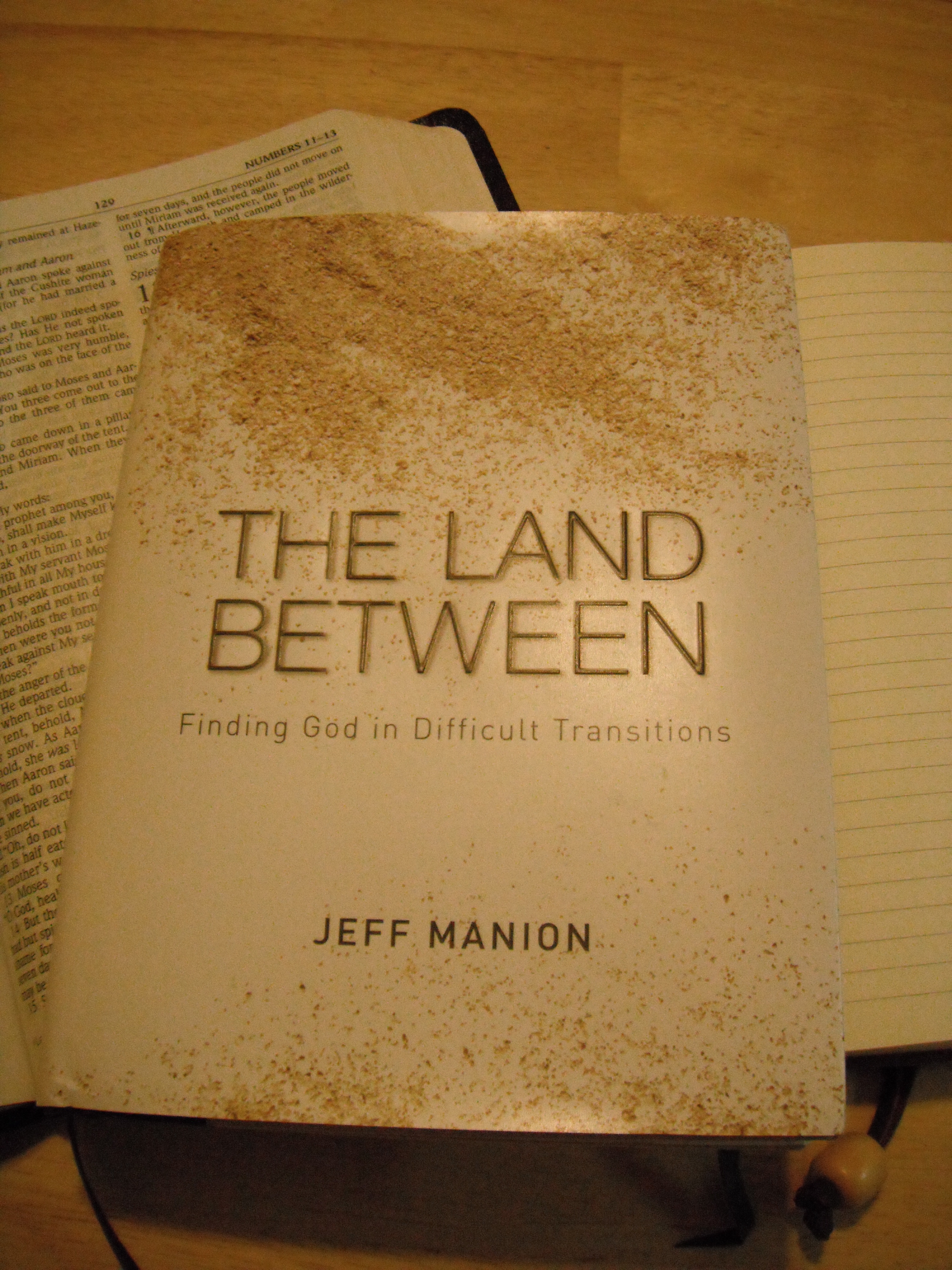
Book Review: The Land Between by Jeff Manion

The Lang BetweenThe sub-title of the book says it all: Finding God in difficult transitions. Jeff Manion is not dealing with a hard day. The Land Between deals with gut wrenching periods of time. This book ranks as a must read. If you are in traveling in the land between, you’re crazy to ignore what Jeff is communicating. Strong words but true, and coming from a guy in such a transition.

The premise
Using Israel’s trek from Egypt to the promise land, Jeff uses lessons from Israel to help guide us in our own land between. The book handles the Bible passages with excellence. Often the Old Testament is moralized and man centered. Jeff brings out what these passages are really about: God at work preparing and refining His people. He describes God as the hero; not just for Israel but you and I as well. Throughout the book the choice is clear between trusting in God and the pit of complaining & bitterness.

Serious stories
Jeff’s places stories a the right spots like an expert chef using spices. They are brief, real, and at times very raw. (Challenging transitions are like that.) While at times he gives the result, there are times where he does not. Jeff’s own land between ends in blessings. In difficult periods, we need to remember that God does get us through. The stories shared bring reality to light. (Like wondering when the transition will be over.) He clearly articulates the dirty reality of hard times.

The book
The book reads easily and conversationally. I appreciate how the book handles Bible texts well, while not academic in their explanation. That skill is hard to find. The book is applicable in the sense of our relationship with God; the choices we are faced with, the emotions that will boil in us (they will boil) and the intimate involvement of God throughout. Jeff took roughly 200 pages would could be volumes. The Land Between is the perfect size, depth and readability for his intended audience; those of us in the land between.

The bottom line:
The last thing we want to hear is another book we should read when in difficult transitions. This is a book we should read. Why? 1) Israel made costly mistakes that can be avoided. 2) We need to remember that God is not merely with us, He is intimately at work in us. 3) It is not a lassie tale of hard times turned good. The Land Between lays out the road map for our hard journey. More than the insane details of our challenges, we must embrace God. The feeling I got after reading The Land Between was calm resolve. Not the emotion I expected.

There are not many books I’ve read were I have a wish to thank the author in person. Jeff, thank you for you for the map of the desert!

God to us: Where were you when…

Job 38 is a good reminder that God is God and we are not. While it is ok to get mad at God, question Him, or even doubt, in the end we come to this conclusion: God is God and we are not. It is extremely hard to accept “I am God” as the reason for something happening. Even with all his questioning, Job did not sin. In his trial God clearly wanted Job to know that “I am God” more than the reason why.

1 Then the LORD answered Job out of the whirlwind and said, 2 “Who is this that darkens counsel By words without knowledge ? 3 “Now gird up your loins like a man, And I will ask you, and you instruct Me! 4 “Where were you when I laid the foundation of the earth ? Tell Me, if you have understanding, 5 Who set its measurements ? Since you know. Or who stretched the line on it? 6 “On what were its bases sunk ? Or who laid its cornerstone , 7 When the morning stars sang together And all the sons of God shouted for joy ? 8 “Or who enclosed the sea with doors When, bursting forth, it went out from the womb ; 9 When I made a cloud its garment And thick darkness its swaddling band, 10 And I placed boundaries on it And set a bolt and doors, 11 And I said, ‘Thus far you shall come, but no farther ; And here shall your proud waves stop ‘?

12 “Have you ever in your life commanded the morning, And caused the dawn to know its place, 13 That it might take hold of the ends of the earth, And the wicked be shaken out of it? 14 “It is changed like clay under the seal ; And they stand forth like a garment. 15 “From the wicked their light is withheld, And the uplifted arm is broken. 16 “Have you entered into the springs of the sea Or walked in the recesses of the deep ? 17 “Have the gates of death been revealed to you, Or have you seen the gates of deep darkness ? 18 “Have you understood the expanse of the earth ? Tell Me, if you know all this. 19 “Where is the way to the dwelling of light ? And darkness, where is its place, 20 That you may take it to its territory And that you may discern the paths to its home ? 21 “You know, for you were born then, And the number of your days is great ! 22 “Have you entered the storehouses of the snow, Or have you seen the storehouses of the hail, 23 Which I have reserved for the time of distress, For the day of war and battle ? 24 “Where is the way that the light is divided, Or the east wind scattered on the earth ? 25 “Who has cleft a channel for the flood, Or a way for the thunderbolt , 26 To bring rain on a land without people, On a desert without a man in it, 27 To satisfy the waste and desolate land And to make the seeds of grass to sprout ? 28 “Has the rain a father ? Or who has begotten the drops of dew ? 29 “From whose womb has come the ice ? And the frost of heaven, who has given it birth ? 30 “Water becomes hard like stone, And the surface of the deep is imprisoned. 31 “Can you bind the chains of the Pleiades, Or loose the cords of Orion ? 32 “Can you lead forth a constellation in its season, And guide the Bear with her satellites ? 33 “Do you know the ordinances of the heavens, Or fix their rule over the earth ? 34 “Can you lift up your voice to the clouds, So that an abundance of water will cover you? 35 “Can you send forth lightnings that they may go And say to you, ‘Here we are’? 36 “Who has put wisdom in the innermost being Or given understanding to the mind ? 37 “Who can count the clouds by wisdom, Or tip the water jars of the heavens, 38 When the dust hardens into a mass And the clods stick together ? 39 “Can you hunt the prey for the lion, Or satisfy the appetite of the young lions, 40 When they crouch in their dens And lie in wait in their lair ? 41 “Who prepares for the raven its nourishment When its young cry to God And wander about without food ?

The bottom line:
Are we ok with God being God? Can we accept that?

Faith is not the absence of doubt

At BBC there is the all holy seminary reading room. It’s a humorous title, it’s just the seminary room. One day we were brought into this room. I do not remember which professor it was, but I do remember the warning:

“Many of the books in this room were written by men who knew more about the Bible then some of you ever will, but they missed the point.”

It perplexed me that many of the Bible study tools we have today were built on the work of those ho actually doubted the Bible or doubted inspiration and inerrancy. How can doubt produce coldness to God in once sense, and bring others closer? I don’t know, and hence I’m perplexed.

I do not think scholarship, reason or doubt is the enemy. I do not think giving up these things in the name of faith, pragmatism or focusing on what is most important is biblical. Let me give an analogy for each:

Faith: We sit in many chairs without seeing them first verifying they will hold us up. I say that as I sat in my kitchen chair one day and it collapsed underneath me.

Pragmatism: There is nothing pragmatic about romance. ‘Nuff said.

The biggest thing: Coffee brings me great joy in life, but it’s not the meaning of life. (Though, enjoying it does help ponder the larger things in life.)

Often in churches we get very nervous when someone questions or doubts. We get more nervous when someone declares their doubts. In our quest for Christ likeness, do we forget Thomas- one of the foundation stones to the church. Saul was a doubter. The Roman centurion was not. Is one better than the other? I think not.

The Bible has stories of doubters. I do not think doubt is the enemy of faith, but squelching doubt is. The trial by fire for each human is different. For some it will be life circumstance, others pride, addictions to some and some it will be doubt. People will succeed or fail in these challenges.

Truth is truth. If the Bible is fully truth, as I believe and I am convinced of, then in the end truth will prevail. And if we fear those who doubt, or worse question whether they are really saved in the first place, then we poison the situation. The Bible makes it very clear that salvation is solely a work of God and kept by God. The Bible makes very clear that humans will doubt.

Is our faith in God or in people who don’t doubt? Do we believe salvation is by faith or in people who do not sin? How we approach issues can prevent the ability to help or open the door to greater depths of our faith. Which is more important to us and God? Yes, God gets frustrated by doubt. God also gives them an answer in due time. The bigger issue is pursuing God.

The Bottom line:
Squelching doubt is an odd form of denying the power of God. Like any other challenge in life, we should treat doubters with love, patience and respect. Not from  superiority and they are wrong, but a human understanding that each person has their own trial by fire… Let’s be honest, we all at times have doubts. God knows that.

“If we are faithless, He remains faithful, for He cannot deny Himself.” 2 Timothy 2:13

If you were God…

…How would you make yourself known? Would you even bother? Which would you chose?

Creation: Make a perfect paradise for all to enjoy!
(+) There are no struggles. It’s perfect. As God, you get to walk among the world without getting mad or frustrated at imperfection.

(-) People will reject you made it or will choose to focus on creation and not you.

Miracles:  Supernatural events that go against your created laws of science.
(+) There is clear demonstration of your power that also demonstrates your compassion for people.

(-) People will say ya right, attribute them to something else, or deny it happened all together. Those who benefited or appreciate the act done will soon forget it and move on, things getting back to normal.

Mass-disaster: This can take on a few forms, but it results in massive destruction and death.
(+)This approach clearly demonstrates your power, builds fear and in some ways, like the flood, cleans out most of the problem people. It satisfies your justice.

(-) Long term the reason behind the disaster is forgotten. Short term people will adjust out of fear or will just get mad and more offensive toward you. Injustice remains.

Chosen people: Choose a specific group of people to declare and prove your existence.
(+) There is a constant and tangible revelation of your existence. There is also a model of how you would like people to interact and live among each other.

(-) Your chosen people can become arrogant and/or stop doing what you ask of them. Eventually, people may grow tired of you all together. Your chosen people may not be capable of following your instructions anyway.

A special object: Create or decree a special object as pointing to your existence.
(+) There is a visible and verifiable object pointing to your existence that is more tangible than mere creation. It can become a focal point for people to come together in community.

(-) People will end up worshiping the object instead. Others will try to get the object and use it for their own purposed. Some will get tired of the routine and begin to ignore the object all together.

Become a man: Add to yourself humanity so you can live and interact among people.
(+) You demonstrate humility, a virtue you most admire. You can better claim empathy and sympathy for the plight of your creation. You are able to model and teach in a way no one else can, cutting out the “middle man.”

(-) Plato’s Republic said that if a perfectly just man existed, we’d kill him. Likely those who are in error will become jealous. People may just refer to you as a good guy or teacher. Other will accuse you of being divisive. Oh, and you have to walk among unholy imperfection.

A Book: Have people record who you are in a book by telling them what to write.
(+) Words transcend time. They cannot be completely blocked or stopped. It can act as a guide to how people should live, declare who your are, and give your perspective. After all, words and ideas started massive movements in human history.

(-) People will ignore it or say it is not accurate. Others will abuse it for their own purposes. Even if you divinely keep its accuracy, people will charge that since it was written by man it’s not 100% accurate, or since its details cannot be verified, it will be relegated as myth or primitive. Many will take what you say out of context.

The bottom line:
Place yourself in God’s shoes for a moment. You can choose to reject there even is a God. You can choose to reject absolute truth (doesn’t work in math). You can even chose to not bother to make yourself know. But… If you chose to make yourself know, how would you do it? Do you think it would work?

Maybe God isn’t the problem. God did all the things and people in history to now took the negative of each point… no matter how clear or vague the chosen route is.

The bride is not ready yet…

Jesus said the meek shall inherit the Earth. I feel as though we are not always meek, for sure I am not. It seems we are awfully arrogant, more than we would care to admit. This is not bad in the sense of being overwhelming to us. It just means God is not done perfecting us yet. Here are a couple of examples:

Jesus: Whoever is not against you is for you.
I remember sitting in class and the prof started to list out different movements in evangelism, their proponents, and the ensuing criticism. The discussion fascinated me. There wasn’t a linear progression of understanding. It was a cycle we were already repeating. The realization went like this:

“How many of you thought big-ten revivals were a good thing? Uh-huh. And the seeker sensitive movement? Not so many hands this time? In about 150 years evangelism in America came full circle and is now repeating the cycle.” Ouch…

Rather than criticize form we should learn from each other. A large part of a method’s success is its context: both historical and cultural. Granted every method, movement and church carries problems. The problems may be significant, but it doesn’t make them completely wrong nor completely right. We need to listen and discern better.

Paul: Instruct men not to teach strange doctrines…
God really does care about solid doctrine. Paul did not tell Timothy to remove, separate, ignore or burn the men of Ephesus at the stake. Throughout his writings Paul told Timothy to use love and patience, to instruct as a son to a father or a brother to a brother. Said another way, Paul sent a young guy in to help, clean up and correct the church by leveraging humility. Not exactly a quick, authoritarian method to clean up what was a doctrinal mess.

I sense as Christians we speak right past each other. We are great at making straw men and even better and beating them. Confidence of one’s doctrine and humility are not mutually exclusive. The elder professors I had in seminary were very confident in what they taught, but their humility was excessive. They listened and asserted, held firm but still learned with open minds.

One day I purchased a large number book and proceeded to move them to my car. One of the elder professors put his stuff down on the floor and helped me. He taught none of my classes at that point during seminary. I saw and better understood the relationship between confidence, faith and humility when I did have him as a teacher; all based on this event. We need to pursue humility as a path knowing God and truth.

The bottom line:
Other than Christ is it seems the other thing we Christians have in common is our arrogance. We all to easily forget that it is Christ who wills and works in us. It is He who will carry our work until the day of perfection. Christ washes and purifies the bride. In the arrogance we all have in common we can continue to act that way, get overwhelmed, or we can rest in the fact that God isn’t done with us yet. We call can improve in listening, discernment and humility while also laying aside our straw men.

I wonder if we lack peace in what we do because we don’t follows Paul’s instructions if Philippians 4. We are a very anxious people. Yes, there are differences in our churches. But, we can still be thankful and pray for each other. Yes as Christians we disagree on points of doctrine. We can still learn from each other. Christ leveraged humility in leading us, and we should do the same when interacting with each other.

God really is the answer:

Peace, harmony, and righteousness can only happen through submission, forgiveness, and humility at the cost of control, fairness and honor. As humans we crave and fight for control, fairness and honor to get peace, harmony and righteousness. Often this fight is couched in the terms of fairness or equality. God pursues peace, harmony and righteousness through submission, forgiveness, and humility. We demand our rights, God gave them up.

Equal and Distinct
Father, Son and Spirit are co-equal and co-eternal, yet they do not function that way. They are equally God, equally in power, equal in their knowledge, ability: they are God, and they are one. The mystery shouldn’t be all that difficult except for our distaste for one word: Submission.

We hate submission because we crave control. We hate submission because we crave and push for our equality. In various discussions on equality, I wonder how people can push for their equality and at the same time fully claim pursuing Christ? In such a pursuit, one is pursuing a right that Christ did not pursue. Christ submitted.

There can be no harmony without submission. I am not addressing one area, but this concept holds true for marriages, teacher-student relationships, teams, organizations, etc. Our demanding equality often comes at the cost of harmony.

Fair or Grace
Fair is Hell. Life is not fair. We so demand fairness, but it constantly alludes us. Good people can make stupid choices, while evil people succeed. It makes no sense, it is not fair. Viewed another way, was it fair to God for Adam and Eve to eat of the tree? Was it fair for Cain to kill Abel, even after God warned Cain not to? Is it fair to execute a perfectly just man?

We scream at (or ignore) God because being who He is, He allowed unfair things to happen. Some even think God gains some sick pleasure at watching people suffer. Does He? No and in turn gives graces. Grace and mercy are not fair. God would have been perfectly fair in destroying existence after the fall. He didn’t. God did what we value above nearly all virtues, He did not give up. God did not reject people, people reject God. As we demand, so often, fairness from God, we look in the mirror and find we, again so often, are not fair towards Him.

Grace, Mercy and Reconciliation by their very nature are not fair. You and I may wonder why God is taking so long to make things right, we must remember something: In waiting God gave you and I opportunity to reconcile with Him. The only fair thing is for all to suffer. God waits desiring non to suffer. God did what was most unfair: He forgave, He provided a way out by accepting what He most loathes and cannot tolerate.

Two conclusions:
1) It seems to me the total of human History is God proving without Him there is only pain, suffering and chaos.  After all our efforts, we cannot escape our own depravity. Put ourselves in God’s shoes: If we wanted to create something and have a relationship with it, but at the same time wanted to give our creation freedom of choice, would we allow the chance of rejection? If we didn’t, did we truly give freedom of choice? If rejected, what would our actions be? What would the result of our creation be?

2) We want all the goodness of God without the accountability. The greatest ‘crime’ for man to accept God’s existence is the accountability that results from it. For the God of the Bible to exist, there then also exits an external standard we are accountable to. We run from accountability because it destroys another thing we humans desperately crave: control. Ironic that God in creation gave up control and gave us choice.

The Bottom line:
Perhaps the Biblical God is right after all. Humans abuse religion in the name of God, government in the name of justice, and reason in the name of science. We cannot escape that we have a soul, that we are depraved, and that all our progress leaves us in the same plight. We really do want peace, harmony and righteousness. We just love control, fairness and honor more. Interesting Jesus’ words: “He who desires his life shall lose it” and “The meek shall inherit the Earth.”

God is not stupid

I understand the plight to focus on essentials and not have a hostile environment when it comes to theology or the deep questions of life. In these conversations I cannot help but sense an eerie feeling. Do we think God is stupid and or modern man is evolved and enlightened?

Creation:
Instead of creation described poetically, what if God poetically created?

The creation account is written poetically. Days 1-3 God creates spaces and Days 4-6 He fills them. Upon completion God creates rest on the 7th days, and hence our week. The debate over creation vs evolution within Christianity will likely not go away, and should always be congenial. I have to ask, why can’t God poetically create?

While we may not like the way some defend the young Earth view, creationists do show plausibility of a young Earth and catastrophism. Are all discussions sound, bulletproof and complete? No. Neither is evolutionary thinking, which has changed demonstrably since its inception. Early humans maybe naïve, but I don’t think God created humans as intellectually inept. Why do we often view earlier humans as incapable of clear or deep thought? Who is to say that God created in the way He did for no other reason than the discussions about origins today?

Bible:
If an all-etc being, can He not communicate both timelessly, accurately, and use man at the same time?

We act based on what we believe. I wonder if we truly believe God is all-powerful or all-knowing. I mention this because we don’t seem to apply that to the Bible. Why can’t God use fallen man to communicate accurately and sufficiently?

Words and language move people. How many movements start based on an idea? Putting ourselves in God’s shoes, if we wanted to communicate who we are with clarity, how would we do it? Based on history, it seems we prefer to write things down: narratively, poetically, playfully. We learn best through narrative, it gives context, tone, color, and a depth mere bullet points or technical writing cannot. Are not the best story tellers those who are both cunning and correct and the greatest of these stories true?

Grace:
Isn’t freedom of choice as much an act of grace as freedom from consequences?

In hard times we yell at God, asking why He could allow bad things to happen. He could have stopped tyranny, death, destruction, but He has not…yet. While Naive, knowing neither good nor evil, God gave Adam the ability of choice, much like a parent knowing what the outcome will be. There was revealed, demonstrable and verifiable evidence of God’s existence, and yet Adam chose pride. Would we do better?

We often think of grace covering the consequences of our actions, but grace also covers our choices. Even in good times we often forget where they come from or worse that we are deserving of them. God hates sin, but yet he allowed people to sin and create the mess we’re in today. Do we not value our freedom above all else?

Rights:
Why does pursuing our rights lead to so much frustration?

Over the course of human history we, both big and small, pushed for our rights. Wars and quarrels, pain and suffering resulted and resound over rights. We either vocally or deep down demand them. We feel entitled to them. We blame God for allowing the violation of them. If He is love and peace, then why…?

I sense we wish God was more like us. Maybe we should reverse that and look at how He wants us to be more like Him? God has the right to wipe us all out, but He patient. God has the right to shun accusations or anger towards Him, but He listens. God has the right of full worship, yet He came humbly and unjustly executed as a criminal. God has the right to make us all puppets, but He gave us a choice. Maybe the answer to much of our suffering isn’t for God to be like us, but for us to be like Him?

The bottom line:
God is not stupid. When discussing the deeper questions of life and theology, we must not forget that. Human depravity and naïvety is a variable, but truth and God are a constant. If God is truly who He claims to be, then perhaps He overcame people’s problems while still choosing to communicate through them. We may not like or understand how or why God chose the path He did, but we should remember that God is God and we are not.