Tag: church

Why Not Wednesday? Giving Churches

Francis Chan raised a question that I am still trying to wrap my mind around: What if Churches were known more for giving then taking? I tried a few attempts to write this blog entry, but I cannot seem to get my thoughts in line. Perhaps that is why Chan’s question is so potent. Here is what I have observed and sensed:

Meeting the needs of the disadvantage:
In many conservative circles the worry is about following the “social gospel.” They point fingers accusing of other churches or ministries as being part of the social gospel. These anti-social gospel churches are not against disadvantaged people, but they not known for being actively there for the disadvantaged.

Market driven content:
Market forces play a huge role in church curriculum, books and conferences. This often leads to a loss of historical knowledge or ideas that are incredible and often needed today. Its hard to support such financially if one uses a market approach. A worker is worthy of his hire, and we must follow the laws of the land. The bigger trend seems being more capitalistic then one church body. We love to protect or control what we feel is ours, whether physical or intellectual.

Church planting:
The data supports that relational evangelism and church plants are the top ways to lead people to Christ. Yet, why are so many churches not actively pushing church planting? Mega churches have grown who throughout their growth also planted churches. These churches planted and they grew at the same time. I have no clue how to process this one. It is perplexing to me. I see ‘wisdom’ on both sides of the discussion.

Giving:
What does it look like for a church to be giving? Not only to the community, but to the church community as well. Looking back at history, it seems we as churches like to give seconds. I saw this all the time in the area of missions. (I cringe stories of missionaries who were sent used tea bags.) We discuss with the church’s walls the need to give our best to God. What does giving our best to God as local church bodies look like?

Bottom Line:
I think the bottom line is the question: What if churches were more known for giving? I think this raises more questions and calls for more thinking. Perhaps this is the next big question Christ wants the church to deal with in the next few years to come. I wonder if the real issue is that as churches we desire control more than anything? To give ultimately means losing our grip on what we can control.

I wish I had more answers, but for now only questions. It would be fun to see this become a broad discussion amongst our churches.
Why Not Wednesday? A Collaboration Model for Ministry?

Here is the Why Not? question: What would happen to church effectiveness if we moved to a collaboration model verses an institutional model for content and resourcing content?

To better understand institution vs collaboration I highly recommend watching these TED Talks on the subject. Each is about 20 minutes long:

There are 4 points why to consider a paradigm shift:

  1. God is the true owner of all things ministry.
  2. “Non-professionals” often have significant contributions..
  3. Small churches and church plants often lack great resources because of the cost.
  4. Money invested in reaching the poor and meeting needs should be more of a focus than obtaining rights to use content.

God is the true owner of all things ministry.
A friend of mine once raised the wish that things could be given to the church. That the owner of an idea or concept was the church, not a particular church, author or creator. Having things “Copyright The Church” has numerous benefits. Theologically, it is already the truth though in law it is not.

Solomon tells us that there is nothing new under the sun. We further see in Scripture that every perfect gift is given from God above. While a controversial figure, Rush Limbaugh’s often quipped statement is a truth we should all carry with us: “Talent on loan from God.” The trinity enables us to perform ministry effectively. This points to the next idea.

“Non-professionals” often have significant contributions.
We often equate good ideas with success. Success, ideas and ability are are three different things. One may not have ability or success, but their idea may carry incredible impact. This is demonstrated when we only consider an idea based on its success. This is further demonstrated when we discount an idea based on a person’s inability to implement it.

The body principle of the church operates states: Every part of the body needs to do its part. God gives varying abilities and hence contributions to the body of Christ. For the church to succeed we need to open up the ability for each part to contribute what God has given them. This may only be one idea their entire life, and someone else may be the one who makes the idea succeed. An institutional model inhibits this from happening.

Small churches and church plants often lack great resources because of the cost.
Too often I have heard the statement: I could really us [insert name of resource] but our church does not have the money. The thought is ‘if it were really that important a church would find a way.’ This mindset neglects a key reality: Once one need gets met, another will arise. The church is again faced with the same resource challenge. Or worse, in meeting needs there is an opportunity that arises with no monetary resources to get materials (content) needed, even though they have the other resources needed to pull it off. This struggle is insane.

Where do we, and in we I mean the church, want our leadership teams to invest their energy? In trying to figure out how to gain content resources to meet people’s needs or in actually meeting people’s needs? Church plants, often the most effective form of evangelism, really could use the best the church (that’s all of us) has to offer. This leads into the fourth point…

Money invested in helping the poor and meeting needs should be more of a focus than obtaining rights to use content.
What if content became essentially free? How much greater impact would that have in meeting people’s needs? I realize these are very hard questions to answer, and that people’s livelihoods are affected by these questions. But, as a church, what is the overhead cost of how we develop our curriculum?

For a church of about 1,000 people, it costs about $4,350+ for a an excellent curriculum (access rights) and a club program (registration & books) for children’s ministry. Taking those funds elsewhere could look like:

At Children of the Nations (www.cotni.org) it costs $32 month to sponsor a child. A church of 1,000 could sponsor 135+ children at the cost of content. If 10 churches made that move, 1,350+ children could be fed a year.

Think of the total content budget for a church. How many native pastors could be supported? How many future pastors, missionaries, or church planters’ education could be supported? How many church plants supported? Native pastors are for more effective in reaching their country. Schooling debt is a major hurdle for gaining needed training for and then jumping into ministry. Church plants are often the most effective means of evangelism.

The bottom line:
Given today’s technology and the relatively low-cost of disseminating content, we are able to make a paradigm shift that was not available in times past. A new paradigm for content and resourcing our content has the potential to increase the impact of our churches, and better focus our resources on our mission.

Why Kids Ministry: Part 2 (And most vital)

The wonder of children

What’s that, Daddy?
~ Jadon

How often have you heard someone wish to be a kid again? Kids are the gateway to being a kid again. They are live novels in process. We get to be an editor, a writer, and a reader.  There is an infectious nature of kids ministry that the church needs, fresh eyes! The wonder of life is new to children. With the loss of newness we often lose the wonder. Serving kids brings back wonder.

What?
What is the question of discovery. It tries to figure out the uniqueness of an object.  Curious adventures of children take on names. Names answer what. It is more than a name. Kids delight as they can now say what so captivates their attention. Take sky, for example. It is the name of a massive canvas of wonder and adventure, from color, to birds, to planes, to cotton balls suspended in bliss, to the falling of snow on your tongue. Just because we know the name doesn’t mean we should stop asking what.

Why?
If a name were not enough, children remind us of the importance of philosophy, history and theology. They do not use such grandiose words, but those are the fields of study for a child. Simplicity is not the removal of complexity, just try to answer a child’s question of why. Why, a most simple question leading to the most intriguing conversations, amusing anecdotes, and cunning epiphanies. Answering why drives us to the most important aspect of learning, the inevitable ‘I don’t know.’ Just because we’re busy and grown up doesn’t mean we should stop asking why.

Jump up!
You know you want to! Now you’re feeling self-conscious, it’ll pass. Children don’t read into things too much. Yes, this is a result of being naïve, but not always. Children love delight, they love fun. The curse of sin made life hard. Children remind us of what life is to be and one day will be for sure: delightful, fun, engaging. So, jump up! Children do not take themselves seriously because play is serious work. Play is exploring possibilities, seeing what can be done, and just having fun. Play is not entertainment, that gets boring. Just because we’re self conscious and mature doesn’t mean we should stop jumping. (On a bed or couch is most fun!)

Hugs…
Kids understand what is most important. They understand that people matter most. Just because we’re adults with various responsibilities doesn’t mean we should stop looking for ways to bless others.

The bottom line:
Why kids ministry? Because we are forgetful. The crime of lacking a vibrant kids ministry isn’t the loss of a new generation. The crime is we have lost our own. Ask what. Ask why. Jump. Hug. And, if you forgot how, then ask a kid because that is what they do best. It is how kids disciple you and I. We cannot afford losing the wonder of life and the God who made it.

Why Kids Ministry: Part 1

The Value of Children

A Child is a person who is going to carry on what you have started. They are going to sit where you are sitting and when you are gone, attend to those things which you think are important. You may adopt all the policies you please; but how they are carried out depends on them. They will assume control of your cities, states and nations. They are going to move in and take over your churches, schools, universities and corporations. All your books are going to be judged, praised or condemned by them. The fate of humanity is in their hands.
~Abraham Lincoln

I highly doubt a church will come right out and claim that children are not important to God. The adage is true, however, actions speak louder than words. It alarms me that only one out of four churches lists reaching children as a priority. The church, like the society it dwells in, does not value children. Note Barna’s transformation in his chapter entitles I mist the Ocean:

Yet somehow the wisdom and necessity of seeing children as the primary focus of ministry never occurred to me. In that regard, perhaps I’ve simply been a product of my environment. Like most adults, I have been aware of children, fond of them and willing to invest some resources in them; but I have not really been fully devoted to their development. In my mind, they were people en route to significance—i.e., adulthood—but were not yet deserving of the choice resources.

An audiotape of Barna’s workshop describes the reality of this problem. Barna was surprised at how many pastors called and asked if the workshop on children could be moved to a more “skippable” spot because their time was so valuable. Barna purposely placed the session on children in an inconvenient place for people to skip it, thus it confirming his findings.

The problem  will continue to grow
Given advances in medicine and the standard of living, the adult population is continuing to grow. 1993 marked the first year where there were more senior citizens than teens. This trend can be partially attributed to the millions of humans who have been aborted. As the adult population grows, the propensity to gear church ministries primarily to adults will grow. What can children contribute to church finances or church growth? The results of this attitude leave children largely on their own. The mere lack of role models for children points to this issue. Marva Dawn’s states:

What makes the battle so intense in the present world is that so much of life is becoming ambiguous, chaotic, fearsome, unmoored. Consequently, people cling more desperately to whatever idolatries seem to them capable of freeing them from pain, confusion, weariness, or meaninglessness. The powers function to twist such things as efficiency, money, or fame into the gods of our lives, and thus God’s designs for good are distorted, corrupted, and deflected into contrary purposes. Our neighbors in the world (and we, in spite of knowing better) wind up with the ultimate concerns that are trite, violent, enslaving or flimsy. These goals will never ultimately satisfy or repress our deepest longing; they will never alleviate our aching bone-weariness, satiate our galling thirst, or pierce our bitter darkness.

A generation that did not know
What happens when a society does not reach its young ones is disaster. Judges 2:10 states that “another generation rose up who did not know the LORD or the works He had done for Israel.” This is a very easy thing to do if one does not know God nor the things that He has done. With biblical literacy low, many 20-year-olds leaving the church, and church statistics are as dismal as the world. It is becoming safer to say that a new generation grew up that did not know God nor the things of God.

The bottom line
To have a lasting impact on the world one must reach people when they are young, when they are children. Jesus’ words carry more urgency today than ever. Not showing children the way to Christ is another way of hindering them. Mediocrity in the pew comes from lack of diligence in to the cradle. If the “kingdom of heaven belongs to such as these,” the church needs to give serious attention to reaching and equipping the emerging generation.  Millenials search for spirituality and significance may be grasping for the God they know to be there whom they were not clearly told about.

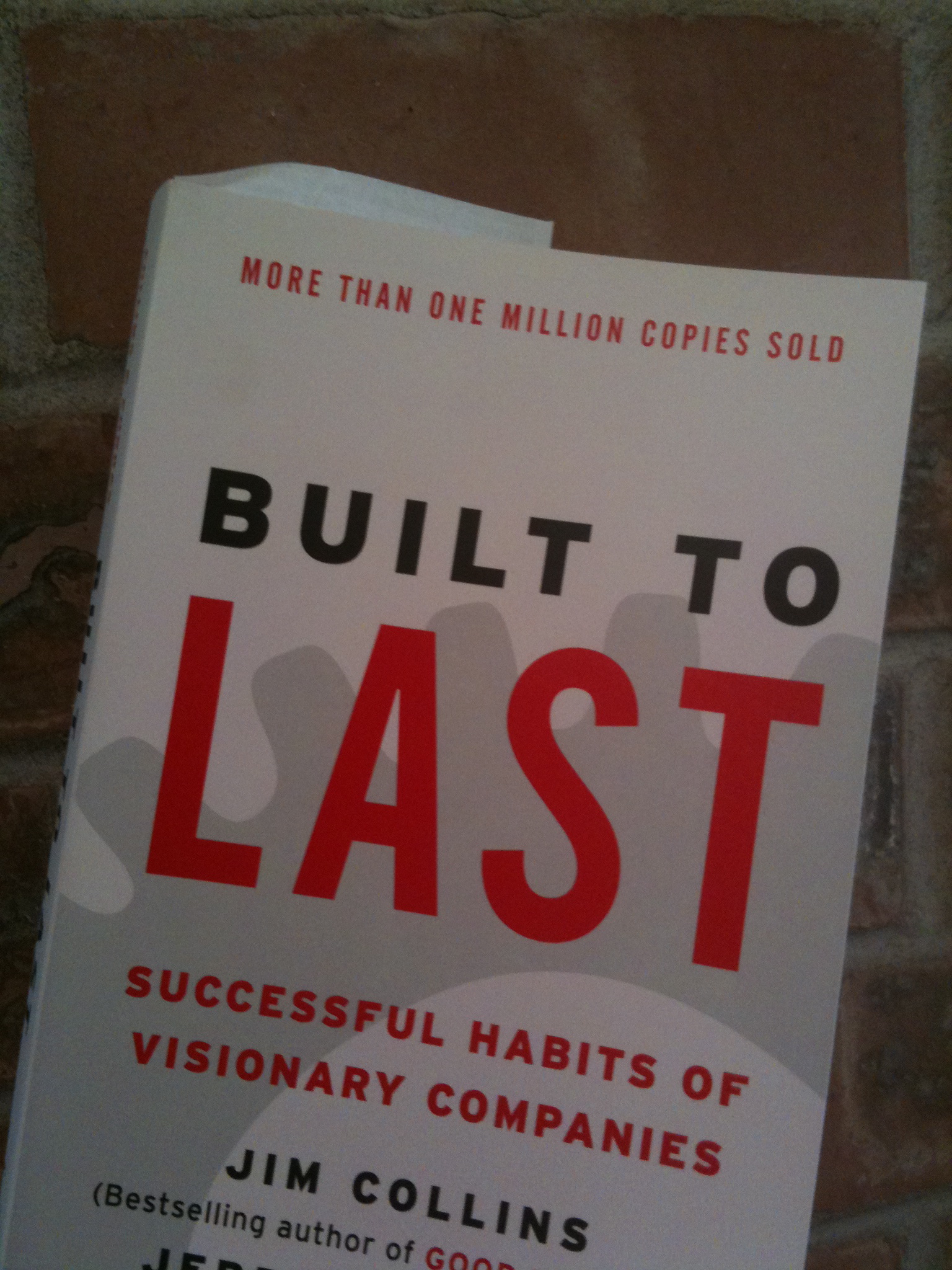
Book Review: Built to Last by Jim Collins & Jerry I. Porras

If you are involved in building and managing an organization, the single most important point to take away from this book is the critical importance of creating tangible mechanisms aligned to preserve the core and stimulate progress. This is the essence of clock building. ~ P. 89

A pastor friend highly recommended I read ‘Built to Last.’ I would echo that sentiment. The quotation above really encapsulates the book. To put it in other words, the book is more concerned about who you are as apposed to what you do. The visionary companies described in their book were more about who they were- their core ideology- then the products produced. Their great products were a result of their core ideology in action.

Building the core
The purpose and values of an organization is what is most essential and non-changing. It is the preservation of this core ideology that drives leadership development, products, adaptations, consistency and culture of visionary companies. These companies have transitioned through multiple CEO’s, economies, products, and culture shifts. Core ideology is the center of visionary companies, not profit nor product. The company itself is the greatest achievement. Preserving the core allows freedom to and opportunity to explore what the company can do.

Vision?
The greatest shock in reading the book was the un-central role vision played. Many of the leaders were not charismatic visionary leaders, though some were. In reading through the book everything went back to who the company was at its core. Growth of these companies normally occurred in one of two ways, BHAG’s or trying a lot things and keeping what sticks. The paperback version, which I read, had a chapter about vision, but this chapter still pointed back to the core ideology. Surprising fact from this book: can you build a dynamic organization without a vision? Yes. Without a core ideology? No. The book does not negate vision, but vision is certainly not the driving force, as the book almost arguing against it being the driving force.

Ministry value
The greatest ministry value from this book is to focus more on who you are and want to be rather than what you do. Values are discovered, rather than imposed, and a culture is developed rather then chosen. Attention should be given to the theology of what a church should be more than its actions. What a ministry does will have a greater impact if it is from its ideological center. As with any book, discernment should be used. The church is an organism not an organization.

A big key to the success of these companies was the preservation of its core ideology, particularly through multiple CEO’s. This is an element many churches struggle with. I have heard of too many stories of ministries declining after a successful tenure of a key leader. The draws attention to a much broader discussion.

The book
The book read ok and the stories were excellent. It did feel very choppy to me. The book is a report on a study and it felt like a report on a study. Things they pointed out were very well done, but the book could have been considerably shorter and communicated the same thing. While a worthwhile read, it was not the most enjoyable to read.

Bottom lines
Focus on living out and preserving the ideological core of the organization you’re in.
Focus on developing the culture and leadership of the organization you’re in.

Why not Wednesday: Be a kid!

“Whoever does not receive the kingdom of God like a child will not enter it at all.” ~Jesus

We often hear the line “child-like faith.” Jesus uses children to teach about humility and faith. Other than the disciples, children are the only group Jesus blesses in his earthly ministry. Leaders in children’s ministry love this verse. (We love other verses too!) In watching my two boyz grow, I’m learning more and more that child-like faith is not about simple trust or joyous abandon. I’m also thinking that children as a model of humility is less about their status. Here is what my boyz are teaching me about child-like faith.

“Amazing!”
My oldest son when I brought (OK, dragged) our first real Christmas tree into the house, stood in complete amazement. The word he used: Amazing! My youngest started kicking and flailing his arms as mom held him in a way he could see the tree. It was big, it was huge. And, after all dad’s kicking, screaming and complaining about a dumb ol’ tree in our house, two boyz changed my heart (my wife gave me the “see I told you so” look). The little and big things are equally amazing to kids. Jadon had the same reaction to the ice machine, the moon, ice cream, toy trains, the list goes on. Kids get amazement. They get wonder. But, its more than just the newness my boyz eagerly seek amazement. Its wired into their DNA. The quest for amazement is a skill we lose or forget.

“Daddy! Daddy!”
Daddy! Daddy! Means the same thing as Jesus saying “Truly truly, I say unto you!” Its not enough for a kid to be amazed. When amazed, we HAVE to share about it. Whether its demonstrating a newly conquered skill, or some simple thing they discovered, kids talk about it. They have to. Discovery is the root of their joy. What is learned and enjoyed must be shared- except with a brother or another child. We’ll talk about depravity at another time. Kids talk. They share what is most valuable- their hopes, dreams, and mostly the little things of life. Its wired into their DNA. The desire to share is a skill we lose or forget.

MA-MAAAAA!!!
When it comes to being hurt, dad is second fiddle to mom. Kids get the ministry of presence. But, my boyz get mad if I’m not around, even though its mama they want to play with or hold them. Jadon grabbed my hand once, sat me down on the couch and then took my wife’s and took her to the choo-choo’s. When I got up to go to the kitchen, play stopped and Jadon looked at me. He did not resume until dad was back in the picture. Kids get that people are the most important thing. People are more important than the task or what is being done. And whether it’s being held, or just being near, kids thrive on presence. Its wired into their DNA. The importance of people is a value we lose or forget.

CHOO-CHOO’S! Train. Train. Trains!?

Kids are devoted. When they like something, they want more. And more. And more. You get the picture. But, they don’t just want it- they CRAVE it! Jadon cannot get enough trains. Gavin cannot get enough doors for him to open. They must have more. They celebrate what they love. They ask for what they love and they go crazy when they get it. What they love is bigger than life. You do not have to convince them they know it. Its wired into their DNA. Devotion is a value we lose or forget.

Child-like faith is being amazed at, sharing, being there for, and being fully devoted to God and the people He places in our life. Sure, simple trust and joyous are a part of that, but those barely scratch the surface. Children are not simple followers. They are much, much more, and we would be wise to re-learn the skills that were once a part of our DNA.

Three lessons from Apple…

“Everyone in silicon valley was trying to be someone else…”
~Welcome to Macintosh

It is no secret that I’m a Mac. I watched Welcome to Macintosh, written and directed by filmmakers Robert Baca and Josh Rizzo, while my wife baked incredible delights. Expecting to enjoy the back ground story behind my beloved computer company, three big lessons stood out to me: 1) Be who you are, 2) Only take on projects you are passionate about and 3) Be dedicated to your strategy. These lessons are reflected both positively and negatively in Apple.

1) Be who you are!
A theme throughout the documentary was people trying to be who they were not. In Apple’s dark times, this was rampant. People in Apple were trying to be Steve Jobs, or some other key person. (It was also mentioned that its a Silicon Valley wide issue.) This theme really came out when discussing the future of Apple without Steve Jobs. The worst thing that could happen would be for someone to come in and try and be the next Steve.

Ministry touch point
One thing is clear: God designed you to be you, and ministry happens best when you are true to how God designed you! Focus on how God designed you. There may be similarities with others. There may be great ideas from others you can incorporate. But, the final question must always be asked and answered effectively: Who did God design YOU to be?

2) Only take on projects you are passionate about
A key quote from the movie: “When Apple really got behind a product, it did well, when they didn’t, it did really poor.” The story of the iPod demonstrated this point. Apple did not invent the mp3 player. Apple revolutionized it. Good design aesthetics and simplicity stand as pillars in Apple culture. The people of Apple also love music. The iPod revolutionized the mp3 market and music industry based on the merging of those two passions. Apple’s culture of innovation and passion drive the company, more so than the profit aspect. Its art verses business. It’s being verses doing.

Ministry touch point
If God is our delight, our desires will become/match up with His. If a project lacks passion, a key question to ask is: Is this what God wants us to do? (Sometimes the answer is yes, as obedience to His Word is another key aspect.) Passion is not everything, but it is what often will gets the job done. No something is not a negative. The power of no is a stronger yes. God gives us all 24/7 to accomplish His will. Our no’s are just as important as our yes. Go for the passionate yes, and be ready to say no a lot.

3) Be dedicated to your strategy
Innovation, simplicity, good design drive Apple. It is not a mistake that Apple developed 3 game changers: the personal computer, the iPod, and the iPhone. Apple rarely invented a concept, but they revolutionized it and made it usable. Apple’s success came about when they held to their core strategy or values. Again, its about being not doing.

Ministry touch point
How you get a job done is as important as what you do. Its a variation on the “Its the journey not the destination” principle. Understanding and articulating your values and strategy is essential to accomplishing effective ministry in the long run. Being creative is not always about new, but making something usable and best. Apple innovated, and their strategy centers on that. Innovation and creativity should be a result of who you are, and not the other way around. Its about being missional not program driven.

Methods and Content and Needs (oh, my!)

There is a tension between methods, content, and needs. With tensions we often pit one against each other, or take the “both/and” approach. This pours into another tendency; using nebulous terms such as balance, equilibrium or compromise. Everyone defines balance differently. We love to prioritize, especially if we’re analytical types, or just make bigger messes, if we’re mystical ministry as art types. How do we navigate these big three things?

The big three defined
What do I mean by methods and content and needs? Here are some definitions with examples of how they look when taken to an extreme:

Methods: What we do.
On steroids? Over emphasis on the non-biblical.. aka maximizing leadership, synergistic program developments, the latest greatest book based on statistical analysis.

Content: Who we are, theology.
On steroids? Over emphasis on the biblical… aka comatose preachy preaching, Word studies from languages we don’t speak, dead orthodoxy.

Needs: Where people around us are at.
On Steroids? Over emphasis on doing… aka the social Gospel, building self-help groupies, incredible families enterprises, political action.

What we need is balance right? In a word, no. Equilibrium? Not so much. Both/and? Sigh. These concepts often get people thinking in terms of 50/50 or compromise. I believe God cares about all three.

Think organic
The body is an incredible organic analogy. No one thinks to prioritize the heart, lungs or brain. Without each of these things you’re quite dead, and perhaps this is why many ministries are dying. We think in terms of health. We seek to sharpen our minds, and build a strong cardiovascular system. These are both keys to a long healthy life.

How the disciples succeeded
In Acts 6 the church was not healthy in an area. Hellenistic widows were being overlooked (need). The old program was not working and a new one was needed (methods). The Apostles recognized that focusing their energy on that problem would take away from what was essential, God’s Word and prayer (content). These things could have been in tension, but they weren’t. Rather the situation called for radical change, an opportunity to live out the Gospel and repentance, and a chance to reaffirm who we are. The church moved forward and God’s power was unleashed.

Where the disciples learned success
WWJD? Luke tells another story. 5,000 men were hungry and in need of food (need). The disciples thought the best idea was to send them away: there wasn’t enough food or enough money to feed everyone (program). Jesus was not about to stop what was essential, His teaching (content). Did  the disciples pass this test? No. But, they learned and God’s power was evident. (When we lack in an area, God will provide.)

The lesson
The disciples learned from failure that ministry is about health. Methods, content, and needs must have an intentional active focus. They did not sacrifice one area to bolster another. They brought up the weaker area through the power of God, while continuing the other essential areas. They changed when needed, tackled opportunities when they arrived, and kept their message front and center.

The bottom line
Think organically. The overall health of your ministry is related to the health of the three areas discussed. Ask: How is your health?

Methods:
Are in you a rut or open to radical change?
How well are you leading?
What steps of change or improvement have you taken lately?

Content:
How well do you know and understand God?
Are you still a student to the Bible & Theology?
What was the last theological topic you’ve studied lately?

Needs:
Do you know where your people are at?
When was the last time you studied your community to see how you can best serve?
How has your ministry demonstrated compassion?

Book Review: Think Orange by Reggie Joiner

“As leaders our primary purpose is not to keep our children in church, but to lead them to be the church.” (p. 217)

Think Orange will be the defining work on Children’s Ministry & Family Ministry for quite some time. A significant discussion within the church is the relationships between the church, the family, and the various generations within both. From a methodology standpoint, Think Orange gives a road map to answer these questions. The book’s strengths are in explaining the why and what questions of a Family Ministry. There are other resources by the ReThink group that address the how.

The why question is critical
While there are many who do not appreciate or think philosophically, what you believe truly effects what you do. Reggie Joiner does an excellent job of explaining the essential role of both the family, the church and how they are combined and interact through leveraging community. A continual frustration of mine in Children’s Ministry is how programs or materials merely view parents as important, not essential. Think Orange views parents as essential! The combination or synergy of the family with church produced produces a powerful result. Reggie states: “2 combined influences make a greater impact than just 2 influences.” (p. 15) This principle, along with others, gives practical guidance to living out the truths of Scripture, in particular the parents’ role in discipling their children and the church’s role in equipping the saints for ministry.

The what question is helpful
What is needed is a collaborative model for family ministry, and not a hap hazard, random, or departmentalized one. Essential #1: Integrate Strategy, starting on page 110, is the most critical section answering what we need. A professor of mine often used the term “braiding,” getting various things to work together.  Having an integrated strategy helps all areas of family ministry to be on the same team and working towards the same goal. Said another way, it teaches children about the church by being a church. As a child grow up in the church, he or she is taken to another level at each life stage, including transitions between life stages. With society causing more and more fragmentation, the church needs to be a place that brings people together. Think Orange understands the equilibrium between families together, age appropriateness, and being one church. This equilibrium is a result from Reggie high view of community. Children are not the church of tomorrow but the church of today.

Final Thoughts
The book’s design and layout is helpful for those who are sequential & analytical thinkers, or the more abstract & random thinkers. It offers many ideas, discussion questions and insights. The book can be read sequentially, treated as a manual or encyclopedia on family ministry methodology. The charts and quotes that stand out were extremely well done and help to navigate the book.

Reggie shares frequently how the ideas translated into what was done at North Point. One should be careful to distinguish between example and what is/ what works at North Point. This is normally distinguishable, but there are times when it may be confusing. This is not a criticism, just something to be aware of. Another point that stands out and one should be aware of is Reggie’s humility. He gives permission to disagree with him, and even states that he may disagree with himself. This tone and attitude is refreshing and should be more prevalent within the church.

The Bottom Line
Think Orange is a critical work to navigate through if you are serious about impacting yours and other children to be the church, not merely attend church! Its strength is in family ministry methodology, with a close secondary strength in ministry philosophy.