Category: Theo…

Not Perfect is a Holy Thing: John Mark

Person: John Mark
Epic Fail: Desertion
God’s View: A useful man

Ever been unfaithful, quit or walked out and think God can no longer use you? STOP! God uses quitters. Being unfaithful creates significant consequences and fallout. The issue is not the sin, but in repentance. John Mark quit, but that’s not the last word.

God’s man of action
Mark wrote my favorite Gospel. As a boy I remember always being in and studying the Gospel of Mark. It described Jesus as a man of action. It’s the adventure Gospel. (As a college & seminary student Mark had a lot of action as well.) The Gospel was written to encourage and spur Christians to serving and pursuing Christ. Its abrupt ending (depending on one’s view of the last chapter) begs the question of what’s next.

John Mark served the apostolic community as well, and he contributed to the New Testament. His ministry still impacts people today. The Bible describes him as a fellow worker. He went on missionary journeys. Mark was a man of action.

Mark’s Failure
Mark was a deserter… On a missionary journey Mark deserted Paul at Pamphylia. Paul, also a passionate man of action, did not want to take John Mark on his second missions trip. This created tremendous tension between Paul and Barnabas. This caused the two great leaders to part company.

Barnabas gave Mark a second chance and took him. Paul took Silas. And, as history would have it, Mark demonstrated repentance and stood as a man of action. Quitting produces significant consequences, but it does not have to be the end.

God’s final view
Pick up Mark and bring him with you, for he is useful to me for service. ~2 Timothy 4:11

Paul, who wanted nothing to do with Mark, at the end of his ministry… when he was  at the end of his life… when all were abandoning him… requested the presence of John Mark because he was useful. That is change.

This week as we looked at Not Perfect is a Holy thing, remember this key point: imperfection and sin does not have to be the last word on your life! When we see Christ face to face we will be made perfect and lacking nothing in the realm of holiness because of Christ’s work on the cross. But today… right now… as you’re reading this… you are not perfect, but in Christ you are holy!

The bottom line of Not Perfect is a Holy Thing:
Do not pursue perfection, pursue repentance. Do not make sinless your goal, but actively serving Jesus Christ. You and I will fail, we may even fail in epic ways, but that does not mean God is done with us. The moment we stop pursuing God, the moment when we stop striving for repentance that’s when we cease being holy on Earth.

The Holy man is the one who pursues a life of repentance not perfection, a life of service, not a life of ‘I’m right you’re wrong.’ The holy man lives by grace, and grace covers a multitude of sins. Our Savior is that big!
Not Perfect is a Holy Thing: Moses

Person: Moses
Epic Fail: Anger and frustration
God’s View: One of the greatest prophets

Ever avoid getting involved because you’re angry or frustrated? STOP! Moses had numerous occasions whereby he got frustrated and angry. He even failed in this area. God still used him! Moses was an imperfectly HUGE hero in the Bible. While anger and frustration may be a weak area, perhaps you should pursue God and overcome these struggles.

God’s Man
By faith Moses, when he had grown up, refused to be called the son of Pharaoh’s daughter, choosing rather to endure ill-treatment with the people of God than to enjoy the passing pleasures of sin, considering the reproach of Christ greater riches than the treasures of Egypt ; for he was looking to the reward. By faith he left Egypt, not fearing the wrath of the king ; for he endured, as seeing Him who is unseen.

By faith he kept the Passover and the sprinkling of the blood, so that he who destroyed the firstborn would not touch them. By faith they passed through the Red Sea as though they were passing through dry land ; and the Egyptians, when they attempted it, were drowned.
~Hebrews 11:24-29 NASB

Moses’ Failure
The story of Moses did not go as smoothly as mentioned in Hebrews 11. He took matters into his own hands by killing an Egyptian, causing him to have to flee. While this may not be the best way of handling his situation, look at how God viewed it. Even in failures or when we do things wrong there can be glimmers of faith.

Moses did not view himself as a good communicator. So, God gave him Aaron to be Moses’ mouthpiece. This lead to some problems down the road. Still, Moses lead the people out of Israel. There were multiple occasions that lead to anger and frustration for Moses. In one instance, he struck a rock out of frustration rather than following the instructions God gave him. This failure kept Moses from entering the promised land.

God’s final view
God describes Moses as a man of faith. Moses wrote the 5 most critical books of the Bible, the Torah, by which all other books point and connect to. He conquered nations, stood for God when all Israel, save a few, looked elsewhere. He saw God. Moses was not a great man because he lacked faults, was perfect, or in him was no sin. Moses became a great man because he pursued God.

Yes, Moses had to face consequences for his sin, but its not the sin that God brings up, its the acts of his faith. Here is the key to God’s grace and forgiveness- it wipes away all sin! While there may be consequences to sin here on Earth, the failure of sin is not the final word on our lives! Out of the trials and failures that Moses, and ourselves, face on Earth will be written the strengths of our faith and the grace God granted to us.

Why not Wednesday: A not so perfect start

A professor of mine wrote a quote on the whiteboard that shattered all thinking in the room:

“It something is truly worth doing, its worth doing poorly.”

Yeah, but…

Even now I bet you are thinking “yeah, but…” The classroom filled with those kinds of statements. The prof, as is normal for teachers, sat back and smiled at the ensuing discussion. We are, after all, trained to think: If you can’t do with excellence, don’t do it at all.” We are, after all, taught that doing something poorly might result in not being able to try it again.

Some, after the prof’s enduring silence, took the statement to mean: “You have to start at some point.” The ‘yeah, but…’ statements kept flowing, though. These transitioned into the statement being an excuse for pool quality. We were left at a loss because the statement was still on the board.

A poor start
Remember the early days of Toyota, Honda, or Hyundai? They were known for poor quality. They rose to the top. Recently, Hyundai is starting to edge out Toyota and Honda. They started poorly, but all three came around. Here is the meaning:

They key words are “truly” and “doing.” Some things are not truly worth doing- like crime. Some things are truly worth doing- like saving a life. Doing gets things done. An idea or potential is just that, an idea or potential. They mean nothing until you act, that’s doing. Helping meet transportation needs has true worth. Toyota, Honda and Hyundai started to act. They made cars, and the did it poorly at first.

So what, do it!

What ministry adventure would you like to do? Is it truly worthwhile to take that step? Then do it! Because you start poor does not mean you have to stay poor. You can grow, you can learn, you can overcome- if it is truly worth doing. I am not saying this will be easy- it may be very painful.

This week as we’re looking at how ‘Not Perfect is a Holy Thing,’ the theme is how God used people who had epic failures. Practically speaking, it is better to act now, even though you may not be ready or may even make significant mistakes. Why? Because if something is truly worth doing, its worth doing poorly. Pursing God is worth doing, and though you may not have it all figured out or even know what you’re doing, what may start as poor can turn into something incredible down the road.

The bottom line:
So, start now, and don’t be afraid of making mistakes! Greatness or excellence is not the absence of failure or mistakes.

Not Perfect is a Holy Thing: Abraham

Person: Abraham
Epic Fail: Took maters into his own hands
God’s View: A man of faith

If you’re the type that needs things figured out before pursuing something: STOP! God calls people to do things even when the person has no clue what to do. Abraham is such a person. God told him to rise up and go to a land that He’d show him. Pack up, move, I’ll tell you later. Abraham as a holy man.

God’s Choice Man
Abraham and his descendants succeed for one reason: God chose Abraham. The story starts in Genesis 12 and following. God promises Abraham land, descendants as numerous as the sand on the seashore, and blessing. Abraham and his wife had one son, Isaac. The path of his descendants would not be easy, rising up out of a land that was no their own.

Anyone who blesses Abraham’s family would be blessed, anyone who cursed it would be cursed. Abraham is the father of two great nation groups: Israel- sons of Isaac, and Arabs- sons of Ishmael. Wondering in the wilderness, God protected and prospered his family. Being the patriarchal head of Israel, Abraham is a hero.

Abraham’s Failure
Desperate for God’s promise, Abraham took maters into his own hands. Abraham was promised an heir, but at 100 years old He did not see it happening. Earlier Sarah talked Abraham into sleeping with her concubine Hagar to produce an heir, called Ishmael. The descendants of Isaac and Ishmael do not get along, as evident in the Middle East today.

God’s final view
God does not call Abraham a failure. Hebrews 11 describes Abraham and his descendants men of faith. They were not perfect men, but they were faithful men. To this day we deal with the consequences of Abraham taking maters into his own hands. God does not call Abraham a failure. Romans 4:18ff describes God’s view of Abraham:

In hope against hope he believed, so that he might become a father of many nations according to that which had been spoken, “SO SHALL YOUR DESCENDANTS BE.” Without becoming weak in faith he contemplated his own body, now as good as dead since he was about a hundred years old, and the deadness of Sarah’s womb; yet, with respect to the promise of God, he did not waver in unbelief but grew strong in faith, giving glory to God, and being fully assured that what God had promised, He was able also to perform. Therefore IT WAS ALSO CREDITED TO HIM AS RIGHTEOUSNESS.

Abraham was holy not because he never sinned, but because he pursued God.

Not Perfect is a Holy Thing: You and I

Person: You and I
Epic Fail: Pick any sin
God’s View: Holy

If you think God cannot use you because you’re not perfect: STOP! God uses imperfect people. Heroes of the Bible are viewed as heroes because of God’s grace and a heart of repentance. While some will be rewarded more than others based on the quality of our work, God will make us perfect and sinless one day. This week we will look at how ‘Not Perfect is a Holy Thing.’ People who had epic failures, and yet they pleased God. People like you and I.

Think process not product
The focus on holiness should be on the process of being who God wants us to be. The New Testament often speaks of of growth. Jesus used the analogy of the vine. Paul uses the concept of a body or a building. Maturity is not described as an event, but more the process of repentance. The Bible describes our walk with Christ in organic terms, and not as a college course. On this side of eternity holiness is about becoming like Christ. It is a process, not a product.

Holiness is being set apart. Think of it this way: If I do not sin am I being holy? I am being the person God wants me to be? Am I pursuing what He wants? The people listed in Hebrews 11’s were imperfect throughout their lifetimes and had epic failures. God’s final mention is one of admiration and pleasure because of their faith. Their success occurred from God choosing them for His service. These imperfects were set apart. God made them holy. God used imperfect people.

Epic fail: pursing perfection
We want our heroes and ourselves to be perfect. Jesus, who knew no sin, became sin on our behalf. This is the perfect picture of grace. Grace is the measure of a biblical hero. Grace focuses on on what God did. The heroes in the Bible were not perfect. People in life and in scripture succeeded and became highly esteemed because of His grace. Heroes in the Bible failed in epic measure, but that is not God’s final verdict! Pursing perfection is pursing self; pursing holiness is pursing God’s grace.

The Apostle John states: ‘If we say we have no sin then we lie.’ He goes further and states that the truth is not in us. Being sinless misses the mark. There is more to holiness than perfection. I would go as far to say that holiness does not equal perfection, though that is not a license to go sin. Holiness has more to do with purpose then perfection, pursuit instead of destination. All sin is covered by the cross. Real failure is the lack of repentance.

God’s final view is done and will be done
Our position in Christ matters a great deal! Once we are in Christ we are declared holy. God views us as holy. When we see Christ face to face we will be holy and lacking of all  sin. All of this is based on what Christ did, not what we did or didn’t do. God’s final verdict on you and I who are in Christ is one of sinless perfection. This position is eternally secured by Christ and sealed by the Spirit. It is done.

Here is God’s verdict on you and I: “For I am confident of this very thing, that He who began a good work in you will perfect it until the day of Christ Jesus. Phil 1:6” It will be done!

Why Not Wednesday: God speaking

God speaking through a burning bush sounds good right now. Whispers from God are nice. The Balaam route? I’d say sounds crass.

God speaking through angels is scary, uhmin and thumin weird. Jonah’s route, i’d like to pass.

So the Bible I sit and read-giving not my wants but what I need. Though it’s powerful and yet so meek-God tells me to praise Him this week.

So we crave things for a look- instead God gave us a book. Not epic things to grab attention-but powerful words for retention.

Oft I fold my hands to pray, now reminded of His way. God speaks to me from His Word and it tells me my prayer is heard.

To be godly or not to be, that is the wrong question…

God or Godly Character? Is it a matter of balance? How do we address the fact of God changing the inside verses outward appearance and conformity? In discipleship and teaching there is a tension between these two.

Where we are at
Within the North American Church there seems to be a dichotomy between theology and practice. Such a focus tends to make church man centered rather than God centered as people focus on what is seemingly practical and ‘skip’ the foundation that sustains the practical. The high value we see for practical, application, “easy to do” gives evidence to this dichotomy. At the same time, I’ve seen dead orthodoxy where the Bible and theology are taught, but frankly it is dull and seemingly not applicable to one’s life, just tons of data. Theology is not a data dump.

Where the Bible points
The pattern we often see in Scripture is that as people encounter God (theology), their lives change (application). In Joshua chapter 1, God explicitly tells Joshua to know the law cold (theology) so he may be careful obey it and have success by following it (application). Paul instructs Timothy to be watchful of his teaching (theology) and his ministry (application). Theology at its core, its very essence, is encountering God. Encountering God demands that we change as we realize who He is. To separate theology from application is to create a dichotomy that does not exist in Scripture.

Bottom line
We act (application) based on what we believe (theology).

Perhaps if our eyes become more attuned to God and our relationship with Him, that correct behavior will follow. That is the pattern we see in Scripture. Your faith has healed you, go and sin no more.

We need more stained glass windows…


Stained Glass Window
by Hauki-

“We will use these stones to build a memorial. In the future, your children will ask, ‘What do these stones mean to you?’ Then you can tell them…” ~ Joshua 4:6-7a NLT

Where is the art?
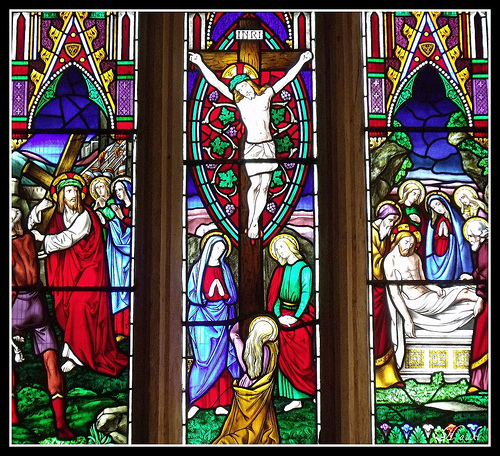
Stained glass windows were used to communicate basic bible stories to a largely illiterate world. Part of this was an extreme case of the Bible being in a language people didn’t understand. To communicate the stories from the Bible, the church used art. The buildings, decor, everything was to communicate and teach something about God, to inspire worship. For better or worse, we’ve lost the sense of art in many churches.

Theology in Art
God frequently used artistic expression as a tool to both remember and pass on who He is. Think about this, how abstract is a pile of stones in a middle of a river? The picture itself has to be explained. Think of the passover where God uses taste to communicate bitterness- the bitter herbs. Intertwined through the Old Testament God placed artistic expression to generate conversation. Some expressions were very abstract, others very understandable, they all were intended to generate conversation and engage people in theology- understanding who God is.

Generate why….
We need awe. We need environments and opportunities that get kids and adults to ask why, to dream. There is a broader context to following Christ. Our walk of faith is not an island unto itself. God showed Himself to be the one true God. If the church is truly one body, then our story and the stories of others in history connect. Theology is not a vacuüm, its communicated and lived out in history, in life. Art understands this language, as God created that rainbow of grammar and syntax. We need more stained glass windows…

Questions:
If all the words in your ministry environments disappeared, what does it communicate about God and who you are?

What have you done to help people see what God has done through the history of your church or ministry?

Do kids in your ministry start asking questions and talking about God because of what surrounds them?

Methods and Content and Needs (oh, my!)

There is a tension between methods, content, and needs. With tensions we often pit one against each other, or take the “both/and” approach. This pours into another tendency; using nebulous terms such as balance, equilibrium or compromise. Everyone defines balance differently. We love to prioritize, especially if we’re analytical types, or just make bigger messes, if we’re mystical ministry as art types. How do we navigate these big three things?

The big three defined
What do I mean by methods and content and needs? Here are some definitions with examples of how they look when taken to an extreme:

Methods: What we do.
On steroids? Over emphasis on the non-biblical.. aka maximizing leadership, synergistic program developments, the latest greatest book based on statistical analysis.

Content: Who we are, theology.
On steroids? Over emphasis on the biblical… aka comatose preachy preaching, Word studies from languages we don’t speak, dead orthodoxy.

Needs: Where people around us are at.
On Steroids? Over emphasis on doing… aka the social Gospel, building self-help groupies, incredible families enterprises, political action.

What we need is balance right? In a word, no. Equilibrium? Not so much. Both/and? Sigh. These concepts often get people thinking in terms of 50/50 or compromise. I believe God cares about all three.

Think organic
The body is an incredible organic analogy. No one thinks to prioritize the heart, lungs or brain. Without each of these things you’re quite dead, and perhaps this is why many ministries are dying. We think in terms of health. We seek to sharpen our minds, and build a strong cardiovascular system. These are both keys to a long healthy life.

How the disciples succeeded
In Acts 6 the church was not healthy in an area. Hellenistic widows were being overlooked (need). The old program was not working and a new one was needed (methods). The Apostles recognized that focusing their energy on that problem would take away from what was essential, God’s Word and prayer (content). These things could have been in tension, but they weren’t. Rather the situation called for radical change, an opportunity to live out the Gospel and repentance, and a chance to reaffirm who we are. The church moved forward and God’s power was unleashed.

Where the disciples learned success
WWJD? Luke tells another story. 5,000 men were hungry and in need of food (need). The disciples thought the best idea was to send them away: there wasn’t enough food or enough money to feed everyone (program). Jesus was not about to stop what was essential, His teaching (content). Did  the disciples pass this test? No. But, they learned and God’s power was evident. (When we lack in an area, God will provide.)

The lesson
The disciples learned from failure that ministry is about health. Methods, content, and needs must have an intentional active focus. They did not sacrifice one area to bolster another. They brought up the weaker area through the power of God, while continuing the other essential areas. They changed when needed, tackled opportunities when they arrived, and kept their message front and center.

The bottom line
Think organically. The overall health of your ministry is related to the health of the three areas discussed. Ask: How is your health?

Methods:
Are in you a rut or open to radical change?
How well are you leading?
What steps of change or improvement have you taken lately?

Content:
How well do you know and understand God?
Are you still a student to the Bible & Theology?
What was the last theological topic you’ve studied lately?

Needs:
Do you know where your people are at?
When was the last time you studied your community to see how you can best serve?
How has your ministry demonstrated compassion?