Category: Life & Learning

Dream: You say that I’m a dreamer…

Dreamers pursue God. They are not inward focused, self-serving, trite or vengeful. Dreamers pursue reflecting who God is.

“For I am confident of this very thing, that He who began a good work in you will perfect it until the day of Christ Jesus.” ~ Philippians 1:6

“Brethren, I do not regard myself as having laid hold of it yet; but one thing I do: forgetting what lies behind and reaching forward to what lies ahead, I press on toward the goal for the prize of the upward call of God in Christ Jesus.” ~ Philippians 3:13-14

The goal beyond self
We choose our attitude. The book of Philippians focuses on Paul’s attitude. This attitude, and the whole mindset of the book is a passionate pursuit of God. The book is an internal focused book. It is an attitude check. The goal Paul refers to is beyond self. The key is found in Phil 2:5- having the same attitude that was also in Christ Jesus.

Being is the focus

The best dreams are ones that focus on being, not doing. If there is any lesson that is crystal clear in the Bible it is this: we cannot earn favor with God. Doing, achieving, possessing means nothing if we fail to be who God wants us to be. Focusing on who we want to be will have greater impact on what we do. Our attitude affects everything. Dreamers need humility. Great leaders and people in life show this attitude. Focus on being humble. It works! Look at Christ.

God is the dream
Regardless of our history, our present or our future, we get to be with God. This is why our attitude and our focus on being is so important. No matter how good or bad, rich or poor, healthy or ill, we can posses our dream. This is why the best dreams are the ones that focus on being. A slave can be a dreamer. An alcoholic can be a dreamer. A murder can be a dreamer. A single mom can be a dreamer. An orphan can be a dreamer. Dreams are not about our situation but our destination. The Gospel forges our dreams in Christ, not our wishful thinking or our own power.

Why be a dreamer
There is more to life than now. There is more to life than our preferences and whims. Dreams move us beyond ourself. Dreamers pursue being the kind of person God designed us to be in the places He puts us. God did not create us as an afterthought. God does not save people to merely escape Hell. There is a story, a masterpiece that is your life. Pursuing God paints this work of art.

The Bottom Line:

In the craziness of life, no matter how upside down it us, we have a choice: we can pursue self or we can pursue God. God made us to reflect who He is. Perhaps it is time we take God seriously. There is a work that He wants to accomplish in our lives. It starts with an attitude change and a focus on being who He wants us to be. Reflect on this thought:

“Now to Him who is able to do far more abundantly beyond all that we ask or think, according to the power that works within us, to Him be the glory in the church and in Christ Jesus to all generations forever and ever. Amen.” ~ Ephesians 3:20-12


Dream: Mr. Sandman…

God is the Sandman, the author and artist of a masterpiece that is you. Dreams are not fairy tales, events, or possessions. Dreams are reflections of God’s glory in and from your life.

“The Lord God formed man of dust from the ground…The Lord God fashioned into a women the rib which He had taken from the man…”
~ Genesis 2:7 & 22

“God created man in His own image, in the image of God He created them male and female He created them. God blessed them and said, ‘Be fruitful and multiply…’”
~ Genesis 1:27-28a

The God who fills things
We believe in the God who fills things. God filled creation, He filled the temple, He filled our days and He fills our very being. God is a designer, an artist, a musician, God is a dreamer. He thrives and exists in community. God is as poetic as He is just. The very concept of dream is rooted in the purposeful creation of you… ‘that you may be filled up to all the fullness of God.’

God as creator
The order of creation mirrors and exhibits God’s desire to fill things. Days 1 through 3 God creates the space and then fills it days 4 through 6. Upon His good creation God placed the crown jewel: mankind. From the sand God made us, purposefully, artistically, in community. Mankind was not a blank slate of random chance, God made mankind the visible finite image of the infinite God. He blessed the human race. And God commanded mankind to fill the Earth.

Time to dream
Starting on Day 7 of Creation, God creates the Sabbath. Sabbath, meaning 7th day, also caries the concept of rest. It was time to stop and smell the roses. It was a time to reflect. It was a time to rest. Later in Exodus, Leviticus and Deuteronomy God institutes feasts where His people could celebrate, learn, reflect, teach, and ultimately enjoy Him. The Sabbath and celebrations focuses on one key thing: to remember God. In remembering God, He reminds us of who He wants us to be.

God is the Sandman
The danger of not dreaming is forgetting God. Lack of dreams is not a loss of purpose, a depletion of vision, an absence innovation, busyness or exhaustion. A lack of dream or dreams is forgetting who artistically sculpted you from dust. God forged dreams in the purpose for your life, for you carry His image. And, once in Christ, that purpose, that dream becomes crystal clear. You are not a mistake. God made you. He gave you a dream.

The Bottom Line:
Even with the confusion of life, we must remember God. A dream answers this question: How is my life to glorify God? How is my life to reflect who God is because I carry His image? Whether you naturally dream, are in limbo, are busy, are apathetic, or life has you exhausted, reflect on this thought:

For we are His workmanship, created in Christ Jesus for good works, which God prepared beforehand so that we would walk in them. ~ Ephesians 2:10

Provision through perseverance

Often people state one’s need to enter the desert before God uses them. Others put it as God needing to break someone before using them. After reading through Proverbs 1-5, I wonder if we have it backwards. What if the desert is God’s provision?

Wisdom as an active pursuit
Proverbs chapter 1 details how we should actively pursue wisdom. It states how the fear of the Lord is the beginning of knowledge. Proverbs also contrasts the destructive end of foolishness and the emptiness of naïvety. The last statement brings out the biggest issue: “But he who listens to me shall live securely and will be at ease from the dread of evil.” Thus begins the perseverance resulting in provision pattern.

Perseverance results in provision
The formula of Proverbs states if you actively pursue wisdom, it will give you life. For example:

Perseverance
Proverbs 3:1- “My son, do not forget my teaching, but let your heart keep my commandments.”

Provision
Proverbs 3:2- “For length of days and years of life and peace they will add to you.

Wisdom takes perseverance to posses. It is more an act than a possession. Wisdom does not come by chance. Wisdom is not absorbed. One must pursue it and live it. Keep wisdom through the challenges of life, and it become yours. It takes listening, pondering, treasuring, and keeping wisdom to get it. Wisdom is forged and realized through hardship.

Fear God
Both wisdom and knowledge start with the fear of the Lord. It is here that we come to the desert. In reading through the persevering for wisdom followed by provision, it makes sense that God would use the desert. Desert moments bring clarity of thought, aptness to listen, and they confront our finite mortality.

While the desert is a life and death struggle, it is also fertile ground for transformational growth. Given the statements at the start of Proverbs, my perspective on the desert changed. The purpose of the desert is not God breaking us. The purpose of the desert is God providing for us. At the end of the desert is provision. The most essential provision God gives us through the desert is knowledge of Himself.

The bottom line:

For wisdom, perseverance leads to provision. It is by going through the desert that we obtain life. To avoid this seeming paradox we can be easily taken by naïvety or foolishness. Persevering through the desert provides us the start of life and theology. God is God, and we are not.

Book Review: Switch by Chip & Dan Heath

Switch by Chip Heath and Dan Heath, writers of Made To Stick, deal with “how to change things when change is hard.” The book shares encouraging stories and a helpful process for change.

Humanity not process
Switch develops a process around the most obvious fact: we’re human! Many change books view change from the perspective of process vs the perspective of people. Reality is, people make or break change more than a process. The greatest benefit of Switch is its process places our humanity into the equation.

Think holistically
The book takes a holistic view to the change process. Too often people like to segment things, avoiding how things connect. Left brain types (stereotypically men) fall into this category. If you’re an left brain type this book will greatly benefit how you enact change.

Elephant riding
Having a change process is more important than no process at all. The book has an interesting intersection of modern psychology and philosophy in is use of the Rider & Elephant metaphor. The metaphor is the foundation for the book and very helpful. Each section has helpful exercises to develop your elephant riding skills.

Style
While the content is solid and helpful, the style of the book is frustrating at best. There are no topic heading in each chapter, just numbers. If you want to use the book as a reference, mark it well. The stories read like a stream of conscious. It is good training and helpful to left brain bullet pointed types, but you will find it frustrating. Being a right brain stream of conscious type, it slightly annoyed me as well. For a book focused on a process of change, the layout and style is not helpful, almost to the extent of being a hindrance.

The stories are inspirational. They are worth reading through and will help you process how change. One thing I struggle with is whether or not the process is really a change process vs the book being about people who were creative in making change happen. This is a broader philosophical discussion but worth noting.

The Bottom line:
If you are left brained analytical type, Switch is a must read. If you are a right-brained creative type, a more analytical book would benefit you more. The book is solid and a change process is better than no process. The greatest strength Switch; it’s holistic. Too often humanity is left out of the equation. Change is as much art as it is science. In fact, I’d say its more art. We are human.

Divided

Avoid…. Doom & gloom… The tendency when dealing with the church division is to get all critical or guilty. The Bible makes it quite clear that one day the church will be perfected and we’ll be ok. Rather than see a mess, let’s get together and put the puzzle pieces together. We really do have all the pieces!

Divided by age
A serious division I’ve seen in church since I started attending at 5 years old is age separation. There are huge advantages to meeting people where they’re at. There are huge advantages to kids being with kids, young couples being with young couples, etc. We often go to far. The issue with 20’s and young 30’s leaving the church is an example of the division by age problem.

Divided culturally by age
Each generation in America became its own subculture. Think about it. Each generation has its own style, music, language, literature, forms of communication, etc. Given culture’s push to move people into their niche, sub-cultures grow and multiply at a rapid pace. Society is overly divided and segmented. Who is going to bring life together?

Two dangers:
Division by age results in a breakdown of discipleship. In talking with pastors, there is often a break down of discipleship post high school. A man goes to Bible college and maybe seminary afterwards, but post graduation continued discipleship is not a guarantee. It’s almost as if the churches we grew up in handed off leadership development to colleges & seminaries, seldom hearing from them during or after our training. That’s just pastors, a very small segment of our 20’s & 30’s. It is the trend in other areas as well.

Division by age results in loss of perspective & importance. The church needs the energy, ideas, enthusiasm, and I dare say mistakes of youth. Equally, the church needs its seasoned saints to offer their wisdom, be the voice to tell us when we need to slow down and let God, to make sure we don’t forget that God really is at work. Many problems could be avoided by listening to the older. Refreshing viewpoints and challenges to continue growing come by listening to the young.

Two cures:
Retire retirement. An example: I wish every church could have a “retired” pastor who shepherds the pastor or pastors. “Retired” pastors have been there. They know what’s human nature vs a unique situation. They know the questions to ask. They have the sense to let things work themselves out or to get involved. Elder pastors can fill a need in churches: pastors need shepherding too. Retirement is heaven for saints. Until then, seasoned saints have much-needed work to do. We need them to do it!

Take seriously body passages. (Romans 12ff, 1 Cor 12, Eph 4-6) We are truly one body! We are one church. Church should be a place where life comes together. Too much division hurts the body. Brining the body together is an essential because it is the Gospel of Jesus Christ that binds us together. Affinity based groups are not wrong! We need them. Having everyone together all the time is counter productive as is the division mentioned. Viewing church as body needs both.

We need to view and operate the church as one body. The danger of focusing too much on affinity is it becomes what binds vs the Gospel. The danger of too much division is you lose. Judges 2:10 There arose a generation in Israel who did not know God nor the things of God. Where did the breakdown start? It ended with not teaching children, but it did not start there.

The bottom line:
Seriously, we have all the pieces to do incredible things for the Gospel. We cannot accomplish it divided. When one part suffers, we all suffer. Growth happens by what each part supplies. At the day of Christ Jesus, we know the job is done. We or the saints after us will get it figured out. The key is putting the pieces together, and that has never been more available than today.

The ideas and energy we need is with the youth. The road map to get there is in the hands of our seasoned saints. Perhaps that leaves the rest of us carrying the middle. It gives a different sense and feel to leadership and our “most productive years.”   Think of it this way: Can We be the hero? What if We is the hero? Is We what Jesus meant in His John 17 prayer? What would happen if We, the church, became the hero?

You can’t steer a still ship

If you want to steer a ship, get it moving. Water passing over the rudder is what makes it maneuver. This is a quote that I want my boys to grasp, and it is one many need to. The concept is you need to get moving, you can always change course later. Pick. Dream. Pursue. And, let God work in you as He gets you to the destination.

Military. Job. College.
My dad gave me those three options when I started 7th grade. They were a huge motivation to do well in school. The last part of the statement went: “But either way, you’re out of the house.” Dad spoke the message clearly. Man up. I picked a direction quickly and pursued it. A key element imparted to me was variety. Broad experiences help clarifies when one pursues a direction. Direction may change from experience. It is hard to change course when you’re not moving.

“Kids don’t dream today…”
The statement surprised me in a conversing with a well seasoned pastor. It made sense. In my high school, many worried over what they were to do. Graduation became somber as much as celebration. I cannot fathom people not dreaming, of not having direction. Partly because I’m wired that way. Partly because time doesn’t stop for limbo. Dreaming is not a passive exercise.

Eat. Pray. Love (Lament).
I can see where the elements of this book & movie resonate with America. Americans do not know how to simply enjoy life. The pace of life also pours into spiritual confusion. Then, with the non stop spiritually confused state, one loses their love life. Love needs a focus other than one’s self. Kelly and I discussed this at length. As we understand it thus far, Eastern Philosophies focus on balance has two key themes: emptying (meditation) and waiting (letting things show themselves). In contrast, Christian thought is filling (God is the God who fills things) and pursuing (Pursuing God is part of waiting on Him) and answers come. This pursuit includes a sabbath principle whereby God want us to simply rest to remember.

Values over Vision; Journey over Destination
Americans love big things. We love vision. We love destinations. In this quest, our blinders go up to values and journey. How often in our literature, art, dramas, and talks do we realize this anew? In “Built to Last” Jim Collins realizes that great companies focus intently on their values more than anything. They focus on being more than doing; the key to their successed. Our thought process is best summed up by Han Solo’s statement: “I prefer a straight fight to all this sneakin’ around.” Dave Ramsey’s one piece of advice he’d give to young leaders: “Let problems work themselves out.” Our pragmatic, driven, competitive side should remember that life seldom takes the direct route.

Visions in the Bible are like cars with really bad turbo lag. Some, like Abraham or Joseph, only get a mere whisper of the vision being fulfilled and it is left to others to do it. The pattern goes like this: God gives a vision…………………………………………and then it happens. Often the trouble comes when one tries to force its accomplishment vs pursuing God in the midst of the wait. The lack of peace in the Middle East is a clear example of this. Focus on being vs doing allows you to pursue without rushing. The Bible focuses more on becoming verse doing. The fulfillment and accomplishment of our vision or destination is already secured by God.

The bottom line:
You can’t steer a still ship. Pick a direction and then let God guide your journey. Your vision may be clarified later, it may not be. You might start with one, and you might not. But, know this: time does not stand still. While anchored in indecision, you will lose lessons of what God wants you to become. If you are too set on your destination, you may run aground getting there, and lose what God wants you to become. Pick a direction and learn to navigate. Work with the currents, the weather, the sun and stars. Clarity and discovery comes to those who pursue over those who wait. Pick. Dream. Pursue. And, let God work in you as He gets you to the destination.

Yes we can, no we shouldn’t

Science can tell you about nuclear energy. It can even build you a nuclear bomb. Science cannot tell you whether or not to use the bomb. I can dance. But I shouldn’t. My dancing would be considered an act of terror. Even my 3-year-old asks me to stop.

Can and should are two different questions… Why mention this?

Yes we can!
In America we have the freedom of speech. We can voice our concerns in open. We can make public demonstrations about what we value and hold dear and sacred. We can print and say what we like with little repercussions. We can burn books, protest funerals, put up cheesy phrases on signs, went it comes to speech, we can.

Because we can does not mean we should.
Take Jesus as an example of can & should. Jesus could have come in glory, demanded worship, destroyed Rome, destroyed every sinner by fire, smacked down Satan in the wilderness, but He didn’t.

Often times silent service speaks volumes louder than demonstrations. Often times the thing noticed is not exercising our rights. The concept is known as meekness. The concept is also known as humility. Both demonstrated by Jesus.

Perhaps the values of many Christians go ignored because we live in a time where only silence can be heard. Silence does not meant political inaction or non-involvement. Silence does not mean one is a coward or ashamed of the truth. Silence does not equal apathy. Silence can only mean these things if one does live, pursue and teach the truth in the first place.

The heart is the issue
I disagree with the notion that Jesus was about social action. He wasn’t. In fact, Jesus wasn’t about anything political. Jesus aimed for the heart. Without a change of heart, there can be no lasting change. Jesus knew clearly that to be heard with deafening clarity, one must show the silent resolve of a changed life.

Jesus championed truth and living out the truth. Jesus knew the only way to equal the scales of justice was by giving up would He could do for something far greater. The Bible calls this sacrifice, and for Jesus it meant the cross. Though equal with God in every way, Jesus chose to humbly submit. From a perfect life to a life of poverty, ridicule and false accusation, Jesus’ resurrection shook the foundations of history. Jesus did this to bring people back to truth. To redeem. A changed life will change society.

The Bottom line:
Can we speak and loudly proclaim? Yes. Should we? No. The silent servant is often heard louder than the person shouting on the corner. For in silent service the question builds further and further to the point of needing to be asked: Why? And when asked, the truth can be heard. Aim for the heart and you will win in the long run. Silent resolve is powerful.

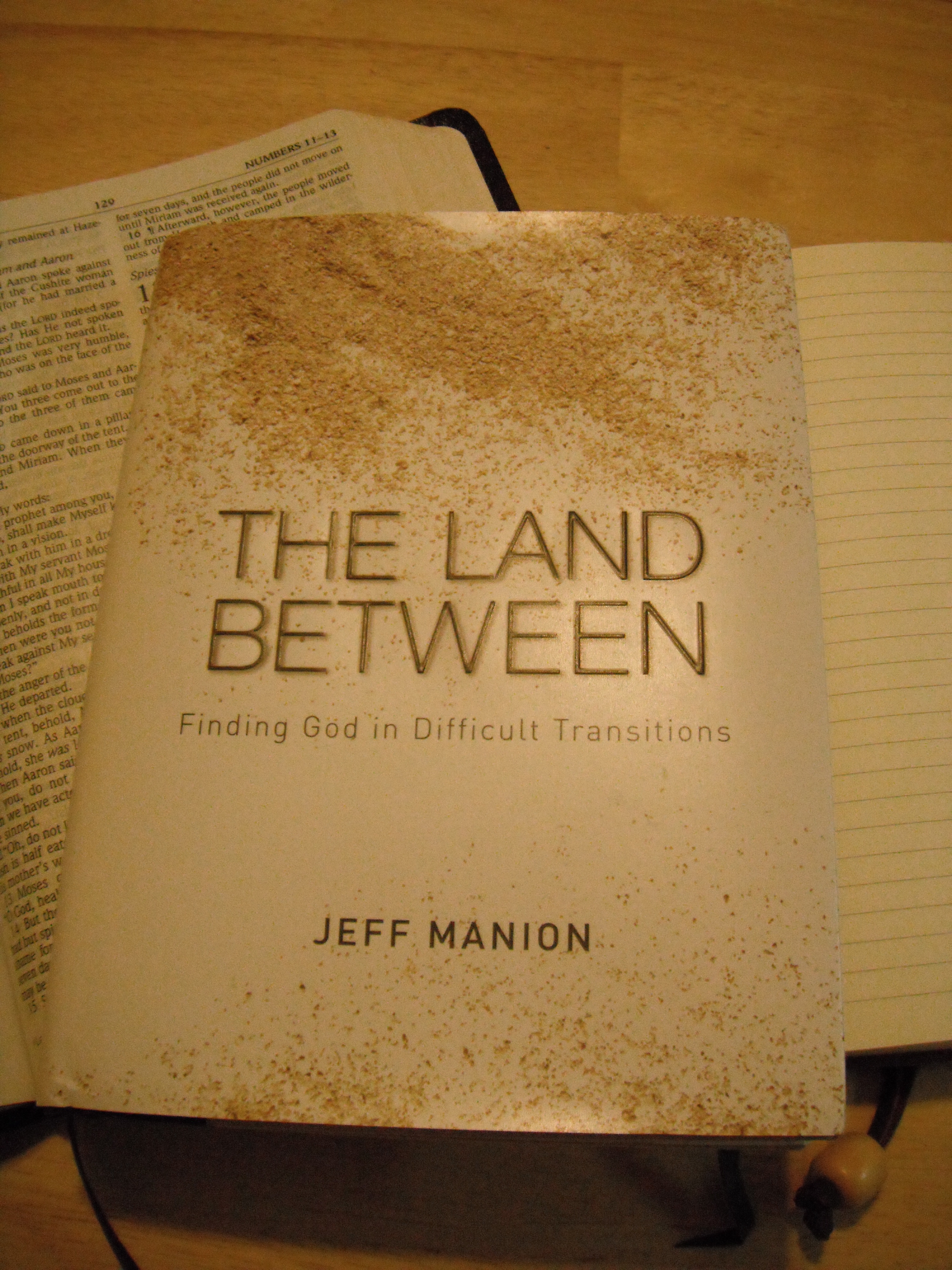
Book Review: The Land Between by Jeff Manion

The Lang BetweenThe sub-title of the book says it all: Finding God in difficult transitions. Jeff Manion is not dealing with a hard day. The Land Between deals with gut wrenching periods of time. This book ranks as a must read. If you are in traveling in the land between, you’re crazy to ignore what Jeff is communicating. Strong words but true, and coming from a guy in such a transition.

The premise
Using Israel’s trek from Egypt to the promise land, Jeff uses lessons from Israel to help guide us in our own land between. The book handles the Bible passages with excellence. Often the Old Testament is moralized and man centered. Jeff brings out what these passages are really about: God at work preparing and refining His people. He describes God as the hero; not just for Israel but you and I as well. Throughout the book the choice is clear between trusting in God and the pit of complaining & bitterness.

Serious stories
Jeff’s places stories a the right spots like an expert chef using spices. They are brief, real, and at times very raw. (Challenging transitions are like that.) While at times he gives the result, there are times where he does not. Jeff’s own land between ends in blessings. In difficult periods, we need to remember that God does get us through. The stories shared bring reality to light. (Like wondering when the transition will be over.) He clearly articulates the dirty reality of hard times.

The book
The book reads easily and conversationally. I appreciate how the book handles Bible texts well, while not academic in their explanation. That skill is hard to find. The book is applicable in the sense of our relationship with God; the choices we are faced with, the emotions that will boil in us (they will boil) and the intimate involvement of God throughout. Jeff took roughly 200 pages would could be volumes. The Land Between is the perfect size, depth and readability for his intended audience; those of us in the land between.

The bottom line:
The last thing we want to hear is another book we should read when in difficult transitions. This is a book we should read. Why? 1) Israel made costly mistakes that can be avoided. 2) We need to remember that God is not merely with us, He is intimately at work in us. 3) It is not a lassie tale of hard times turned good. The Land Between lays out the road map for our hard journey. More than the insane details of our challenges, we must embrace God. The feeling I got after reading The Land Between was calm resolve. Not the emotion I expected.

There are not many books I’ve read were I have a wish to thank the author in person. Jeff, thank you for you for the map of the desert!

Manic Monday: Be real & listen

I watched a video with Fancis Chan, Mark Driscoll and Joshua Harris. I’m not quite sure what the discussion was about, but Mark switched the topic to what Francis is doing. The conversation exemplified speaking the truth in love, asking hard questions, and theology. I encourage you to take the time to watch and listen here. It’s about 15 min.

Note these things:

1) A concern and valuing of a brother takes precedent over the agenda.

2) The issue was discussed in community at Francis Chan’s church.

3) The Bible and the Gospel drove the conversation and issue.

4) The spirit of love, concern and truth.

We need to be real with each other in a way that is gracious and loving while also being truthful and discerning. We also need to have theology be a driving force in our discussion processes. Too often we assume the theology and disguise our conversations as “general revelation” or “it’s not an “un-biblical” issue, just a “non-biblical” one. We act based on what we believe. This conversation is an example of that. We need more of this kind of talk in churches.

(especially on Monday)

http://thegospelcoalition.org/blogs/tgc/2010/08/30/what%E2%80%99s-next-for-francis-chan/