Category: Book Reviews

Book review: No One Like Him by John S. Feinberg

Defined systematic theology as that branch of theology which studies the whole of Scripture and presents the results on the basis of logical connection, detailing what the scriptures mean in our contemporary context. This is the greatest strength of Feinberg’s work on the Doctrine of God. This doctrine has been brushed over in my life and “No One Like Him” is the first serious discourse I have read about the Doctrine. It raises the question of why this doctrine is often taken for granted.

The question being asked
Feinberg’s task in the book is to give a constructive overview (understated) of who God is, in terms of our contemporary culture. Constructive and contemporary are key elements in the book as Feinberg takes on a unique approach. Instead  of a flat-out rejection of any theological system that contradicts itself or his own system, Feinberg looks at what the issues of such systems are. Within process theology or the open view of God, the driving force, driven by contemporary culture, is a highly relational God. Feinberg brings out the value of such false systems, and then clarifies how a refined conservative approach fits the needs of contemporary culture. God is King, but He is the God who cares. While not purposely bringing a balance of two conflicting views, in each section Feinberg seeks to answer properly the questions being raised. This approach leads to a logical approach within the book.

Book Size
Oddly, another strength of the book is its size. One reading is not adequate to review this book as its flow of thought builds a solid argument for God. While the spirit of communication is to state one’s point as briefly as possible, making a case for a God who cares and is King is not something that can be done in a theological journal or a Two hundred page, easy read. In a contemporary culture where people generalize, the need to give ‘exhaustive’ coverage is critical in developing a subject, especially in dealing with a infinite person such as God.

The main Point
The conclusion Fienberg reaches is one of both/and. God is king, and God cares. The conclusion, while the answer for contemporary society, does not fit with how society thinks today. It is today’s culture which polarizes issues, not seeing how they fit together as a whole, resulting in the growing popularity of process theology. God as sovereign and man as a free agent seem incompatible, unless one thinks in a both/and mindset. Great comfort comes from knowing that one need only to prove the possibility of something, not the logical necessity of something. Classical thought, while solid, is a system derived by men with inherent problems.

The bottom line
After reading this book, it begs the question of why there is not a class dealing with God exclusively. It seems that since the concept of God is so immense. As Christians we gloss over the topic and move onto more tangible things, like Christology. Perhaps it is this avoidance of focusing on God that is the root of church decline in North America. In listening to the testimonies of those brothers and sisters undergoing persecution, it would seem that they have a better grasp of who God is than we do. A solid look at God would do us all good, as there truly is no one like Him.

Book Review: Crazy Love by Francis Chan

Crazy Love goes on my must read list! The book draws out things that we easily forget, like the transforming reality of God in our life. The interplay between church, theology, and living is hard to navigate. Crazy Love brings these elements together,

What if…
‘What if’ jumps out of this book. The question Francis Chan asked that has my mind spinning is this: What if churches were more known for giving and not taking? This question, and others like it, call for a radical approach to how we live for Christ. One chapter of the book just gives story after story of people living based on God’s crazy love for them. It really is not a fluff book.

Guilt by love
Crazy Love challenges you on the love front. Many people cringe at hell, fire and brimstone (HFB) sermons, saying they’re tired of feeling guilty all the time. Others criticize for ignoring the gruesome aspect of eternity. Crazy Love has the potential to produce more guilt or conviction then any HFB sermon I ever heard. It is the book equivalent of a loving mother looking you in the eye and saying: “I love you, but I’m disappointed.

Tone
Francis Chan writes with the art of a surgeon. He is very careful to say clearly what needs to say, while also attempting to hold back negative emotions that can get one sidetracked. Chan’s book refreshes you in how he specifically speaks against church bashing. He is right in asserting that what we truly love and are convicted about produces the most solid change. His tone focuses on process not perfection, pursuit, not purity. Perfection and purity will come because of what Christ did. The tone of this books would be one many writes should absorb.

Bottom line:
This review is brief for one reason: I don’t want to give anything away, you need to listen and engage yourself! The book will challenge your faith. Some may feel guilty at first from reading it, but it gives you a clear and balanced approach of how God’s love should impact us. For others, this book will reignite you passion to go all out for God.

Book Review: Rework by Fried & Hansson

Written by the founders of 37signals.com, Rework is a byproduct from their development and leadership of 37signals. Its form and insights into running a business or organization are insightful. There are good ideas to implement in a ministry setting, though everything from the business world doesn’t carry over directly to the ministry world. Still, there are key insights worthy of reflection. I will give one example.

“Don’t scar on the first cut”
This chapter deals with policy making. “Policies are organizational scar tissue.” (p.260) Church ministry thrives on developing policies. Often they are one line statements posted somewhere with slightly curled brown-aged scotch tape. Be discerning about how or when to develop a policy. Be careful when making a policy based on one incident of someone lacking discretion. Deal with the lack of discretion instead.

Be human
Rework is really a business book, but it does not have the dryness, dullness or blandness of many business books. Chapters are refreshingly brief and to the point. What needs to be said is stated tersely with exactly the amount of explanation needed. (They address the dullness of many business books.) If you struggle with being verbose (yep!) this is a good work to learn from in communication style.

Irreverent
Rework goes right at the heart of the matter. The language at times is colorful (not in the artistic sense), and very casual. Rework challenges conventional wisdom. While the language and challenge of the book can rattle cages, it points to something the crucial- discernment in how we run and communicate.

Format
Chapters are grouped into larger categories. The chapter titles carry the essential point that being made. The layout and brevity of each chapter is something that many would do well to emulate.

There are some ideas in the book that are hard to carry over into a ministry context as we’re in the people ‘business.’ It is key to view the book from the lens of discernment and how to make wise choices in the moment. One thing Rework brings out often is being who you are. Discerning what this looks like is critical for any endeavor.

Bottom Line:
Rework is an excellent read that will challenge you and give you fresh eyes on how to run on an organizational level. It will give guidance in operating within who you are.

Book Review: The Pursuit of God by A.W. Tozer

Tozer’s book is incredibly technical and mysterious at the same time. He pushes you, hard, and asks very pointed questions about your belief in who God is. Often theology proper (the study of God Himself) is glossed over and assumed. Tozer implies throughout the book that maybe it should be first among the theologies.

God Speaks
The big thing that stands out is how God actively wants to communicate today, just as much as in times past. The very fact that God gave us the Bible speaks volumes on how God wants to actively pursue and interact with people. God is not a set it and forget it person. God speaks actively today as He did in times past. This includes authorial intent, what God spoke and meant then is what He is saying to us today.

“The Bible will never be a living book to us until we are convinced that God is articulate in his universe…I think a new world will arise out of the religious mists when we approach our Bible with the idea that it is not only a book which was once spoken, but a book which is now speaking.” (p. 71-72, Italics author’s emphasis)

More than Saved
We forget God the father. The book brings out something we too easily forget, lose, or never attained. God gave salvation as a means to pursue Him, not as a ‘get out of jail free card.’ The danger of viewing the Bible or Christianity as a psychological self-help community, or merely as a redemptive story is that both neglect the key to the Bible, to faith, to life, and that is a personal God. Jesus will and purpose was the will of the Father. We must get back to that.

Format
Tozer is hard to read. He writes in a way that we do not speak or think like today. This makes getting through the book a little difficult. It’s like reading someone’s journal. He is very humble and very pointed, but it is a chore to get through the book. I say this to be aware of it, not as a criticism. I wish I read this book long ago.

Tozer ends each chapter with what is a lost art in churches today- written prayers. His prayer for himself and those who read the book create a significant impact. One can develop a solid prayer life from the end of each chapter. We often view prayer as only genuine and heartfelt if it is spontaneous. A book of prayers may be helpful and a great resource for today. Each generation must speak to God. Being formal is just as genuine and heartfelt as being spontaneous.

Bottom line:
The Pursuit of God is on my “Must Read List.” It brings into balance that Christianity and the Bile is about God wanting and being known, and everything else is subservient to that foundational principle.

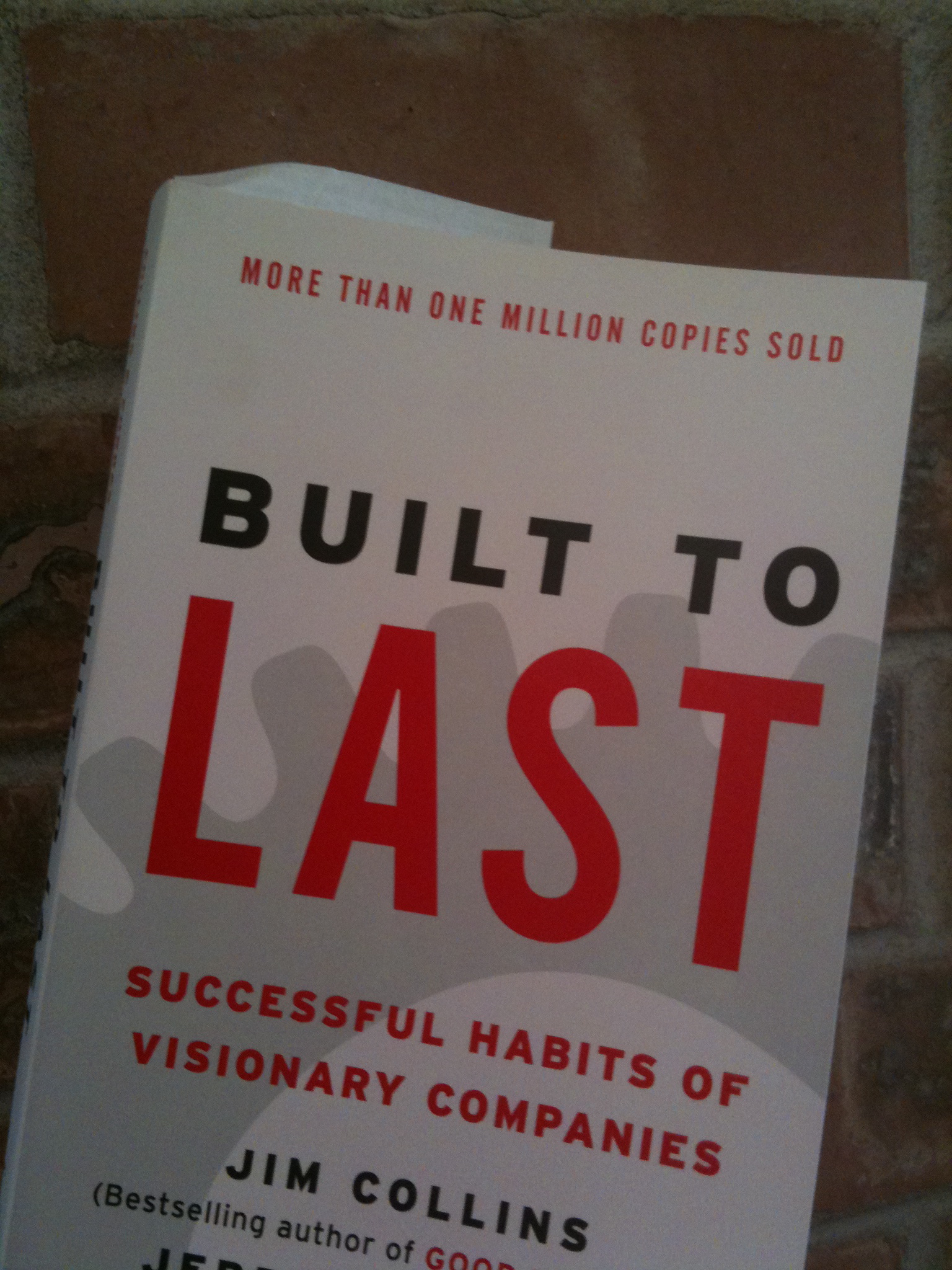
Book Review: Built to Last by Jim Collins & Jerry I. Porras

If you are involved in building and managing an organization, the single most important point to take away from this book is the critical importance of creating tangible mechanisms aligned to preserve the core and stimulate progress. This is the essence of clock building. ~ P. 89

A pastor friend highly recommended I read ‘Built to Last.’ I would echo that sentiment. The quotation above really encapsulates the book. To put it in other words, the book is more concerned about who you are as apposed to what you do. The visionary companies described in their book were more about who they were- their core ideology- then the products produced. Their great products were a result of their core ideology in action.

Building the core
The purpose and values of an organization is what is most essential and non-changing. It is the preservation of this core ideology that drives leadership development, products, adaptations, consistency and culture of visionary companies. These companies have transitioned through multiple CEO’s, economies, products, and culture shifts. Core ideology is the center of visionary companies, not profit nor product. The company itself is the greatest achievement. Preserving the core allows freedom to and opportunity to explore what the company can do.

Vision?
The greatest shock in reading the book was the un-central role vision played. Many of the leaders were not charismatic visionary leaders, though some were. In reading through the book everything went back to who the company was at its core. Growth of these companies normally occurred in one of two ways, BHAG’s or trying a lot things and keeping what sticks. The paperback version, which I read, had a chapter about vision, but this chapter still pointed back to the core ideology. Surprising fact from this book: can you build a dynamic organization without a vision? Yes. Without a core ideology? No. The book does not negate vision, but vision is certainly not the driving force, as the book almost arguing against it being the driving force.

Ministry value
The greatest ministry value from this book is to focus more on who you are and want to be rather than what you do. Values are discovered, rather than imposed, and a culture is developed rather then chosen. Attention should be given to the theology of what a church should be more than its actions. What a ministry does will have a greater impact if it is from its ideological center. As with any book, discernment should be used. The church is an organism not an organization.

A big key to the success of these companies was the preservation of its core ideology, particularly through multiple CEO’s. This is an element many churches struggle with. I have heard of too many stories of ministries declining after a successful tenure of a key leader. The draws attention to a much broader discussion.

The book
The book read ok and the stories were excellent. It did feel very choppy to me. The book is a report on a study and it felt like a report on a study. Things they pointed out were very well done, but the book could have been considerably shorter and communicated the same thing. While a worthwhile read, it was not the most enjoyable to read.

Bottom lines
Focus on living out and preserving the ideological core of the organization you’re in.
Focus on developing the culture and leadership of the organization you’re in.

Book Review: Think Orange by Reggie Joiner

“As leaders our primary purpose is not to keep our children in church, but to lead them to be the church.” (p. 217)

Think Orange will be the defining work on Children’s Ministry & Family Ministry for quite some time. A significant discussion within the church is the relationships between the church, the family, and the various generations within both. From a methodology standpoint, Think Orange gives a road map to answer these questions. The book’s strengths are in explaining the why and what questions of a Family Ministry. There are other resources by the ReThink group that address the how.

The why question is critical
While there are many who do not appreciate or think philosophically, what you believe truly effects what you do. Reggie Joiner does an excellent job of explaining the essential role of both the family, the church and how they are combined and interact through leveraging community. A continual frustration of mine in Children’s Ministry is how programs or materials merely view parents as important, not essential. Think Orange views parents as essential! The combination or synergy of the family with church produced produces a powerful result. Reggie states: “2 combined influences make a greater impact than just 2 influences.” (p. 15) This principle, along with others, gives practical guidance to living out the truths of Scripture, in particular the parents’ role in discipling their children and the church’s role in equipping the saints for ministry.

The what question is helpful
What is needed is a collaborative model for family ministry, and not a hap hazard, random, or departmentalized one. Essential #1: Integrate Strategy, starting on page 110, is the most critical section answering what we need. A professor of mine often used the term “braiding,” getting various things to work together.  Having an integrated strategy helps all areas of family ministry to be on the same team and working towards the same goal. Said another way, it teaches children about the church by being a church. As a child grow up in the church, he or she is taken to another level at each life stage, including transitions between life stages. With society causing more and more fragmentation, the church needs to be a place that brings people together. Think Orange understands the equilibrium between families together, age appropriateness, and being one church. This equilibrium is a result from Reggie high view of community. Children are not the church of tomorrow but the church of today.

Final Thoughts
The book’s design and layout is helpful for those who are sequential & analytical thinkers, or the more abstract & random thinkers. It offers many ideas, discussion questions and insights. The book can be read sequentially, treated as a manual or encyclopedia on family ministry methodology. The charts and quotes that stand out were extremely well done and help to navigate the book.

Reggie shares frequently how the ideas translated into what was done at North Point. One should be careful to distinguish between example and what is/ what works at North Point. This is normally distinguishable, but there are times when it may be confusing. This is not a criticism, just something to be aware of. Another point that stands out and one should be aware of is Reggie’s humility. He gives permission to disagree with him, and even states that he may disagree with himself. This tone and attitude is refreshing and should be more prevalent within the church.

The Bottom Line
Think Orange is a critical work to navigate through if you are serious about impacting yours and other children to be the church, not merely attend church! Its strength is in family ministry methodology, with a close secondary strength in ministry philosophy.